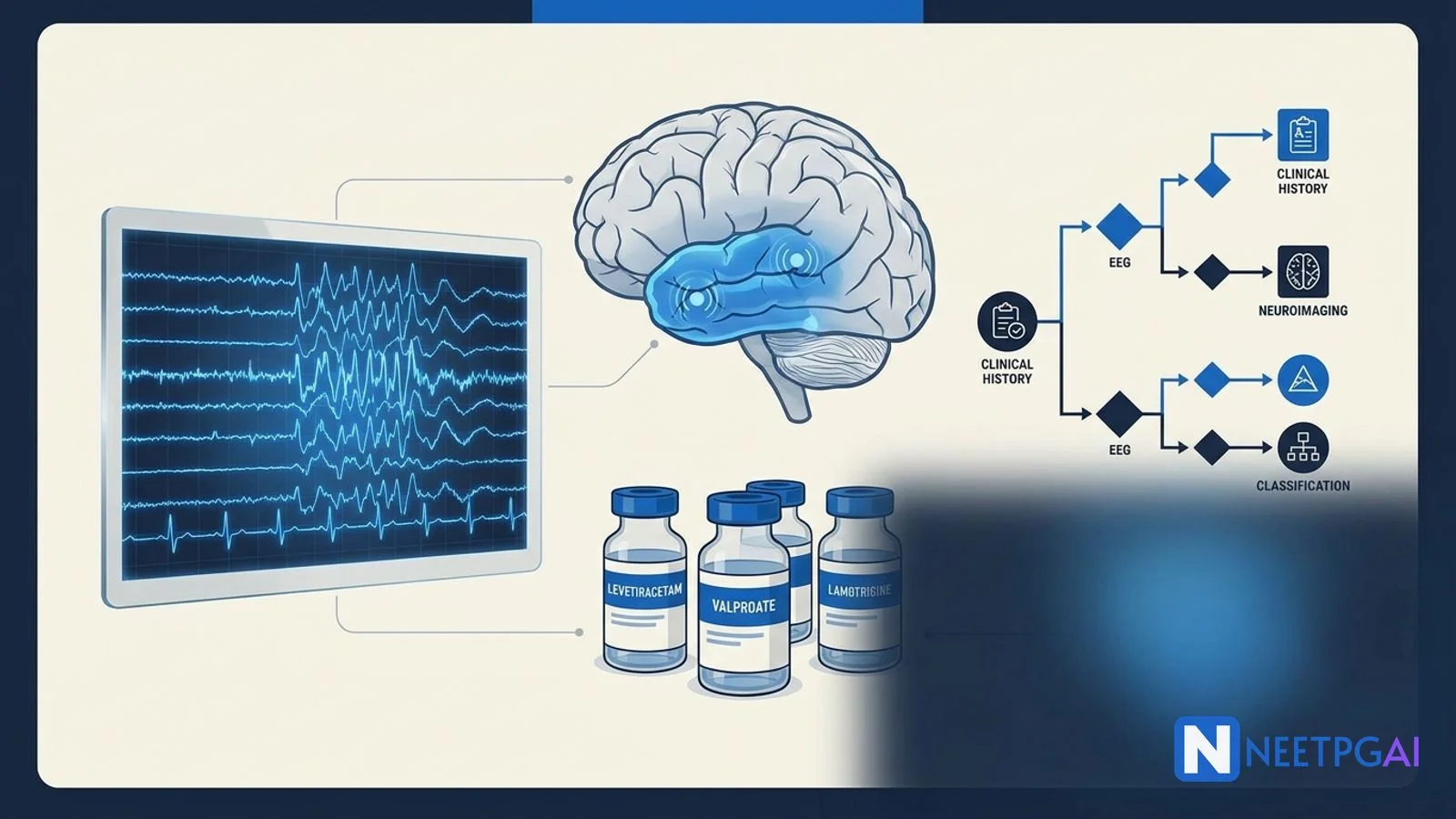
Master seizures and epilepsy for NEET PG 2027: ILAE 2017 classification, semiology, status epilepticus algorithm, EEG patterns, AED selection by seizure type, AEDs in pregnancy, and driving rules.
NEETPGAI EditorialPublished 22 Jan 2026Updated 29 Sept 202615 min read
Share this article
This content is for educational purposes for NEET PG exam preparation. It is not a substitute for professional medical advice, diagnosis, or treatment. Clinical information has been reviewed by qualified medical professionals.
Ready to put this into practice?
Start practicing NEET PG MCQs with AI-powered explanations.
Comparison of the authorities that shape NEET PG, INI-CET, FMGE, and Indian medical education: NMC (regulator), NBEMS (exam conductor), MCC (AIQ counseling), DGHS (health services), AIIMS (INI-CET), plus state councils and FMG pathway — clarifies who does what.
Status epilepticus definition — Seizure >=5 minutes OR >=2 seizures without recovery of consciousness between them
Status management algorithm — IV lorazepam 0.1 mg/kg → IV fosphenytoin 20 mg PE/kg or levetiracetam 60 mg/kg or valproate 40 mg/kg → midazolam / propofol infusion if refractory
AEDs in pregnancy — Lamotrigine and levetiracetam are safest. Valproate contraindicated (neural tube defects, IQ reduction). Folic acid 5 mg daily preconception.
Hypersensitivity — Carbamazepine, phenytoin, lamotrigine, phenobarbitone carry SJS / TEN risk. HLA-B*1502 test before carbamazepine in Asian patients.
Cognitive side effects — Phenobarbitone, topiramate (word-finding), phenytoin (encephalopathy at toxic levels >20 mcg/mL). Levetiracetam behavioural (irritability).
Driving rules (India) — 1-year seizure-free for private licence, 3-year for commercial vehicle per the Motor Vehicles Act.
Epilepsy is a disorder of the brain characterised by an enduring predisposition to generate epileptic seizures — and it sits at the intersection of medicine, pharmacology, and pediatrics in NEET PG. The student who masters ILAE 2017 classification, status algorithm, and first-line AED by seizure type has covered the foundation for 2–3 marks across papers. Pair this guide with daily MCQ practice on the Medicine subject hub and cross-reference the high-yield medicine topics overview for context on how neurology sits within the broader medicine pattern.
ILAE 2017 classification of seizures and epilepsy
The ILAE 2017 framework is a two-tier system: it classifies each individual seizure by onset, then classifies the underlying epilepsy by type and etiology.
Level 1 — Seizure type (onset-based):
Onset
Subtype
Examples
Focal onset
Aware (old: simple partial)
Focal motor (Jacksonian), focal sensory, focal autonomic
NEET PG trap: The terms "simple partial" and "complex partial" are obsolete under ILAE 2017. Use "focal aware" and "focal with impaired awareness" instead. Examiners now expect the new terminology in single-best-answer stems.
Seizure semiology — localising the lesion
Semiology is the clinical description of a seizure — and it points to the lobe of origin, which is high-yield because it maps directly to structural epilepsy etiology.
Syncope: Prodrome (lightheadedness), pallor, brief loss of consciousness, rapid recovery, situational trigger, no postictal state
Psychogenic non-epileptic seizure (PNES) clues: Side-to-side head movement, closed eyes during event, pelvic thrusting, long duration (>5 minutes), no cyanosis, normal EEG during event.
Status epilepticus — definition and management
Status epilepticus is a seizure lasting 5 minutes or longer, or two or more seizures without recovery of consciousness in between — a neurological emergency with mortality of 10–20%.
Counsel patients and caregivers; consider seizure-detection devices
Sources and references
International League Against Epilepsy — Fisher RS et al. Operational classification of seizure types by the ILAE: Position paper of the ILAE Commission for Classification and Terminology. Epilepsia 2017; 58:522-530.
Kapur J et al. Randomized trial of three anticonvulsant medications for status epilepticus (ESETT). New England Journal of Medicine 2019; 381:2103-2113.
Harrison's Principles of Internal Medicine, 21st Edition (Loscalzo et al., 2022) — Chapter on Seizures and Epilepsy.
NICE Guideline NG217 — Epilepsies in children, young people and adults (2022) — AED selection protocols.
Tomson T, Battino D. Teratogenic effects of antiepileptic drugs. Lancet Neurology 2012; 11:803-813 — landmark EURAP data on AED-pregnancy outcomes.
Indian Epilepsy Society Consensus Guidelines on Management of Epilepsy in India (2022).
Frequently asked questions
How many seizure and epilepsy questions appear in NEET PG?
Seizures and epilepsy contribute 2-3 direct questions per NEET PG paper across medicine, pharmacology, and pediatrics. ILAE 2017 classification, status epilepticus management, and first-line AED by seizure type are the three most tested subtopics based on 2019-2025 pattern analysis.
What is the ILAE 2017 seizure classification?
The ILAE 2017 framework classifies seizures by onset into focal (aware or impaired awareness), generalized (motor — tonic-clonic, myoclonic, atonic, tonic, clonic; non-motor — absence), and unknown onset. It replaces the older partial or simple-complex terminology. Epilepsy is then classified by type (focal, generalized, combined, unknown) and by etiology (structural, genetic, infectious, metabolic, immune, unknown).
What defines status epilepticus?
Status epilepticus is a seizure lasting 5 minutes or longer, or two or more seizures without full recovery of consciousness in between. The older 30-minute definition is now obsolete because neuronal injury begins well before that. Refractory status epilepticus means seizure activity persists despite a benzodiazepine plus one second-line AED.
What is the first-line treatment for status epilepticus?
First-line therapy is IV lorazepam 0.1 mg/kg (max 4 mg per dose) or IV diazepam 0.15-0.2 mg/kg. If no IV access, use IM midazolam 10 mg (adult). Second-line agents after benzodiazepine failure include IV fosphenytoin 20 mg PE/kg, IV levetiracetam 60 mg/kg, or IV valproate 40 mg/kg — ESETT trial 2019 found all three roughly equivalent.
Which AED is first-line for focal seizures?
Carbamazepine and lamotrigine are traditional first-line agents for focal seizures. Levetiracetam is increasingly preferred because of minimal drug interactions, no hepatic enzyme induction, and safety in pregnancy. For focal-to-bilateral tonic-clonic seizures, the same agents apply. Phenytoin remains an option in resource-limited settings but has more side effects.
Which AED is safest in pregnancy?
Lamotrigine and levetiracetam are considered the safest AEDs in pregnancy. Valproate is strictly contraindicated — it carries the highest teratogenic risk (neural tube defects 1-2 percent, major congenital malformations 10 percent) and reduces childhood IQ by 7-10 points. All pregnant women on AEDs need folic acid 5 mg daily preconception and throughout pregnancy.
What is the classic EEG finding in childhood absence epilepsy?
Childhood absence epilepsy shows generalized 3 Hz spike-and-wave discharges on EEG, typically provoked by hyperventilation. Onset is between 4-10 years with brief staring spells (5-10 seconds), no postictal confusion, and frequent daily events. Ethosuximide is first-line; valproate or lamotrigine are alternatives.
What is hypsarrhythmia and which syndrome does it indicate?
Hypsarrhythmia is a chaotic high-voltage EEG pattern with disorganized slow waves and multifocal spikes. It is the hallmark of West syndrome (infantile spasms), which presents at 3-12 months of age with flexor or extensor spasms in clusters, developmental regression, and the classic hypsarrhythmia EEG. Treatment is ACTH, vigabatrin (first-line for tuberous sclerosis), or prednisolone.
Which AEDs are most associated with Stevens-Johnson syndrome?
Carbamazepine, phenytoin, lamotrigine, and phenobarbitone are the AEDs most associated with Stevens-Johnson syndrome and toxic epidermal necrolysis. HLA-B*1502 testing is recommended before starting carbamazepine in patients of Asian descent, because this allele increases SJS risk 10-fold. Lamotrigine rash risk rises with rapid dose titration — always titrate slowly.
What are the driving restrictions for epilepsy patients in India?
The Motor Vehicles Act (India) requires a seizure-free period of 1 year for private driving licence eligibility. For commercial driving (heavy vehicles, passenger transport), a 3-year seizure-free period is required. Patients must disclose the diagnosis during licence application or renewal. Physicians should document counselling in the medical record.
Ready to test your seizure and epilepsy knowledge? Convert this guide into exam marks with active MCQ recall — cross-link to stroke management for NEET PG for adjacent neurology territory and use the AI tutor to drill EEG pattern recognition on demand.
Explore our pricing plans for unlimited practice across all 19 subjects, AI-powered doubt resolution, and personalized study plans.
This content is for educational purposes for NEET PG exam preparation. It is not a substitute for professional medical advice, diagnosis, or treatment. Clinical information has been reviewed by qualified medical professionals.
Written by: NEETPGAI Editorial Team
Reviewed by: Pending SME Review
Last reviewed: March 2026
This article is reviewed by qualified medical professionals for clinical accuracy and exam relevance. For corrections or updates, contact the editorial team.