Quick Answer
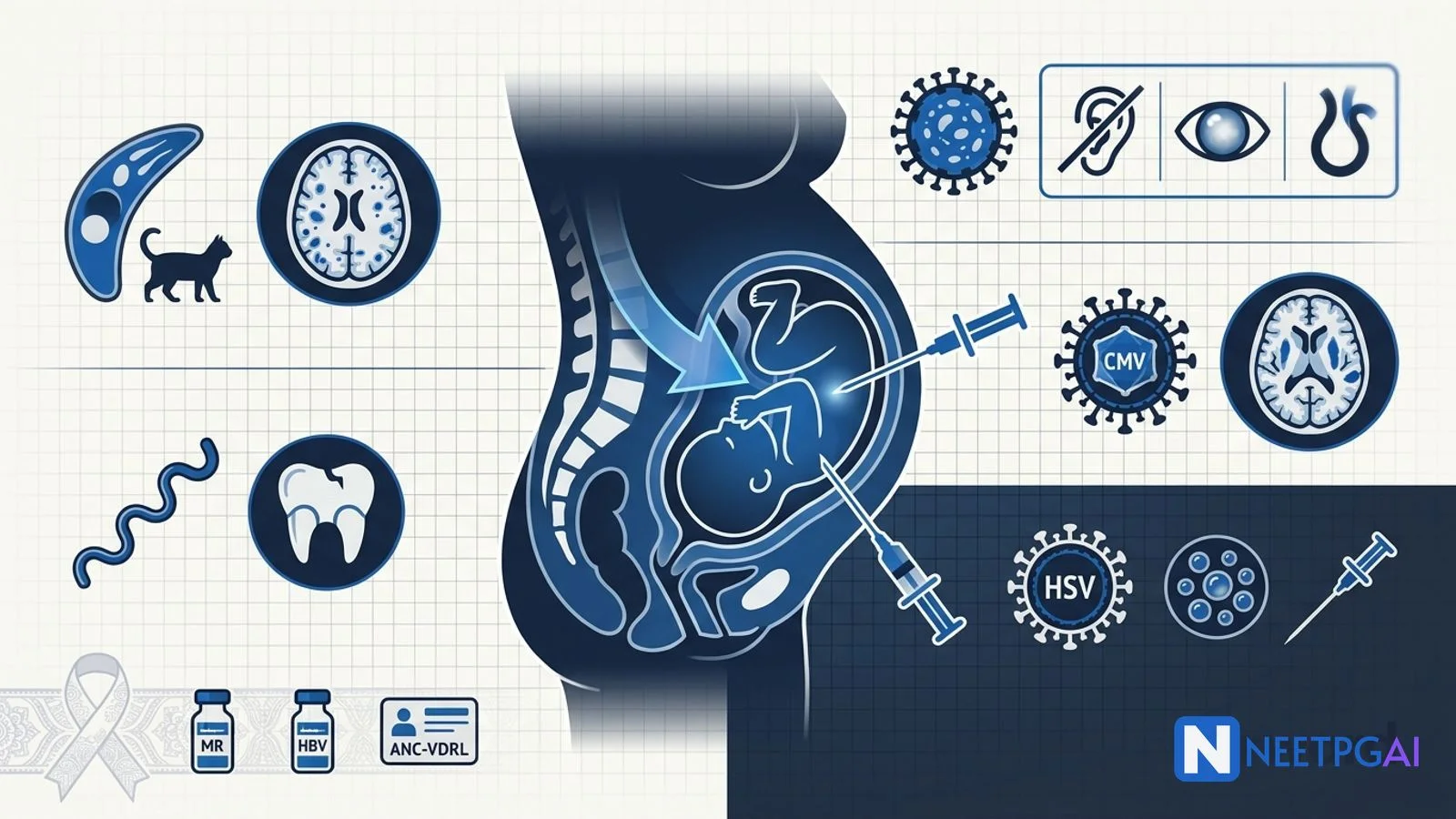
TORCH infections deliver 3 to 4 NEET PG questions per year across pediatrics, microbiology and OBG. Lock these:
- TORCH — Toxoplasma, Other (syphilis, VZV, Parvo B19, HIV, HBV, Zika), Rubella, CMV, HSV.
- CMV — most common congenital viral infection; periventricular calcifications + sensorineural hearing loss.
- Toxoplasma — diffuse intracranial calcifications + hydrocephalus + chorioretinitis (Sabin tetrad).
- Rubella — Gregg triad — deafness + cataract + PDA; blueberry-muffin rash; MR vaccine (UIP 2017).
- Neonatal HSV — SEM vs CNS vs disseminated; IV acyclovir 60 mg/kg/day for 21 days.
- Congenital syphilis — Hutchinson triad (teeth, keratitis, deafness); saddle nose, saber shins.
- India context — CRS elimination via MR campaigns; NNS screening; universal syphilis screening in ANC.
TORCH is a mnemonic-driven MCQ powerhouse — the same five pathogens (with the Others bracket now including syphilis, VZV, Parvovirus B19, HIV, HBV and Zika) return year after year, distinguishing themselves by a handful of pathognomonic radiographic and clinical features. Missing the difference between periventricular (CMV) and diffuse (Toxoplasma) intracranial calcifications, or between the Gregg triad (rubella) and the Hutchinson triad (late syphilis), is a recurring NEET PG error.
This NEETPGAI deep dive walks through every TORCH pathogen — transmission, timing-of-worst-outcome, fetal ultrasonographic findings, neonatal presentation, gold-standard diagnostics, and specific treatment — then folds in the India-specific screening framework (Universal ANC VDRL, MR vaccine drive, National Neonatal Screening) so you can crack both direct-recall and applied-vignette items.
Framework — timing, transmission, prevention
Every TORCH pathogen answers three exam questions — when in gestation does it damage the fetus most, how does it cross the placenta, and how can it be prevented?
| Pathogen | Worst trimester | Route | Prevention |
|---|
| Toxoplasma | 1st (severity), 3rd (frequency) | Transplacental | Avoid cat litter and undercooked meat |
| Rubella | 1st (over 80 percent damage) | Transplacental | MMR/MR pre-pregnancy — live vaccine |
| CMV | 1st | Transplacental | Hand hygiene around toddlers; no vaccine yet |
| HSV | Third trimester and delivery | Perinatal ascending | C-section if active genital lesions |
| Syphilis | Any (worse if untreated) | Transplacental | Universal ANC VDRL; penicillin |
| VZV | 8-20 weeks | Transplacental | Varicella vaccine pre-pregnancy |
| Parvo B19 | 2nd (hydrops peak 18-24 wk) | Transplacental | Serial USG; intrauterine transfusion |
| HIV | Delivery, breastfeeding | Perinatal | Maternal ART; PPTCT |
| HBV | Delivery | Perinatal | Birth-dose vaccine + HBIG |
| Zika | 1st (microcephaly) | Transplacental, sexual | Mosquito control; travel advisory |
Toxoplasmosis
Toxoplasma gondii is an obligate intracellular protozoan whose definitive host is the cat. Humans acquire it through oocyst-contaminated soil, undercooked meat with tissue cysts, or transplacental spread.
Fetal transmission risk rises across gestation while severity falls — 10 to 15 percent in the first trimester (severe damage), 25 to 30 percent in the second, 60 to 70 percent in the third (mostly subclinical).
Sabin tetrad
- Hydrocephalus — aqueductal obstruction from ependymitis.
- Diffuse intracranial calcifications (scattered, unlike periventricular CMV).
- Chorioretinitis — bilateral punched-out macular lesions, cotton-wool exudate.
- Convulsions.
Diagnosis
- Sabin-Feldman dye test (gold standard historically).
- IgM and IgG serology (mother and infant).
- PCR of amniotic fluid — most sensitive for fetal infection.
- Fetal USG — ventriculomegaly, hepatic calcifications, ascites.
Treatment
- Pregnancy up to 18 weeks — spiramycin (limits placental transfer, does not cross placenta).
- Confirmed fetal infection or after 18 weeks — pyrimethamine + sulfadiazine + folinic acid.
- Congenital toxoplasmosis — pyrimethamine + sulfadiazine + folinic acid for 1 year.
Rubella
Congenital rubella syndrome (CRS) is trimester-dependent — 80 to 90 percent risk of major defect if infected before 12 weeks, negligible risk after 20 weeks.
Gregg triad (1941)
- Sensorineural deafness — most common single defect.
- Ocular — nuclear pearly cataract, salt-and-pepper retinopathy, microphthalmia, glaucoma.
- Cardiac — PDA is classic; peripheral pulmonary artery stenosis, VSD, ASD next.
Other features — blueberry-muffin rash (dermal extramedullary haematopoiesis), microcephaly, mental retardation, hepatosplenomegaly, thrombocytopenia, radiolucent bone disease.
Diagnosis
- Maternal IgM (recent infection) and IgG seroconversion.
- Fetal — RT-PCR of amniotic fluid or chorionic villi.
- Neonatal — IgM in cord blood; virus isolation from urine/nasopharyngeal swab up to 12 months.
Treatment — no antiviral. Termination offered if maternal infection is confirmed before 20 weeks.
Prevention — MMR / MR vaccine (live attenuated) pre-conception. India added MR to UIP in 2017 targeting CRS elimination.
Cytomegalovirus (CMV)
CMV is the most common congenital viral infection (0.5 to 1 percent live births globally, 1 to 2 percent India). Only about 10 percent are symptomatic at birth; another 10 to 15 percent develop late sequelae.
Symptomatic at birth
- Microcephaly.
- Periventricular calcifications (versus diffuse in Toxoplasma).
- Chorioretinitis.
- Hepatosplenomegaly, jaundice, purpura ("blueberry-muffin" — overlaps with rubella).
- IUGR, thrombocytopenia.
Sequelae — sensorineural hearing loss is the most common long-term problem (40 to 60 percent symptomatic, 10 to 15 percent asymptomatic).
Diagnosis
- Urine or saliva PCR within 3 weeks of birth — the definitive congenital-vs-postnatal distinguisher.
- Maternal IgM plus IgG avidity for primary infection.
Treatment
- Oral valganciclovir for 6 months in symptomatic disease with CNS or hearing involvement.
- IV ganciclovir if oral not feasible.
- Improves hearing outcomes; audiology follow-up mandatory.
Neonatal HSV
Herpes simplex virus (usually HSV-2, increasing HSV-1) is acquired perinatally in 85 percent — ascending from an infected genital tract. Primary maternal HSV at delivery carries a 30 to 50 percent transmission risk versus 1 to 3 percent for recurrent lesions.
Three phenotypes
- Skin-eye-mouth (SEM) — about 45 percent; vesicles at day 10 to 12; excellent outcome on acyclovir.
- CNS disease — about 30 percent; seizures, temporal-lobe encephalitis at 2 to 3 weeks; 30 percent mortality even with treatment.
- Disseminated disease — about 25 percent; multi-organ failure, hepatitis, DIC, pneumonia at 5 to 7 days; 80 percent mortality untreated.
Diagnosis — PCR of CSF, blood and surface swabs (mouth, nasopharynx, conjunctiva, rectum). Viral culture of vesicle fluid.
Treatment — IV acyclovir 60 mg/kg/day for 21 days (disseminated/CNS) or 14 days (SEM), followed by oral suppression for 6 months.
Prevention — C-section for mothers with active genital lesions at delivery; maternal acyclovir suppression from 36 weeks in known HSV.
Congenital syphilis
Treponema pallidum crosses the placenta at any gestational age; risk of transmission is 100 percent in untreated primary/secondary syphilis, falling with later stages.
Early congenital syphilis (under 2 years)
- Snuffles — persistent nasal discharge (highly infectious).
- Hepatosplenomegaly, jaundice.
- Maculopapular rash on palms and soles.
- Osteochondritis — Wimberger sign (bilateral tibial metaphyseal destruction), pseudoparalysis of Parrot.
Late congenital syphilis (over 2 years)
- Hutchinson triad — notched (peg-shaped) incisors + interstitial keratitis + eighth-nerve deafness.
- Saddle nose, saber shins, mulberry molars.
- Clutton joints (symmetrical painless knee effusion).
- Rhagades — perioral radiating scars.
Diagnosis
- Infant VDRL/RPR titre four-fold higher than maternal.
- IgM FTA-Abs (does not cross placenta — infant-produced).
- Long-bone X-rays; CSF VDRL.
Treatment — aqueous crystalline penicillin G IV for 10 to 14 days. Benzathine penicillin IM (single dose) only for asymptomatic exposed infants with normal workup.
Prevention — universal syphilis screening in every ANC visit is Indian national policy (VDRL at booking + third trimester + delivery).
Congenital varicella
Maternal chickenpox between 8 and 20 weeks carries a 1 to 2 percent risk of congenital varicella syndrome.
- Limb hypoplasia with cicatricial (zig-zag) skin scars in a dermatomal distribution.
- Chorioretinitis, cataract, microphthalmia.
- Cortical atrophy, microcephaly, seizures.
Neonatal varicella (maternal rash 5 days before to 2 days after delivery) is the highest-mortality window (up to 30 percent). Give VZIG to the neonate; IV acyclovir if lesions appear.
Parvovirus B19
Parvo B19 infects erythroid precursors, causing profound fetal anaemia.
- Hydrops fetalis — peak at 18 to 24 weeks; ascites, pleural effusion, skin oedema.
- Aplastic crisis — especially devastating in fetuses with underlying haemoglobinopathies.
- Fifth disease ("slapped-cheek" rash) in the mother.
Diagnosis — maternal IgM; middle cerebral artery peak systolic velocity on Doppler for fetal anaemia.
Treatment — intrauterine transfusion for severe fetal anaemia; hydrops resolves in most cases.
HIV, HBV, Zika
- HIV — vertical transmission 15 to 30 percent without intervention; falls to under 2 percent with maternal ART, elective C-section for high viral load, and formula feeding where safe. India's PPTCT programme provides free ART, and neonates receive nevirapine or zidovudine prophylaxis for 6 weeks.
- HBV — perinatal transmission risk is highest for HBeAg-positive mothers (over 90 percent). Neonate gets HBIG plus birth-dose HBV vaccine within 12 hours, followed by the standard 6/10/14-week schedule. India added birth-dose HBV to UIP in 2011.
- Zika — mosquito-borne flavivirus; first-trimester infection causes microcephaly plus intracranial calcifications, arthrogryposis and ocular findings. No treatment; travel advisories and mosquito control are the only prevention.
NEET PG MCQ traps
- CMV = most common congenital viral infection; periventricular calcifications; sensorineural hearing loss.
- Toxoplasma = diffuse intracranial calcifications; hydrocephalus; chorioretinitis.
- Rubella — Gregg triad = deafness + cataract + PDA. Blueberry-muffin rash.
- PDA is the classic cardiac lesion in rubella (peripheral PA stenosis second).
- Rubella + CMV both cause blueberry-muffin rash (dermal extramedullary haematopoiesis).
- HSV — three phenotypes — SEM (best), CNS (temporal encephalitis), disseminated (worst).
- IV acyclovir 60 mg/kg/day for 21 days in disseminated/CNS neonatal HSV.
- Congenital syphilis early — snuffles, Wimberger sign, pseudoparalysis of Parrot.
- Congenital syphilis late — Hutchinson triad = teeth + interstitial keratitis + eighth-nerve deafness.
- Saddle nose, saber shins, mulberry molars, Clutton joints — late syphilis.
- Congenital VZV — dermatomal cicatricial scars + limb hypoplasia + chorioretinitis.
- Parvo B19 — hydrops fetalis at 18-24 weeks; middle cerebral artery Doppler; intrauterine transfusion.
- Zika — microcephaly + intracranial calcifications; mosquito-borne.
- Spiramycin — first-line for Toxoplasma in pregnancy before 18 weeks.
- Pyrimethamine + sulfadiazine + folinic acid — after 18 weeks or confirmed fetal infection.
- Toxoplasma PCR of amniotic fluid is the most sensitive fetal test.
- CMV congenital diagnosis — urine or saliva PCR within 3 weeks of birth (later cannot distinguish from postnatal).
- Valganciclovir 6 months for symptomatic congenital CMV with CNS/hearing involvement.
- VDRL — infant titre four-fold higher than mother = congenital syphilis.
- IgM FTA-Abs — infant-produced (does not cross placenta) — confirms congenital syphilis.
- HBV birth-dose vaccine + HBIG within 12 hours for babies of HBsAg-positive mothers.
- MR vaccine in UIP since 2017 — CRS elimination target for India.
- HIV vertical transmission — under 2 percent with maternal ART + elective C-section for high viral load.
Recent updates and India context
- Measles-Rubella (MR) campaign — India integrated rubella into UIP as MR vaccine in 2017 (targeting 9-month and 15-month doses), followed by nationwide catch-up campaigns for children 9 months to 15 years. The WHO SEARO region committed to measles and rubella elimination targets by 2023; India verified sustained progress at the 2023 regional review but has not yet achieved formal CRS elimination status.
- Universal ANC syphilis screening — VDRL/RPR at booking, third trimester and delivery is national policy under the RMNCH+A programme. Point-of-care dual HIV-syphilis rapid tests are being rolled out in high-burden districts.
- PPTCT (Prevention of Parent-to-Child Transmission of HIV) — universal maternal HIV screening + free ART + infant nevirapine or zidovudine prophylaxis for 6 weeks + early infant DNA-PCR diagnosis at 6 weeks.
- Birth-dose HBV vaccine — in UIP since 2011; national coverage over 80 percent.
- Congenital CMV screening — not yet universal in India, but many tertiary NICUs perform targeted saliva-PCR screening on infants with hearing failure at NNS, IUGR or microcephaly.
- National Neonatal Screening (NNS) — covers congenital hypothyroidism, CAH, G6PD, sickle cell, hearing (OAE / BERA) and haemoglobinopathies; congenital-infection screening is triggered by suggestive clinical features.
- Zika surveillance — Indian outbreaks reported in Rajasthan (2018), Madhya Pradesh, Kerala and Maharashtra (2021 onwards); NCDC issues seasonal advisories.
- Valganciclovir supply — available at tertiary centres; cost remains a barrier (about 6,000 to 10,000 INR/month for a 6-month course).
Frequently asked questions
What is the classic triad of congenital toxoplasmosis?
The Sabin tetrad — hydrocephalus, diffuse intracranial calcifications, chorioretinitis and convulsions — is the classic congenital toxoplasmosis pattern. The intracranial calcifications are diffuse and scattered (unlike the periventricular calcifications of CMV — a favourite NEET PG distinguishing point). Risk of fetal transmission is lowest in the first trimester (about 10 to 15 percent) but severity is highest, while third-trimester transmission is common (60 to 70 percent) but usually subclinical. Diagnosis rests on Sabin-Feldman dye test, IgM/IgG serology and PCR of amniotic fluid; treatment is pyrimethamine plus sulfadiazine plus folinic acid, or spiramycin during pregnancy to prevent placental transfer.
Which is the most common congenital viral infection worldwide?
Cytomegalovirus (CMV) is the most common congenital viral infection, affecting about 0.5 to 1 percent of all live births globally and about 1 to 2 percent in India. Only 10 percent are symptomatic at birth (microcephaly, periventricular calcifications, chorioretinitis, hepatosplenomegaly, jaundice, purpura — the classic blueberry-muffin baby overlaps with rubella). Sensorineural hearing loss is the most common long-term sequela, developing in about 40 to 60 percent of symptomatic and 10 to 15 percent of asymptomatic congenital CMV. Diagnosis is by urine or saliva PCR within 3 weeks of birth. Treatment is oral valganciclovir for 6 months in symptomatic disease with CNS involvement or hearing loss.
What is the Gregg triad of congenital rubella syndrome?
The Gregg triad (1941) is the classic congenital rubella syndrome (CRS) presentation — sensorineural deafness (most common), cataract (nuclear pearly cataract) and cardiac defects (patent ductus arteriosus is classic, followed by pulmonary artery stenosis). Additional findings include blueberry-muffin rash (extramedullary dermal haematopoiesis), microcephaly, salt-and-pepper retinopathy and hepatosplenomegaly. Risk of fetal damage is highest in the first trimester (over 80 percent) and negligible after 20 weeks. India introduced the measles-rubella (MR) vaccine into the Universal Immunisation Programme in 2017 aiming for CRS elimination by 2023, and the National Neonatal Screening (NNS) framework flags CRS at delivery.
How is congenital syphilis diagnosed and treated?
Congenital syphilis is diagnosed by non-treponemal (VDRL, RPR) titres in the infant that are four-fold higher than maternal titres, or by IgM FTA-Abs positivity. Early congenital syphilis (under 2 years) presents with snuffles (rhinitis), hepatosplenomegaly, maculopapular rash, osteochondritis (Wimberger sign — bilateral tibial metaphyseal destruction) and pseudoparalysis of Parrot. Late congenital syphilis (over 2 years) shows the Hutchinson triad — notched incisors, interstitial keratitis and eighth-nerve deafness — plus saddle nose, saber shins, mulberry molars and Clutton joints. Treatment is aqueous crystalline penicillin G intravenously for 10 to 14 days; benzathine penicillin IM is reserved for asymptomatic exposed infants.
Why does neonatal HSV present in three distinct phenotypes?
Neonatal HSV is acquired perinatally (85 percent) from an infected genital tract, ascending transplacentally (5 percent) or post-natally (10 percent). Presentations diverge based on viral spread and immune status. Skin-eye-mouth (SEM) disease (about 45 percent) — vesicles at 10 to 12 days with excellent outcome on acyclovir. CNS disease (about 30 percent) — seizures, temporal-lobe encephalitis, lethargy at 2 to 3 weeks with 30 percent mortality even with high-dose IV acyclovir 60 mg/kg/day for 21 days. Disseminated disease (about 25 percent) — multi-organ failure, hepatitis, DIC, pneumonia at 5 to 7 days with 80 percent mortality untreated, still 30 percent with acyclovir. Empirical acyclovir for any suspicious neonatal vesicle plus PCR of CSF, blood and surface swabs is the NEET PG-favourite algorithm.
This content is for educational purposes for NEET PG exam preparation. It is not a substitute for professional medical advice, diagnosis, or treatment. Clinical information has been reviewed by qualified medical professionals.
Written by: NEETPGAI Editorial Team
Reviewed by: Pending SME Review
Last reviewed: July 2026