Quick Answer
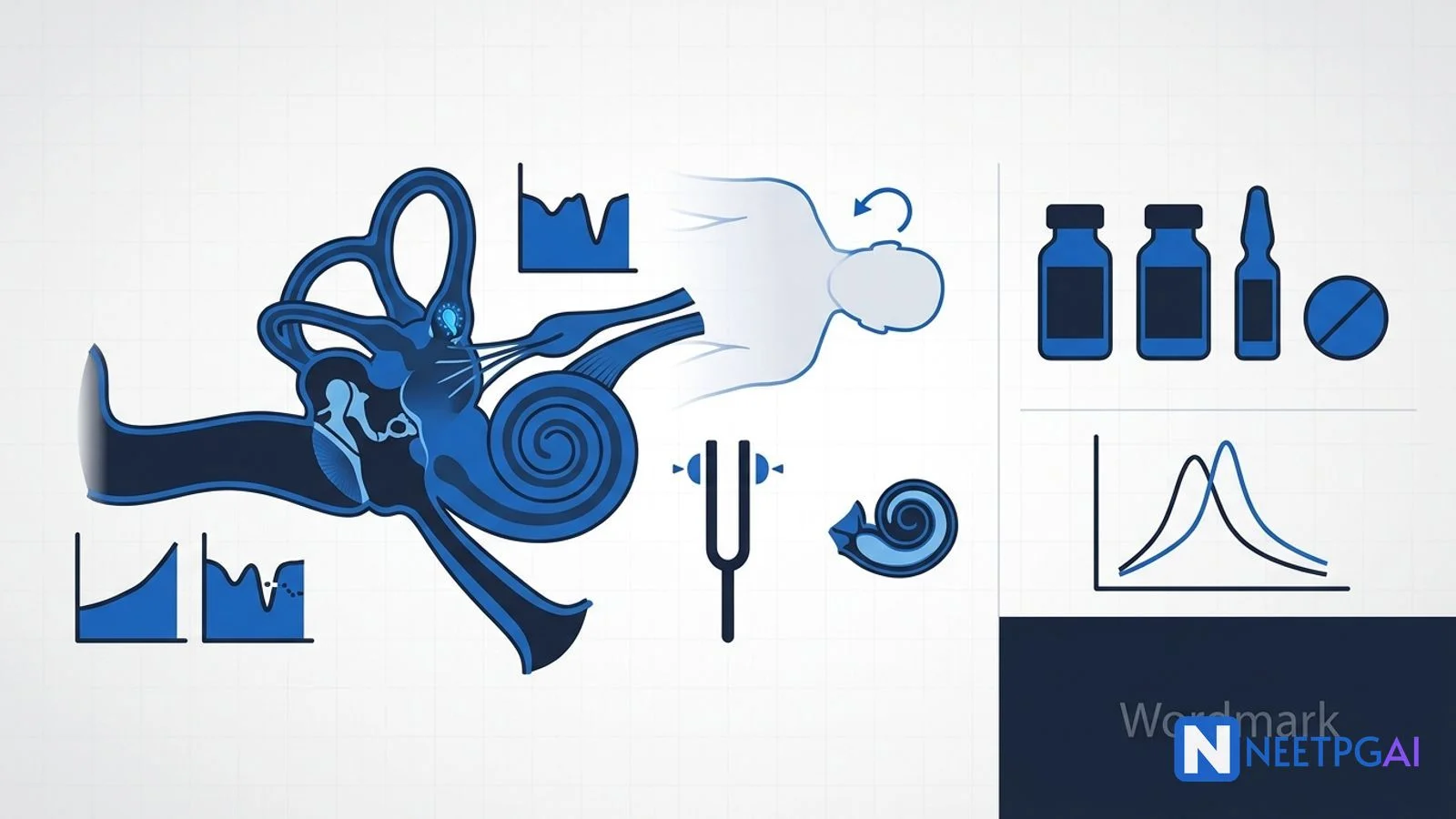
Vertigo and hearing loss are pillar topics for NEET PG ENT and yield 2 to 3 questions per paper. Lock these:
- Peripheral vs central vertigo — peripheral is severe, brief, fatigable, with tinnitus; central is persistent with neurological signs.
- BPPV — Dix-Hallpike diagnoses, Epley manoeuvre treats. Posterior canal involved in 85 to 95 percent of cases.
- Meniere triad — episodic vertigo, fluctuating sensorineural hearing loss, tinnitus, plus aural fullness. Pathology: endolymphatic hydrops.
- Conductive vs sensorineural — Rinne and Weber bedside; audiometry confirms with air-bone gap (conductive) versus equal threshold drop (sensorineural).
- Otosclerosis — bilateral conductive hearing loss in young adult, Carhart's notch at 2000 Hz, Schwartze's sign. Stapedectomy is curative.
- Ototoxic drugs — aminoglycosides, cisplatin, loop diuretics, salicylates, quinine.
Vertigo accounts for 5 percent of all primary-care visits in India, yet only a quarter of patients receive an accurate diagnosis at first presentation. NEET PG examiners exploit this clinical murkiness with vignettes that hinge on tiny details — the duration of the spell, the presence of nystagmus direction, the trigger position, the audiogram pattern. Add the 2017 Barany Society criteria for vestibular migraine and the 2024 update on superior canal dehiscence, and the topic has only grown denser.
This NEETPGAI deep dive separates peripheral from central vertigo, walks through the four big peripheral syndromes, decodes audiometry, and flags every NEET PG trap on otosclerosis, presbycusis, noise-induced hearing loss, and ototoxic drugs. Pair this guide with the common mistakes ENT guide for examiner-favourite question patterns.
Vertigo overview and peripheral versus central
Vertigo is the illusion of movement, distinct from disequilibrium (sense of imbalance) and presyncope (light-headedness preceding faint). Vestibular origins are subdivided into peripheral (labyrinth, vestibular nerve) and central (brainstem, cerebellum, cortex).
| Feature | Peripheral | Central |
|---|
| Onset | Sudden | Gradual |
| Severity | Severe | Mild to moderate |
| Duration of spell | Seconds to days | Constant |
| Nystagmus | Horizontal-rotatory, unidirectional, suppressed by fixation | Vertical, multidirectional, not suppressed |
| Hearing loss / tinnitus | Often present | Usually absent |
| Neurological signs | Absent | Present (dysarthria, diplopia, weakness) |
| Romberg | Falls toward affected side | Variable |
| Common causes | BPPV, vestibular neuritis, Meniere's, labyrinthitis | Stroke, MS, vestibular migraine, posterior fossa tumour |
HINTS examination
In acute vestibular syndrome (continuous vertigo lasting more than 24 hours with nystagmus), the HINTS battery distinguishes peripheral from central with sensitivity higher than early MRI:
- Head Impulse Test (HIT) — corrective saccade after rapid head turn suggests peripheral lesion (vestibular neuritis). A normal HIT in acute vestibular syndrome is a red flag for stroke.
- Nystagmus — pure horizontal unidirectional suggests peripheral. Direction-changing or vertical suggests central.
- Test of Skew — vertical ocular misalignment on alternate cover test suggests central (brainstem).
A positive HINTS pattern (normal HIT plus direction-changing nystagmus plus skew) is more sensitive than 48-hour MRI for posterior circulation stroke.
Peripheral vertigo syndromes
Benign paroxysmal positional vertigo (BPPV)
The commonest cause of vertigo overall. Otoconia displaced from the utricular macula float into the semicircular canals (canalithiasis) — most often the posterior canal (85 to 95 percent), occasionally horizontal canal, rarely anterior.
Clinical — brief (under 60 seconds) episodes of vertigo triggered by head movements (rolling over in bed, looking up, bending forward). No hearing loss. Symptoms cluster on waking.
Diagnosis — Dix-Hallpike manoeuvre is positive when a torsional upbeating nystagmus appears after 5 to 20 seconds latency, lasts under 60 seconds, and fatigues on repetition.
Treatment — the Epley canalith-repositioning manoeuvre is curative in 80 percent at first attempt. Semont liberatory manoeuvre is an alternative. For horizontal canal BPPV, use the Lempert (barbecue roll) manoeuvre. Vestibular suppressants (meclizine, prochlorperazine) only worsen long-term recovery and should be avoided beyond the acute attack.
Vestibular neuritis (and labyrinthitis)
Acute inflammation of the vestibular nerve, often post-viral. When cochlear involvement adds hearing loss, the term labyrinthitis is preferred.
Clinical — sudden severe vertigo lasting hours to days, persistent imbalance for 1 to 4 weeks, no hearing loss in pure neuritis. Romberg and gait fall toward the affected side; nystagmus beats toward the unaffected side (compensatory).
Treatment — short course of vestibular suppressants for 48 to 72 hours, brief steroid taper (methylprednisolone — Strupp 2004 trial), and early vestibular rehabilitation exercises which speed central compensation.
Meniere disease
Endolymphatic hydrops causes episodic distension of the cochlear and vestibular labyrinth.
Diagnostic criteria (Barany Society 2015 / AAO-HNS 2020) — definite Meniere's requires:
- Two or more episodes of spontaneous vertigo lasting 20 minutes to 12 hours.
- Audiometrically documented low- to mid-frequency sensorineural hearing loss in the affected ear before, during, or after one episode.
- Fluctuating aural symptoms (hearing, tinnitus, fullness) in the affected ear.
- Not better explained by another vestibular diagnosis.
Clinical — the classic tetrad is episodic vertigo, fluctuating sensorineural hearing loss, tinnitus, and aural fullness. Tumarkin otolithic crises (drop attacks without warning) are pathognomonic.
Treatment — low-salt diet (2 g sodium/day), trigger avoidance (caffeine, alcohol, stress), thiazide plus potassium-sparing diuretic, betahistine, intratympanic gentamicin (chemical ablation for refractory disease), endolymphatic sac decompression, vestibular nerve section, or labyrinthectomy as last resort. Hearing aids and cochlear implant for advanced hearing loss.
Vestibular migraine
Now recognised as the most common cause of recurrent spontaneous vertigo in young women. Barany 2012 criteria: at least 5 episodes of moderate to severe vestibular symptoms lasting 5 minutes to 72 hours, current or past history of migraine, and at least half the episodes accompanied by migrainous features (photophobia, phonophobia, visual aura, or headache).
Treatment — migraine prophylaxis (propranolol, topiramate, amitriptyline, flunarizine), triptans for acute attack with caveats, lifestyle measures (sleep, hydration).
Other peripheral causes
- Cholesteatoma fistula — vertigo on Valsalva or pneumoscopy (Hennebert sign).
- Superior canal dehiscence — vertigo and oscillopsia triggered by loud sound (Tullio phenomenon) or pressure changes; CT temporal bone confirms bony dehiscence over superior canal.
- Vestibular schwannoma — usually presents with progressive unilateral sensorineural hearing loss, tinnitus, and only mild dysequilibrium because growth is slow and central compensation occurs. NF2 association if bilateral.
Hearing loss — classification and bedside
Hearing loss is conductive (external or middle ear), sensorineural (cochlea or VIII nerve), or mixed. Bedside tuning fork tests at 512 Hz remain the cornerstone:
| Test | Conductive (right) | Sensorineural (right) |
|---|
| Weber (tuning fork on forehead) | Lateralises to right (affected) ear | Lateralises to left (unaffected) ear |
| Rinne (mastoid then ear canal) | BC greater than AC on right (negative Rinne) | AC greater than BC on right (positive but reduced) |
Three-tuning-fork test (256, 512, 1024 Hz) helps quantify the hearing loss. A false-negative Rinne (BC felt longer than AC despite normal hearing) occurs in profound unilateral SNHL when the tuning fork is heard via cross-conduction by the contralateral cochlea.
Audiometry
Pure-tone audiometry (PTA) measures hearing threshold across 250 Hz to 8 kHz. Air conduction is tested through headphones; bone conduction via mastoid vibrator. Threshold is the softest sound heard 50 percent of the time at each frequency.
Severity grading (WHO)
| Grade | Threshold (better ear, average 500/1000/2000/4000 Hz) |
|---|
| Normal | 25 dB or below |
| Mild | 26 to 40 dB |
| Moderate | 41 to 60 dB |
| Severe | 61 to 80 dB |
| Profound | 81 dB or above |
Pattern recognition
- Conductive — air-bone gap of 10 dB or more with normal bone conduction. Causes: cerumen, otitis externa, middle-ear effusion, tympanic membrane perforation, otosclerosis, glue ear, ossicular discontinuity.
- Sensorineural — air and bone conduction depressed equally, no air-bone gap.
- Mixed — air-bone gap plus depressed bone conduction.
Specific patterns
- Otosclerosis — bilateral conductive loss with Carhart's notch (a dip in bone conduction at 2000 Hz, an artefact that reverses after stapedectomy).
- Presbycusis — bilateral high-frequency sensorineural loss starting at 4 kHz and above, sloping configuration.
- Noise-induced hearing loss — notched sensorineural loss centred at 4 kHz with recovery at 8 kHz (the "boilermaker's notch").
- Meniere's — low- to mid-frequency sensorineural loss in early disease, becoming flat with progression.
- Vestibular schwannoma — unilateral asymmetric high-frequency sensorineural loss with disproportionate speech discrimination loss (rollover phenomenon).
- Sudden sensorineural hearing loss (SSNHL) — at least 30 dB drop across three contiguous frequencies within 72 hours; medical emergency, treat with high-dose oral steroids within 14 days, intratympanic steroids if oral fails.
Tympanometry
Measures middle-ear compliance:
- Type A — normal.
- Type As — shallow peak; otosclerosis or fixation.
- Type Ad — deep peak; ossicular discontinuity or healed perforation.
- Type B — flat trace; middle-ear effusion or perforation (depends on canal volume).
- Type C — peak shifted to negative pressure; eustachian tube dysfunction.
Specific hearing loss conditions
Otosclerosis
Bony remodelling around the stapes footplate progressively fixes ossicular movement. Female-predominant, family history common, often worsens during pregnancy. Bedside: bilateral conductive hearing loss in a young adult with normal tympanic membrane, Carhart's notch at 2000 Hz, and Schwartze's sign (pink hue over the promontory from active otospongiotic vasculature). Diagnosis: pure-tone audiometry plus high-resolution CT temporal bone showing footplate sclerosis. Treatment: stapedectomy or stapedotomy (gold standard), hearing aid, or sodium fluoride for cochlear involvement.
Presbycusis
Age-related sensorineural hearing loss starting in the high frequencies. Schuknecht subtypes: sensory (basal-turn hair-cell loss), neural (spiral ganglion loss), strial (atrophy of stria vascularis), and cochlear conductive (basilar membrane stiffening). Patients describe particular difficulty in noisy backgrounds. Hearing aids are the mainstay; cochlear implants if profound.
Noise-induced hearing loss
Caused by prolonged exposure to noise above 85 dB(A). Initial threshold shift is temporary (TTS) and recovers within 16 to 48 hours; with cumulative exposure it becomes a permanent threshold shift (PTS). Pattern: notched sensorineural loss at 3 to 6 kHz with recovery at 8 kHz. Workplace prevention with hearing protectors (mandatory above 85 dB), regular audiometry, and the OSHA action level of 85 dB are common PSM-style stems.
Sudden sensorineural hearing loss
Defined as at least 30 dB drop across three contiguous frequencies within 72 hours. Possible causes: viral cochleitis, vascular insult, autoimmune (Cogan syndrome), perilymphatic fistula, vestibular schwannoma. Treat as a medical emergency with high-dose oral prednisolone within 14 days; salvage with intratympanic steroids. MRI of the internal auditory canal to rule out schwannoma.
Ototoxic drugs
| Class | Drugs | Pattern |
|---|
| Aminoglycosides | Gentamicin, streptomycin (vestibular); amikacin, neomycin (cochlear) | Bilateral, dose-related, may be progressive after stopping |
| Platinum chemotherapy | Cisplatin worse than carboplatin | High-frequency sensorineural; cumulative |
| Loop diuretics | Furosemide, ethacrynic acid (worst) | Reversible hearing loss with rapid IV |
| Salicylates | High-dose aspirin | Reversible tinnitus and high-frequency loss |
| Antimalarials | Quinine, chloroquine | Tinnitus, reversible |
| Macrolides | Erythromycin, azithromycin | Reversible at high IV doses |
| Anti-tubercular | Streptomycin, rifampicin (rare) | Vestibular and cochlear |
Mitochondrial 1555A>G mutation predisposes to severe aminoglycoside-induced sensorineural hearing loss even at therapeutic doses.
NEET PG MCQ traps
- HINTS positive in acute vestibular syndrome — beats early MRI for posterior circulation stroke. The trap stem is a 60-year-old smoker with continuous vertigo and a normal CT — do NOT discharge as labyrinthitis.
- BPPV with vertical nystagmus — vertical-only nystagmus is central until proved otherwise, even with positive Dix-Hallpike triggers.
- Epley first, suppressants second — meclizine prolongs BPPV recovery; the manoeuvre is the treatment.
- Carhart's notch reverses post-stapedectomy — frequently asked.
- Schwartze's sign — pink hue over the promontory; otosclerosis is active.
- Tullio phenomenon — sound-induced vertigo; superior canal dehiscence or perilymphatic fistula.
- Hennebert sign — vertigo on Valsalva or pneumoscopy; cholesteatoma fistula.
- Vestibular schwannoma — unilateral progressive sensorineural hearing loss with rollover phenomenon and disproportionate speech discrimination loss; MRI internal auditory canal is gold standard.
- Cisplatin ototoxicity — high-frequency, irreversible, dose-related; protective role of sodium thiosulfate in paediatric oncology was approved by FDA in 2022.
- Furosemide ototoxicity — rapid IV bolus or large doses in renal failure causes reversible hearing loss; fast-push of 80 mg or above is the trap stem.
- Speech-discrimination test for retrocochlear lesion — disproportionately poor word recognition compared to PTA suggests VIII nerve lesion (rollover).
- Cochlear implant indications — bilateral severe-to-profound sensorineural hearing loss with insufficient benefit from hearing aids; younger age improves outcomes.
Recent updates and Indian context
- 2017 Barany vestibular migraine criteria — formally codified the most common cause of recurrent spontaneous vertigo in young women.
- 2020 AAO-HNS Meniere's criteria update — emphasised audiometric documentation of low-mid frequency SNHL.
- NPPCD (National Programme for Prevention and Control of Deafness) — Indian government initiative since 2007 emphasising newborn hearing screening, school screening, and ENT outreach. PSM-style questions ask about its components and the burden of preventable deafness in India (6.3 percent of population).
- Universal newborn hearing screening — OAE plus AABR in neonates, with diagnostic ABR by 3 months and intervention by 6 months (the "1-3-6" rule).
- NMC and FMGE alignment — Indian undergraduate exams emphasise Dix-Hallpike interpretation, audiometry pattern recognition, and ototoxic drug profiles as cumulative pharmacology cross-reference points.
- Cochlear implant programme — increasingly covered under Ayushman Bharat for bilateral severe SNHL in children under 5.
Frequently asked questions
How do you differentiate peripheral from central vertigo?
Peripheral vertigo (BPPV, vestibular neuritis, Meniere's) is sudden, severe, brief, fatigable, and unidirectional with associated tinnitus or hearing loss. Central vertigo (brainstem, cerebellum) is gradual, less severe, persistent, non-fatigable, multidirectional or vertical, and accompanied by neurological signs. The HINTS battery (Head Impulse, Nystagmus, Test of Skew) is more sensitive than MRI in the first 48 hours of acute vestibular syndrome.
What is the diagnostic test for BPPV?
The Dix-Hallpike manoeuvre diagnoses posterior canal BPPV — the patient is rapidly moved from sitting to head-hanging position with the head turned 45 degrees toward the affected ear. A torsional upbeating nystagmus that begins after a 5 to 20 second latency, lasts under 60 seconds, and fatigues on repetition is positive. The Epley manoeuvre is the curative repositioning treatment.
What are the diagnostic criteria for Meniere's disease?
Definite Meniere's needs at least two episodes of spontaneous vertigo each lasting 20 minutes to 12 hours, audiometric documentation of low- to mid-frequency sensorineural hearing loss in the affected ear before, during, or after one episode, and fluctuating aural symptoms (hearing, tinnitus, fullness). Pathology shows endolymphatic hydrops.
What is Carhart's notch?
Carhart's notch is a characteristic dip in bone conduction at 2000 Hz seen on pure-tone audiometry in otosclerosis. It is an artefact of impaired ossicular resonance and reverses after successful stapedectomy. The triad of conductive hearing loss with normal tympanic membrane, Carhart's notch, and Schwartze's sign (pink promontory) strongly suggests otosclerosis.
Which drugs are ototoxic?
Common ototoxic drugs include aminoglycosides (gentamicin, amikacin, streptomycin — vestibular toxicity dominates with gentamicin and streptomycin; cochlear with amikacin and neomycin), platinum chemotherapy (cisplatin worse than carboplatin), loop diuretics (furosemide, especially fast IV), salicylates (reversible tinnitus and high-frequency hearing loss), quinine, and erythromycin. Toxicity is dose-related and often bilateral and symmetrical.
This content is for educational purposes for NEET PG exam preparation. It is not a substitute for professional medical advice, diagnosis, or treatment. Clinical information has been reviewed by qualified medical professionals.
Written by: NEETPGAI Editorial Team
Reviewed by: Pending SME Review
Last reviewed: May 2026