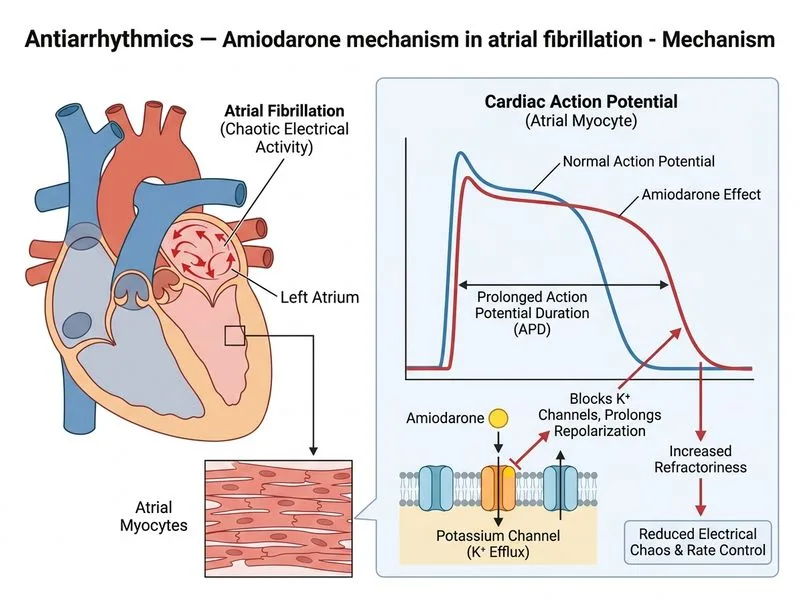
Antiarrhythmics — Amiodarone mechanism in atrial fibrillation
medium
pill Pharmacology
A 58-year-old man with a history of hypertension and left ventricular hypertrophy presents with palpitations. ECG shows atrial fibrillation with a ventricular rate of 120 bpm. He is started on intravenous amiodarone for rate control and rhythm conversion. Which of the following best explains the antiarrhythmic mechanism of amiodarone in this clinical scenario?
A. Calcium channel blockade with slowing of AV nodal conduction
B. Beta-adrenergic blockade with reduction of automaticity
C. Sodium channel blockade with decreased slope of phase 0 depolarization
D. Potassium channel blockade with prolongation of action potential duration and refractoriness
Explanation
Amiodarone's Antiarrhythmic Mechanism
Classification and Primary Action
Key Point
Amiodarone is a Class III antiarrhythmic agent, and its dominant mechanism in treating atrial fibrillation is potassium channel blockade, which prolongs the action potential duration (APD) and refractory period.
Mechanism of Action in Atrial Fibrillation
Amiodarone blocks cardiac potassium channels (particularly IK and IKr), leading to:
1.
Prolongation of the action potential duration — the repolarization phase is extended
2.
Increased refractory period — atrial tissue remains refractory for longer, reducing the ability of re-entrant circuits to sustain arrhythmias
3.
Suppression of re-entry — by lengthening refractoriness, amiodarone breaks the cycle of re-entrant atrial fibrillation, which is the primary mechanism in this patient
Why Amiodarone Works in This Case
Atrial fibrillation is typically driven by re-entrant circuits within the atria. By prolonging the refractory period via potassium channel blockade, amiodarone:
Prevents premature atrial depolarizations from re-entering tissue that has just recovered excitability
Allows the AV node time to recover between atrial impulses, slowing ventricular rate
Promotes rhythm conversion by eliminating the substrate for re-entry
Clinical Pearl
Although amiodarone has all four classes of antiarrhythmic properties (Class I, II, III, and IV), its Class III effect (potassium channel blockade) is the most prominent and clinically important for arrhythmia suppression, particularly in atrial fibrillation.
Why Other Options Are Secondary
While amiodarone does possess:
Class I activity (sodium channel blockade) — slows conduction but is not the dominant effect
Class II activity (beta-blockade) — reduces automaticity but is minor
Class IV activity (calcium channel blockade) — slows AV nodal conduction but is not primary
These properties are adjunctive to its Class III mechanism.
High-YieldNEET PG
On NEET PG exams, when asked about amiodarone's mechanism in atrial fibrillation, always select potassium channel blockade and APD prolongation as the primary answer.
KD Tripathi 8e Ch 35
Loading illustration…
Practice similar questions
Sign up free to access AI-powered MCQ practice with detailed explanations and adaptive learning.