
## Assessment of Asthma Control This patient has **uncontrolled asthma** based on GINA criteria: - Reliever use ≥2 days/week (she uses 4–5 times/week) - Nocturnal symptoms ≥1 night/month (she has 2 nights/month) - FEV₁ 78% predicted (below 80% threshold) ## GINA Step-Up Approach **Key Point:** GINA asthma management follows a stepwise approach based on control level and symptom frequency. | Asthma Control Status | Reliever Use | Nocturnal Symptoms | Recommended Initial Controller | | --- | --- | --- | --- | | Well-controlled | ≤2 days/week | None | No controller needed | | Partially controlled | 2–4 days/week | 1–3 nights/month | Low-dose ICS monotherapy | | Uncontrolled | ≥5 days/week or daily | ≥4 nights/month | Medium-dose ICS or ICS/LABA | **High-Yield:** This patient falls into the **partially controlled** category, making low-dose ICS monotherapy the appropriate first-line controller agent. ## Why Low-Dose ICS Monotherapy? 1. **Evidence-based:** ICS are the most effective anti-inflammatory agents for asthma 2. **Safety profile:** Low-dose ICS have minimal systemic side effects 3. **Cost-effective:** Monotherapy is preferred before escalation to combination therapy 4. **GINA recommendation:** ICS is the preferred controller at Step 2 (partial control) **Clinical Pearl:** LABA monotherapy is contraindicated in asthma without concurrent ICS due to increased risk of asthma-related deaths. ICS/LABA combination is reserved for inadequate control on low-dose ICS alone. ## Expected Outcomes With appropriate ICS therapy: - Reduction in airway inflammation within 2–4 weeks - Improved FEV₁ and symptom control - Decreased reliever use and nocturnal symptoms - If control achieved, maintain same dose; if not, escalate to Step 3 (medium-dose ICS or ICS/LABA) **Mnemonic:** GINA Steps = **SLIC** (Step 1: Salbutamol only; Step 2: Low ICS; Step 3: ICS/LABA or medium ICS; Step 4+: Combination therapy) 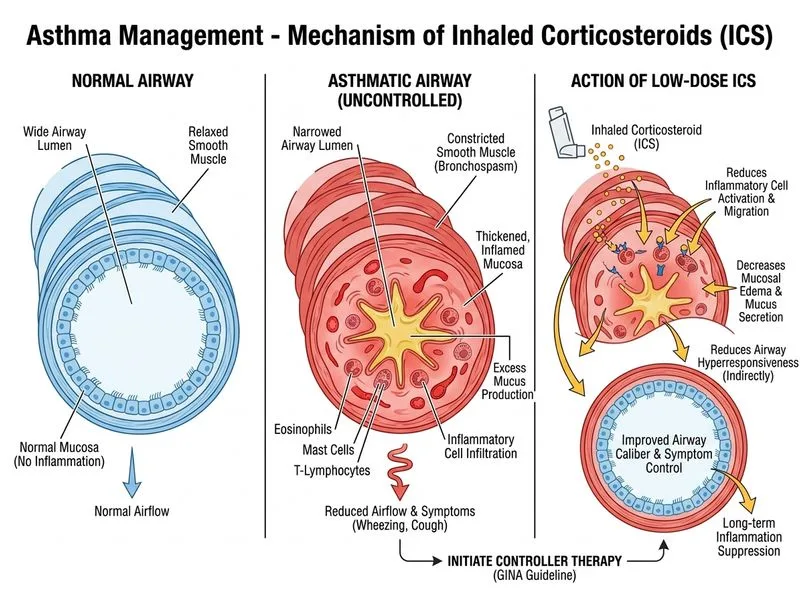
Sign up free to access AI-powered MCQ practice with detailed explanations and adaptive learning.