NEETPGAI
BlogComparePricing
Log inStart Free
NEETPGAI

AI-powered NEET PG preparation platform. Master all 19 subjects with adaptive MCQs, AI tutoring, and spaced repetition.

Product

  • Subjects
  • Previous Year Questions
  • Compare
  • Pricing
  • Blog

Features

  • Adaptive MCQ Practice
  • AI Tutor
  • Mock Tests
  • Spaced Repetition

Resources

  • Blog
  • Study Guides
  • NEET PG Updates
  • Help Center

Legal

  • Privacy Policy
  • Terms of Service

Stay updated

© 2026 NEETPGAI. All rights reserved.
    Practice 2,551+ Medicine MCQs
    Free signup · 10 MCQs/day · AI explanations
    Start Free
    SubjectsMedicine
    Clinical
    AI-powered

    Medicine for NEET PG 2026

    Free practice + topic-wise study material with AI explanations.

    107 daysto NEET PG 2026
    Exam date: 30 Aug 2026
    Your prep stageIntegration Phase
    Foundation
    180+ days
    Deep Study
    90-180 days
    Revision
    30-90 days
    Final Sprint
    <30 days

    Start full-length mocks. Identify and fix weak areas.

    1. 1Prioritise the 62 high-yield topics — they account for ~70% of Medicine questions every year.
    2. 2Practice 2,551+ topic-tagged MCQs with detailed AI explanations to build pattern recognition.
    3. 3Use SM-2 spaced repetition — wrong answers auto-schedule for review at expanding intervals.
    4. 4Revise PYQs from the last 5 years to spot recurring themes and adjust your priorities.
    5. 5Take subject-wise mock tests every 2 weeks to benchmark recall under exam conditions.
    Start Free PracticeGenerate AI Study Plan

    Medicine at a glance

    Live from MCQ bank
    2,551practice MCQs
    Updated daily as new questions are SME-approved.
    62
    HY
    high-yield topics
    ~70% of NEET PG Medicine marks come from these.
    84total topics
    Across 10 canonical systems.
    100% free to start. No credit card. 10 MCQs/day on the free tier.
    About Medicine in NEET PG

    What you need to know about Medicine

    Quick answer

    Medicine is the single largest subject in NEET PG 2026, carrying approximately 25% of the paper (range 22–28%) across 84 syllabus topics spanning 10 body systems. The exam does not test textbook recall alone — it tests applied clinical reasoning: you will be given a patient scenario and asked to pick the next investigation, the most likely diagnosis, or the first-line drug, often with a single differentiating detail (e.g., a PaO₂/FiO₂ ratio of 150 mmHg pointing to moderate ARDS, or an exogenous steroid history pointing to the most common cause of Cushing syndrome). Cardiology alone accounts for roughly 30–35% of Medicine questions, so mastering the top 12 high-yield topics — from ECG interpretation and STEMI management to Mitral Stenosis and Infective Endocarditis — is non-negotiable. Prioritise Harrison's Principles of Internal Medicine (Indian edition, 21st) for mechanisms and Davidson's Principles and Practice of Medicine for concise clinical summaries. Work through the 968 approved NEETPGAI Medicine questions in timed blocks to calibrate your clinical reasoning speed. Spaced-repetition tools like NEETPGAI compress the revision cycle to 7–10 days.

    Medicine in NEET PG 2026 tests your ability to function as a junior doctor making real-time decisions — not a student reciting definitions. At 25% weightage, it is the single subject that can make or break your rank. The exam probes pattern recognition across 84 topics: you must identify a rhythm strip as third-degree AV block, distinguish NSTEMI from Unstable Angina using troponin kinetics, or recognise that a bilateral infiltrate with PaO₂/FiO₂ below 200 mmHg is ARDS rather than cardiogenic pulmonary oedema. Every question stem is a mini-case, and the distractor options are designed to punish surface-level reading.

    Clinically, Medicine is the backbone of your MBBS internship year. The conditions you manage on the general medicine ward — hypertensive emergencies, acute decompensated heart failure, new-onset atrial fibrillation, infective endocarditis — are exactly what NEET PG 2026 will test. This overlap means your ward exposure, if used actively, is a revision tool. When you see a patient on digoxin for AF with a slow ventricular rate, you are looking at a live pharmacology-medicine integration question.

    The syllabus spans 10 body systems: Cardiology, Respiratory, Gastroenterology, Nephrology, Endocrinology, Neurology, Haematology, Rheumatology, Infectious Diseases, and Clinical Pharmacology/Toxicology. Cardiology is the heaviest system, with 12 of the top high-yield topics drawn from it — ECG Interpretation, STEMI, NSTEMI/Unstable Angina, Heart Failure, AF, SVTs, Ventricular Arrhythmias, AV Blocks, Valvular Heart Disease (clinical and Mitral Stenosis specifically), Infective Endocarditis, and Hypertension. Endocrinology (Cushing syndrome, thyroid disorders, diabetes complications) and Neurology (seizure classification, stroke syndromes) are the next two high-yield clusters.

    A common misconception is that Medicine requires only "reading" — aspirants spend weeks on Harrison's without doing a single timed question and then freeze on a 5-line clinical vignette. The other misconception is that cardiology ECG questions are purely pattern-matching; in reality, NEET PG 2026 will give you a clinical context (chest pain, syncope, palpitations) and ask you to integrate the ECG finding with the next management step, not just name the rhythm.

    Free PDF · NEET PG 2026

    Medicine High-Yield One-Liners

    200 textbook-style one-liners auto-extracted from approved Medicine MCQ explanations. Drop your email and we'll send the PDF — no spam, you can reply to unsubscribe.

    Highest-yield topics

    Medicine — focus areas that win the most marks

    These 12 topics historically carry a disproportionate share of Medicine questions on NEET PG. Tap any to start practising — the Medicine filter is pre-selected for you.

    Cardiology

    ECG Interpretation Basics

    Start practising

    Cardiology

    STEMI Diagnosis and Management

    Start practising

    Cardiology

    NSTEMI and Unstable Angina

    Start practising

    Cardiology

    Heart Failure

    Start practising

    Cardiology

    Atrial Fibrillation

    Start practising

    Cardiology

    Supraventricular Tachycardias

    Start practising

    Cardiology

    Ventricular Arrhythmias

    Start practising

    Cardiology

    Heart Block — AV Blocks

    Start practising

    Cardiology

    Valvular Heart Disease — Clinical

    Start practising

    Cardiology

    Infective Endocarditis

    Start practising

    Cardiology

    Hypertension — Essential and Secondary

    Start practising

    Cardiology

    Valvular Heart Disease — Mitral Stenosis

    Start practising

    Preparation strategy

    How to prepare Medicine — tactics that work

    Five repeatable tactics that NEET PG toppers consistently use for Medicine. Below: a deeper play-by-play.

    Build a strong foundation

    Read each high-yield topic from one standard textbook before opening any question bank.

    Practice in tight loops

    After every chapter, attempt 20–30 topic-tagged MCQs while the concepts are still fresh.

    Schedule spaced reviews

    Push wrong answers into SM-2 review queues — short, frequent, expanding intervals beat marathon revisions.

    Mine the last 5 years of PYQs

    Map every PYQ to its parent topic. Recurring themes are louder signal than weightage tables.

    Stress-test with mock tests

    A subject-wise mock every fortnight surfaces blind spots before the real exam does.

    Time budget

    • Allocate 3.5–4 hours of daily study time to Medicine across a 16-week preparation cycle.
    • Spend the first 8 weeks on primary content (system by system), the next 4 weeks on integrated revision, and the final 4 weeks on PYQ-driven weak-area targeting.
    • Cardiology alone deserves 3 full weeks in the first phase given its 30–35% share of Medicine questions.

    Primary textbook

    • Harrison's Principles of Internal Medicine, 21st edition (Indian reprint) — use it for mechanisms, diagnostic criteria, and management algorithms. Do not read it cover to cover; use it chapter by chapter alongside your topic list.
    • Davidson's Principles and Practice of Medicine, 24th edition — faster to read, excellent for clinical summaries and tables. Use it as your first pass for Respiratory, Rheumatology, and Infectious Diseases.

    Supplementary

    • API Textbook of Medicine (10th edition) — Indian-context data, RNTCP tuberculosis guidelines, IAP/ICMR references. Mandatory for Infectious Diseases and Tropical Medicine topics.
    • KD Tripathi's Essentials of Medical Pharmacology — cross-reference when a Medicine question hinges on a drug mechanism (e.g., why amiodarone is used in both AF and ventricular arrhythmias).

    Put this into a 30-minute session today

    We'll pre-select Medicine and serve a mixed difficulty set.

    Try a 10-MCQ set
    Syllabus map
    Medicine — full topic list
    84 topics across 10 systems · 62 marked high-yield
    • ECG Interpretation Basics
      High-yield
    • STEMI Diagnosis and Management
      High-yield
    • NSTEMI and Unstable Angina
      High-yield
    • Heart Failure
      High-yield
    • Atrial Fibrillation
      High-yield
    • Supraventricular Tachycardias
      High-yield
    • Ventricular Arrhythmias
      High-yield
    • Heart Block — AV Blocks
      High-yield
    • Valvular Heart Disease — Clinical
      High-yield
    • Infective Endocarditis
      High-yield
    • Hypertension — Essential and Secondary
      High-yield
    • Cardiomyopathies — Clinical
      Moderate
    • Pericardial Disease
      Moderate
    • Valvular Heart Disease — Mitral Stenosis
      High-yield
    • COPD Management
      High-yield
    • Asthma Management
      High-yield
    • Pneumonia — CAP and HAP
      High-yield
    • Tuberculosis Treatment
      High-yield
    • Pulmonary Embolism — Clinical
      High-yield
    • Interstitial Lung Disease — Clinical
      Moderate
    • Pleural Effusion Workup
      High-yield
    • Sleep Apnea
      Low-yield
    • Acute Kidney Injury
      High-yield
    • Chronic Kidney Disease
      High-yield
    • Nephrotic Syndrome — Clinical
      High-yield
    • Nephritic Syndrome — Clinical
      High-yield
    • Electrolyte Disorders — Hyponatremia
      High-yield
    • Electrolyte Disorders — Hyperkalemia
      High-yield
    • Acid-Base Disorders
      High-yield
    • Dialysis Indications
      Moderate
    • CKD-Mineral Bone Disorder and Anemia
      High-yield
    • Type 1 and Type 2 Diabetes
      High-yield
    • DKA and HHS
      High-yield
    • Hypothyroidism
      High-yield
    • Hyperthyroidism
      High-yield
    • Cushing Syndrome
      High-yield
    • Addison Disease
      High-yield
    • Pheochromocytoma
      High-yield
    • Hyperparathyroidism
      Moderate
    • Pituitary Disorders — Clinical
      Moderate
    • Diabetes Insipidus
      Moderate
    • Peptic Ulcer — Clinical
      High-yield
    • GERD
      Moderate
    • Inflammatory Bowel Disease — Clinical
      High-yield
    • Cirrhosis Complications
      High-yield
    • Acute Pancreatitis
      High-yield
    • Viral Hepatitis — Clinical
      High-yield
    • GI Bleeding — Upper and Lower
      High-yield
    • Celiac Disease
      Moderate
    • Clinical Signs and Symptoms — Examination Findings
      Moderate
    • Jaundice — Approach and Differential
      High-yield
    • Anemia Workup
      High-yield
    • Pancytopenia Workup
      High-yield
    • Bleeding Disorders — Clinical
      High-yield
    • Thrombotic Disorders — Clinical
      High-yield
    • Transfusion Reactions
      Moderate
    • HIV/AIDS — Clinical
      High-yield
    • Malaria — Clinical
      High-yield
    • Dengue — Clinical
      High-yield
    • Enteric Fever
      High-yield
    • Sepsis and Septic Shock
      High-yield
    • Meningitis — Bacterial and Viral
      High-yield
    • Leptospirosis and Scrub Typhus
      Moderate
    • Lyme Disease and Tick-Borne Infections
      Low-yield
    • Ischemic Stroke
      High-yield
    • Hemorrhagic Stroke
      High-yield
    • Seizures and Epilepsy
      High-yield
    • Parkinson Disease — Clinical
      High-yield
    • Guillain-Barré Syndrome
      High-yield
    • Myasthenia Gravis
      High-yield
    • Multiple Sclerosis — Clinical
      Moderate
    • Headache — Migraine vs Cluster vs Tension
      Moderate
    • Dementia Types
      Moderate
    • Rheumatoid Arthritis — Clinical
      High-yield
    • SLE — Clinical
      High-yield
    • Ankylosing Spondylitis
      Moderate
    • Vasculitis — Clinical
      High-yield
    • Gout and Pseudogout
      Moderate
    • Systemic Disease — Cutaneous and Ocular Manifestations
      Moderate
    • ARDS
      High-yield
    • Shock Management
      High-yield
    • Organophosphate Poisoning — Clinical
      High-yield
    • Paracetamol and Salicylate Poisoning
      Moderate
    • Snake Bite Management
      Moderate
    Today's NEET PG Medicine MCQ

    Test yourself in 60 seconds

    New question every day
    Pheochromocytoma
    hard

    A 42-year-old man with a history of hypertension for 8 years presents with recurrent episodes of severe headache, chest pain, and diaphoresis, each lasting 20–30 minutes. His baseline blood pressure is 160/100 mmHg, but during attacks it rises to 220/140 mmHg. Biochemical workup confirms elevated plasma free metanephrines and 24-hour urine metanephrines. CT abdomen reveals a 3.5 cm left adrenal mass with heterogeneous enhancement and no distant metastases. Genetic testing shows a pathogenic mutation in the SDH-B gene. Which of the following is the most appropriate next step in management?

    Tap an option to reveal the answer and AI explanation. New question rotates daily at midnight IST.

    Study guides

    Medicine study guides

    40 in-depth Medicine guides curated for NEET PG aspirants.
    1 / 14
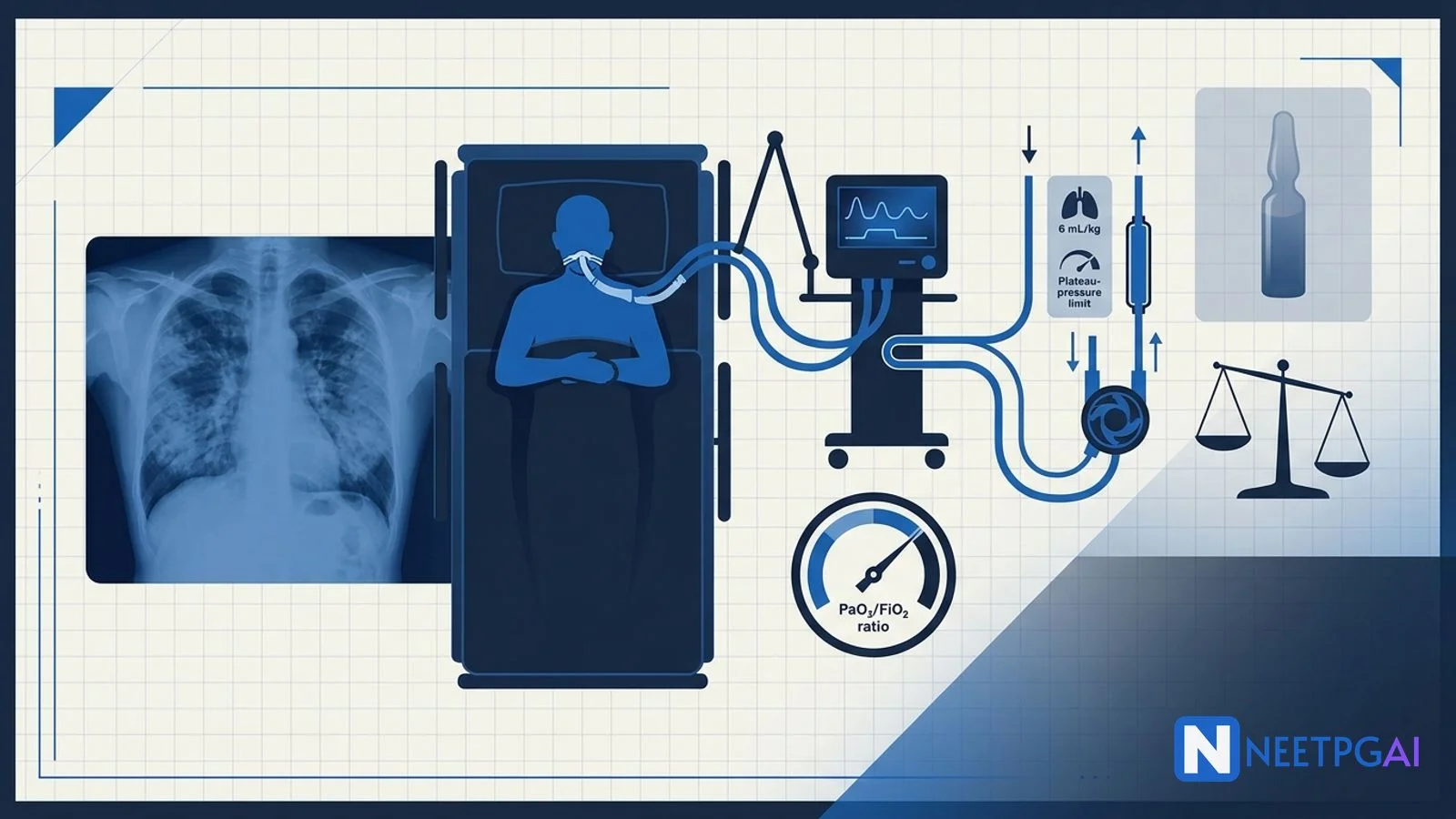
    Clinical Case: 48-Year-Old with Severe Pneumonia Now Hypoxemic with PaO2/FiO2 140 — ARDS Berlin Definition, Lung-Protective Ventilation, and ECMO for NEET PG
    4 May 2026
    clinical case
    medicine

    Clinical Case: 48-Year-Old with Severe Pneumonia Now Hypoxemic with PaO2/FiO2 140 — ARDS Berlin Definition, Lung-Protective Ventilation, and ECMO for NEET PG

    NEET PG ARDS clinical case: 48-yo with severe pneumonia, PaO2/FiO2 140, bilateral infiltrates — Berlin definition, low tidal volume ventilation, proning, NMB, ECMO, MCQ traps.

    Read more
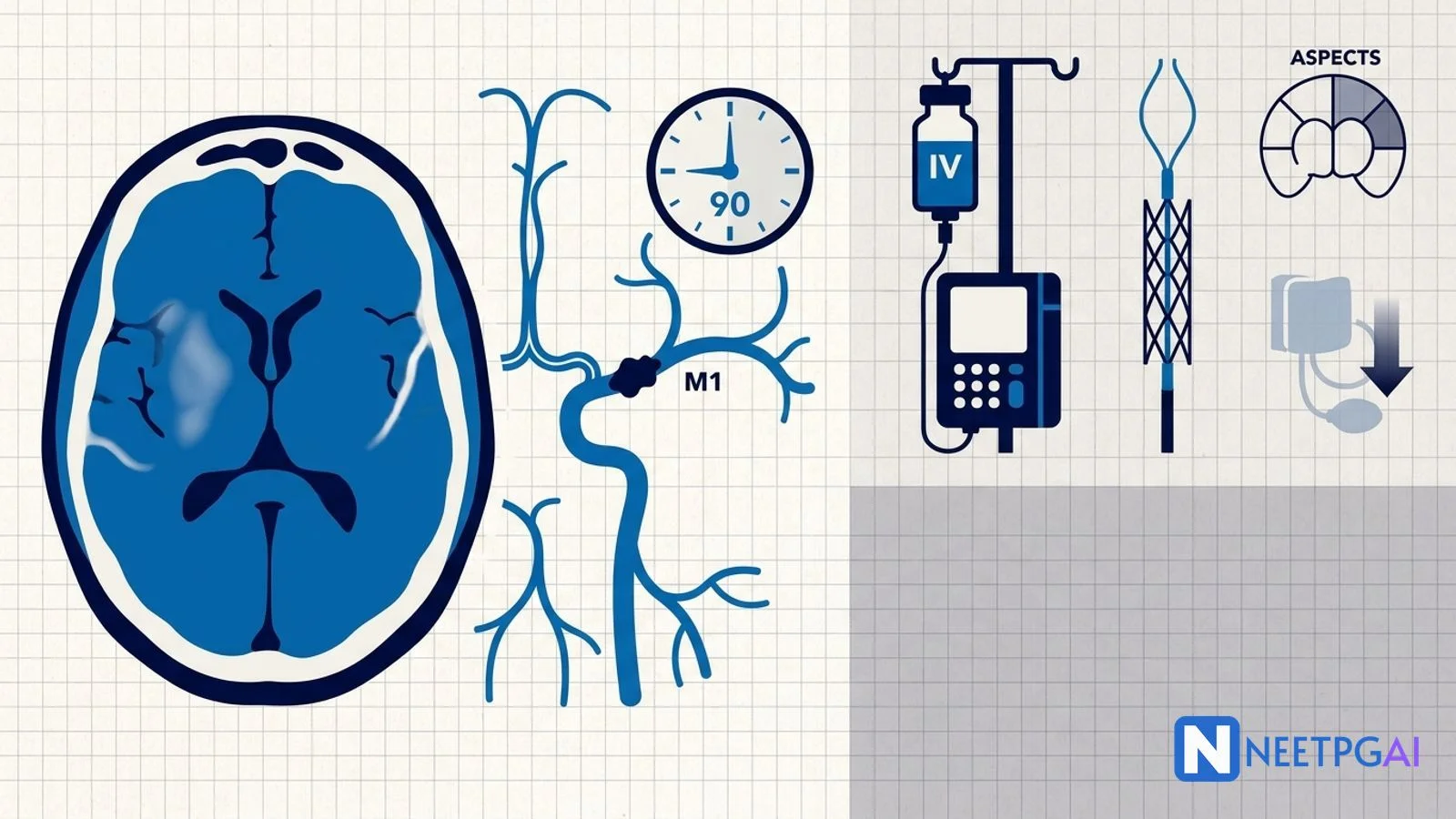
    Clinical Case: 68-Year-Old with Acute Right Hemiparesis and Aphasia at 90 Minutes — Stroke Recognition, tPA Window, and Thrombectomy for NEET PG
    4 May 2026
    clinical case
    medicine

    Clinical Case: 68-Year-Old with Acute Right Hemiparesis and Aphasia at 90 Minutes — Stroke Recognition, tPA Window, and Thrombectomy for NEET PG

    NEET PG acute ischemic stroke case: 68-yo with right hemiparesis and aphasia at 90 min, NIHSS, CT, tPA &lt;4.5h, thrombectomy DAWN/DEFUSE, BP rules, MCQ traps.

    Read more
    Clinical Case: 45-Year-Old Smoker with Crushing Chest Pain — Inferior STEMI Diagnosis, Reperfusion, and Complications for NEET PG
    30 Apr 2026
    clinical case
    medicine

    Clinical Case: 45-Year-Old Smoker with Crushing Chest Pain — Inferior STEMI Diagnosis, Reperfusion, and Complications for NEET PG

    NEET PG inferior STEMI case: 45-yo male smoker, ECG ST elevation in II/III/aVF, V4R for RV involvement, primary PCI vs fibrinolysis, DAPT, Killip class, MCQ traps.

    Read more
    medicine
    Free AI tutor trial · No card required

    Stuck on a Medicine concept? Ask the AI tutor.

    Trained on standard textbooks (Harrison's, Robbins, KD Tripathi, BD Chaurasia, Bailey & Love). Drop your email — we'll send a one-tap link to start asking questions. 3 free messages per day, ongoing.

    • Cite-anchored answers (chapter + page when applicable)
    • Mermaid diagrams and clinical pearls inline
    • NEET PG-tuned, never generic ChatGPT

    Why aspirants choose NEETPGAI for Medicine

    AI-first preparation built specifically for the NEET PG question pattern.

    Textbook-quality AI explanations

    Every Medicine MCQ comes with a detailed Claude-authored explanation citing standard references (Harrison's, Bailey & Love, Robbins, Park's etc.) — never a one-line answer key.

    SM-2 spaced repetition

    Wrong answers auto-schedule for review at expanding intervals (1d → 3d → 7d → 21d). Most aspirants need only half the practice volume to retain the same recall.

    PYQ-aligned question patterns

    Every Medicine question is generated against the NMC syllabus and validated against the last 5 years of NEET PG / INI-CET previous year questions.

    24/7 AI Tutor for Medicine doubts

    Stuck on a tricky topic? Ask the AI Tutor anytime — it answers in seconds with diagrams, mnemonics, and clinical pearls tailored to NEET PG.

    Ready to test yourself?

    Test your Medicine knowledge with AI-powered MCQs and detailed explanations — no signup required to try.

    Practice Medicine MCQs

    Medicine preparation FAQs

    Common questions from NEET PG aspirants preparing Medicine.

    Sources & references
    1. NEETPGAI PYQ Database — Medicine subject pool (N = 968 approved questions, verified 2025)
    2. NMC NEET PG Syllabus 2026 — General Medicine section (84 topics across 10 systems)
    3. Harrison's Principles of Internal Medicine, 21st Edition — McGraw-Hill (Indian reprint)
    4. Davidson's Principles and Practice of Medicine, 24th Edition — Elsevier
    5. API Textbook of Medicine, 10th Edition — Association of Physicians of India
    6. KD Tripathi — Essentials of Medical Pharmacology, 8th Edition (Indian edition)

    Ready to master Medicine?

    Sign up free and practice all 2551+ MCQs with AI-powered explanations tailored to your performance.

    Create Free Account

    Daily rhythm

    • Morning (90 min): Read one topic from Harrison's or Davidson's with a pen — underline diagnostic criteria and first-line drugs.
    • Afternoon (60 min): Solve 20–25 NEETPGAI Medicine questions on that topic in timed mode. Review every wrong answer immediately.
    • Evening (30 min): Write a 10-line summary of the day's topic — ECG criteria for STEMI (≥1 mm ST elevation in ≥2 contiguous limb leads or ≥2 mm in precordial leads), Duke criteria for Infective Endocarditis, Framingham criteria for Heart Failure. Writing fixes numbers.

    Weekly rhythm

    • One full-length 50-question Medicine mock every Sunday. Analyse your error pattern — are you losing marks on ECG interpretation or on drug choices in Heart Failure (beta-blockers, ACE inhibitors, spironolactone, SGLT2 inhibitors)?
    • Every Saturday, revise the week's topic summaries using spaced repetition — NEETPGAI's AI tutor can auto-schedule these.

    High-yield topic tactics

    • ECG Interpretation and AV Blocks: Memorise the PR interval cut-offs (>200 ms = first-degree block), the Wenckebach pattern (progressive PR lengthening then dropped beat), and the complete dissociation of P and QRS in third-degree block. NEET PG 2026 will give you a rhythm strip with a clinical scenario — syncope, post-MI, or bradycardia on beta-blockers.
    • Mitral Stenosis: Know the mitral valve area thresholds (normal >4 cm², severe <1 cm²), the opening snap-S2 interval relationship with severity, and the indications for balloon mitral valvotomy (Wilkins score ≤8). These numbers appear directly in question stems.

    Mistakes to avoid

    • Do not skip Neurology (seizure classification, stroke, meningitis) assuming it belongs only to the Neurology subject — Medicine paper carries its own Neurology questions.
    • Do not memorise drug names without knowing the mechanism; NEET PG 2026 will ask why you choose sacubitril-valsartan over enalapril in HFrEF, not just which drug to use.
    • Do not ignore secondary causes of Hypertension — renovascular hypertension, primary hyperaldosteronism, and phaeochromocytoma are perennial favourites.
    • Avoid passive re-reading. After week 8, every study session must involve active recall — close the book and write the diagnostic criteria from memory before checking.