
## Contact Lens Fitting in Astigmatism Contact lens prescription for astigmatism requires understanding the relationship between corneal curvature, refractive error, and lens parameters. ### Key Principles: - **High-Yield:** Toric contact lenses are required to correct astigmatism ≥0.75 D. - The base curve of the contact lens should align with the flatter (less curved) meridian of the cornea. - The contact lens power must account for the vertex distance difference between spectacles and contact lenses. ### Analysis of This Case: - **Corneal curvature:** Horizontal 44.00 D (flatter), Vertical 45.50 D (steeper) - **Refractive error:** -3.00 D sphere with -1.50 D cylinder × 180° - The cylinder axis 180° (horizontal) indicates the flatter meridian is the one requiring cylinder correction. - **Base curve selection:** Should match the flatter meridian (44.00 D). - **Vertex distance correction:** Contact lens is worn 12-14 mm from the cornea, while spectacles are 12-14 mm from the cornea. For this low myopic astigmatism, vertex distance correction is minimal. - **Correct prescription:** Base curve 44.00 D, sphere -3.00 D, cylinder -1.50 D × 180° ### Mnemonic: "TORIC = Toricity for Astigmatism" When astigmatism ≥0.75 D, use toric lenses. Match base curve to flatter meridian. Maintain the cylinder power and axis. 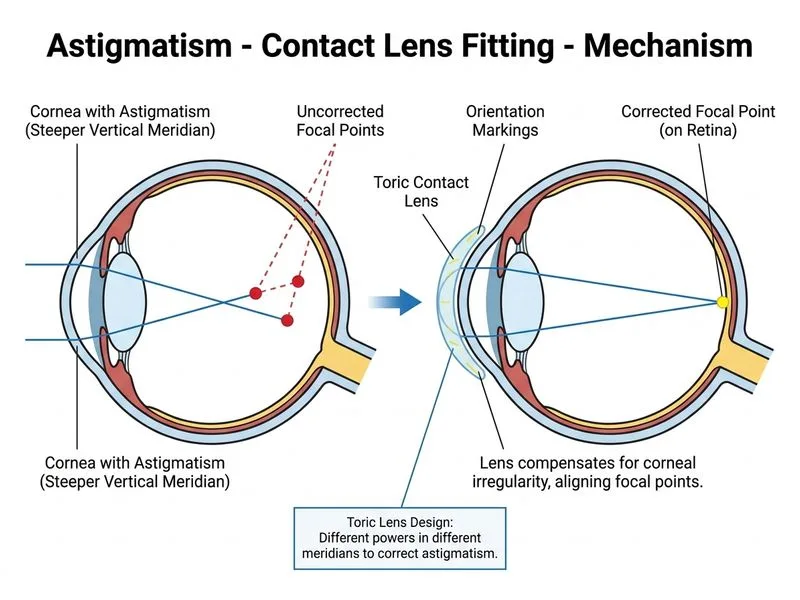
Sign up free to access AI-powered MCQ practice with detailed explanations and adaptive learning.