NEETPGAI
BlogComparePricing
Log inStart Free
NEETPGAI

AI-powered NEET PG preparation platform. Master all 19 subjects with adaptive MCQs, AI tutoring, and spaced repetition.

Product

  • Subjects
  • Previous Year Questions
  • Compare
  • Pricing
  • Blog

Features

  • Adaptive MCQ Practice
  • AI Tutor
  • Mock Tests
  • Spaced Repetition

Resources

  • Blog
  • Study Guides
  • NEET PG Updates
  • Help Center

Legal

  • Privacy Policy
  • Terms of Service

Stay updated

© 2026 NEETPGAI. All rights reserved.
    Practice 939+ Ophthalmology MCQs
    Free signup · 10 MCQs/day · AI explanations
    Start Free
    SubjectsOphthalmology
    Clinical
    AI-powered

    Ophthalmology for NEET PG 2026

    Free practice + topic-wise study material with AI explanations.

    107 daysto NEET PG 2026
    Exam date: 30 Aug 2026
    Your prep stageIntegration Phase
    Foundation
    180+ days
    Deep Study
    90-180 days
    Revision
    30-90 days
    Final Sprint
    <30 days

    Start full-length mocks. Identify and fix weak areas.

    1. 1Prioritise the 20 high-yield topics — they account for ~70% of Ophthalmology questions every year.
    2. 2Practice 939+ topic-tagged MCQs with detailed AI explanations to build pattern recognition.
    3. 3Use SM-2 spaced repetition — wrong answers auto-schedule for review at expanding intervals.
    4. 4Revise PYQs from the last 5 years to spot recurring themes and adjust your priorities.
    5. 5Take subject-wise mock tests every 2 weeks to benchmark recall under exam conditions.
    Start Free PracticeGenerate AI Study Plan

    Ophthalmology at a glance

    Live from MCQ bank
    939practice MCQs
    Updated daily as new questions are SME-approved.
    20
    HY
    high-yield topics
    ~70% of NEET PG Ophthalmology marks come from these.
    37total topics
    Across 8 canonical systems.
    100% free to start. No credit card. 10 MCQs/day on the free tier.
    About Ophthalmology in NEET PG

    What you need to know about Ophthalmology

    Quick answer

    Ophthalmology is the surgical and medical study of the eye and its adnexa, covering 37 topics across the NEET PG 2026 syllabus and contributing approximately 8% of the paper (range 6–10%), which translates to roughly 16–20 questions in a 200-question paper. NEET PG tests clinical pattern recognition — identifying a bacterial corneal ulcer from a post-trauma slit-lamp description, staging diabetic retinopathy on fundoscopy, or distinguishing primary open-angle from angle-closure glaucoma by IOP, gonioscopy, and field defect pattern. Start with the 12 high-yield topics listed in the syllabus; together they account for the bulk of repeated questions. Prioritise Cataract Surgery and IOLs, Glaucoma (both types), and Diabetic Retinopathy — these three alone appear in nearly every recent paper. Work through the 618 approved practice questions on NEETPGAI to calibrate your clinical reasoning before the exam.

    Ophthalmology in NEET PG 2026 tests your ability to translate a clinical vignette — a slit-lamp finding, a fundoscopy report, a visual field defect — into a diagnosis, investigation, or management decision. Pure recall questions (e.g., the most common site of IOL decentration after phacoemulsification) sit alongside multi-step reasoning questions (e.g., identifying hypertensive retinopathy with a macular star pattern and choosing the next investigation). You are expected to know both the anatomy and the applied pathology, not just definitions.

    The subject intersects directly with your MBBS internship postings. Conditions like trachoma (caused by Chlamydia trachomatis, WHO Grade TF/TI/TS/TT/CO), acute bacterial conjunctivitis, and diabetic retinopathy are daily OPD encounters. NEET PG exploits this by framing questions around real patient scenarios — a Tamil Nadu labourer with a corneal abrasion, a diabetic with sudden visual loss — so rote memorisation without clinical context will cost you marks.

    The 37-topic syllabus spans 8 body systems and can be grouped into four functional blocks: (1) Anterior segment — cornea, conjunctiva, lens, anterior chamber; (2) Posterior segment — retina, vitreous, choroid; (3) Glaucoma and optic nerve; (4) Orbit, lids, and lacrimal system. High-yield topics cluster in blocks 1 and 2. Uveitis bridges anterior and posterior segments and is frequently tested alongside systemic associations (HLA-B27 in ankylosing spondylitis, sarcoidosis, Behcet's disease).

    A common misconception is that Ophthalmology is a "short subject" that can be covered in 3–4 days before the exam. In reality, the visual field defect patterns alone (arcuate scotoma in POAG, altitudinal defect in AION, bitemporal hemianopia in pituitary adenoma) require spaced repetition over weeks to retain accurately. Another misconception is ignoring surgical details — IOL power calculation using the SRK-II formula, phacoemulsification steps, and complications of trabeculectomy are all fair game in NEET PG 2026.

    Free PDF · NEET PG 2026

    Ophthalmology High-Yield One-Liners

    200 textbook-style one-liners auto-extracted from approved Ophthalmology MCQ explanations. Drop your email and we'll send the PDF — no spam, you can reply to unsubscribe.

    Highest-yield topics

    Ophthalmology — focus areas that win the most marks

    These 12 topics historically carry a disproportionate share of Ophthalmology questions on NEET PG. Tap any to start practising — the Ophthalmology filter is pre-selected for you.

    Eyelid, Lacrimal, and Orbit

    Orbital Cellulitis

    Start practising

    Cornea and Conjunctiva

    Corneal Ulcer — Bacterial and Fungal

    Start practising

    Cornea and Conjunctiva

    Viral Keratitis

    Start practising

    Cornea and Conjunctiva

    Trachoma

    Start practising

    Cornea and Conjunctiva

    Conjunctivitis — Acute and Chronic

    Start practising

    Lens and Cataract

    Cataract Types and Clinical Features

    Start practising

    Lens and Cataract

    Cataract Surgery and IOLs

    Start practising

    Glaucoma

    Primary Open-Angle Glaucoma

    Start practising

    Glaucoma

    Primary Angle-Closure Glaucoma

    Start practising

    Uvea and Retina

    Uveitis — Anterior and Posterior

    Start practising

    Uvea and Retina

    Retinal Detachment

    Start practising

    Uvea and Retina

    Diabetic Retinopathy

    Start practising

    Preparation strategy

    How to prepare Ophthalmology — tactics that work

    Five repeatable tactics that NEET PG toppers consistently use for Ophthalmology. Below: a deeper play-by-play.

    Build a strong foundation

    Read each high-yield topic from one standard textbook before opening any question bank.

    Practice in tight loops

    After every chapter, attempt 20–30 topic-tagged MCQs while the concepts are still fresh.

    Schedule spaced reviews

    Push wrong answers into SM-2 review queues — short, frequent, expanding intervals beat marathon revisions.

    Mine the last 5 years of PYQs

    Map every PYQ to its parent topic. Recurring themes are louder signal than weightage tables.

    Stress-test with mock tests

    A subject-wise mock every fortnight surfaces blind spots before the real exam does.

    Time budget

    • Allocate 10–12 days of primary reading spread over 6–8 weeks before the exam, not a single block.
    • Reserve 2 dedicated revision days in the final week — one for anterior segment + glaucoma, one for posterior segment + orbit.
    • Daily target during active preparation: 1 topic + 15–20 practice questions from the NEETPGAI bank (618 questions total; at 20/day you finish in ~31 days).

    Primary textbook

    • Khurana's Comprehensive Ophthalmology (7th Indian edition) is the standard for NEET PG. Read the clinical chapters, not just the introductory anatomy sections.
    • For surgical details (phacoemulsification, trabeculectomy, vitreoretinal surgery), supplement with the relevant chapters in AK Khurana's Clinical Methods in Ophthalmology.

    Supplementary resource

    • Parson's Diseases of the Eye (23rd edition) is useful for glaucoma classification and retinal detachment types (rhegmatogenous vs. tractional vs. exudative) — areas where Khurana's descriptions are occasionally thin.

    Put this into a 30-minute session today

    We'll pre-select Ophthalmology and serve a mixed difficulty set.

    Try a 10-MCQ set
    Syllabus map
    Ophthalmology — full topic list
    37 topics across 8 systems · 20 marked high-yield
    • Stye and Chalazion
      Moderate
    • Entropion and Ectropion
      Moderate
    • Dacryocystitis
      Moderate
    • Orbital Cellulitis
      High-yield
    • Corneal Ulcer — Bacterial and Fungal
      High-yield
    • Viral Keratitis
      High-yield
    • Pterygium
      Moderate
    • Trachoma
      High-yield
    • Vernal Keratoconjunctivitis
      Moderate
    • Keratoconus
      Moderate
    • Conjunctivitis — Acute and Chronic
      High-yield
    • Cataract Types and Clinical Features
      High-yield
    • Cataract Surgery and IOLs
      High-yield
    • Lens Dislocation
      Moderate
    • Primary Open-Angle Glaucoma
      High-yield
    • Primary Angle-Closure Glaucoma
      High-yield
    • Congenital Glaucoma
      Moderate
    • Secondary Glaucomas
      Moderate
    • Uveitis — Anterior and Posterior
      High-yield
    • Retinal Detachment
      High-yield
    • Diabetic Retinopathy
      High-yield
    • Hypertensive Retinopathy
      High-yield
    • Age-Related Macular Degeneration
      Moderate
    • Retinitis Pigmentosa
      Moderate
    • Retinoblastoma
      High-yield
    • Papilloedema vs Papillitis
      High-yield
    • Optic Neuritis
      Moderate
    • Pupillary Reflexes and Pathologies
      High-yield
    • Visual Field Defects
      High-yield
    • Myopia, Hypermetropia, Astigmatism
      Moderate
    • Presbyopia and Corrections
      Low-yield
    • Strabismus — Types and Management
      High-yield
    • Amblyopia
      Moderate
    • Astigmatism
      Moderate
    • Ocular Trauma — Evaluation
      Moderate
    • Chemical Injuries of Eye
      High-yield
    • Vitamin A Deficiency — Xerophthalmia
      High-yield
    Today's NEET PG Ophthalmology MCQ

    Test yourself in 60 seconds

    New question every day
    Retinal Detachment
    medium

    A 65-year-old woman with proliferative vitreoretinopathy (PVR) and recurrent retinal detachment after two failed pneumatic retinopexy procedures requires definitive vitreoretinal surgery. Which tamponade agent is the drug of choice for long-term internal tamponade in this scenario?

    Tap an option to reveal the answer and AI explanation. New question rotates daily at midnight IST.

    Study guides

    Ophthalmology study guides

    6 in-depth Ophthalmology guides curated for NEET PG aspirants.
    1 / 2
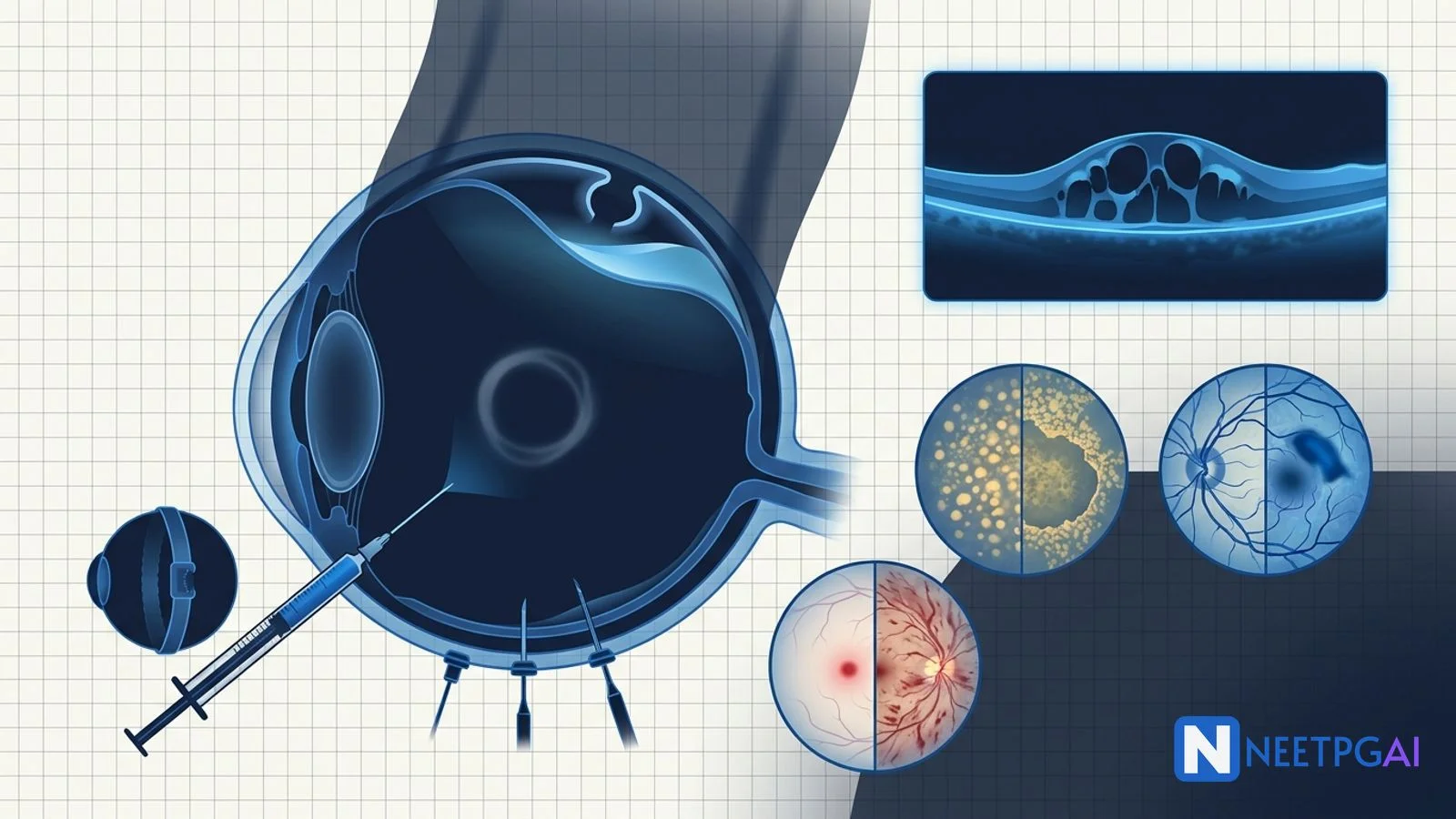
    14 Common Mistakes in Ophthalmology NEET PG — And How to Avoid Them
    5 May 2026
    mistake guide
    ophthalmology

    14 Common Mistakes in Ophthalmology NEET PG — And How to Avoid Them

    Avoid the costliest ophthalmology mistakes in NEET PG 2026: POAG vs PACG, diabetic retinopathy stages, papilledema vs papillitis, CRAO vs CRVO, refractive errors, leukocoria, anisocoria.

    Read more
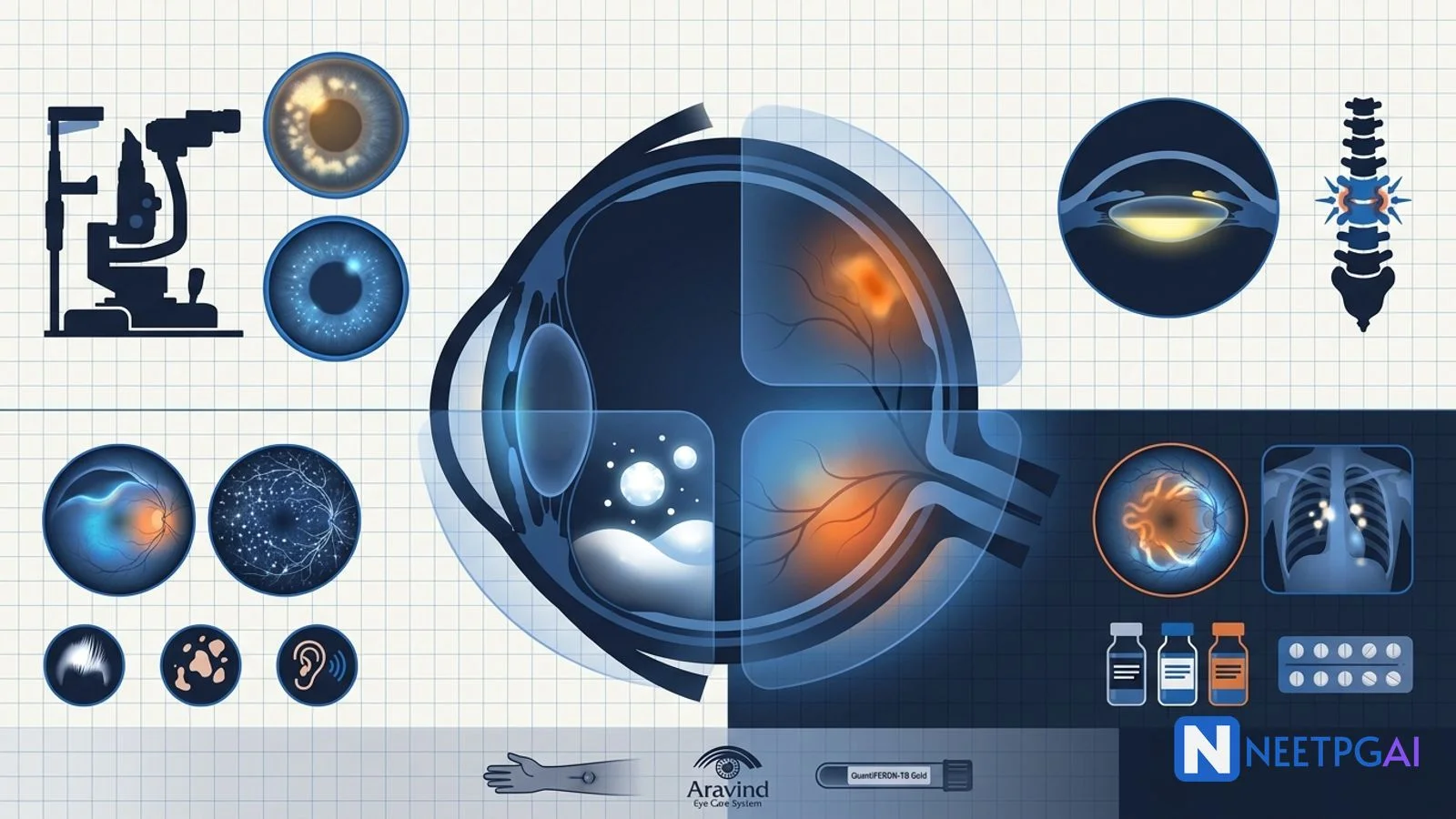
    Clinical Case: 2-Year-Old Boy with White Pupillary Reflex on Flash Photographs — Leukocoria and Retinoblastoma Workup for NEET PG
    4 May 2026
    clinical case
    pediatrics

    Clinical Case: 2-Year-Old Boy with White Pupillary Reflex on Flash Photographs — Leukocoria and Retinoblastoma Workup for NEET PG

    NEET PG pediatric leukocoria case: 2-yo with white pupillary reflex, differential, MRI orbit (never CT), Reese-Ellsworth + IIRC staging, focal therapy, chemoreduction, enucleation, RB1 testing.

    Read more
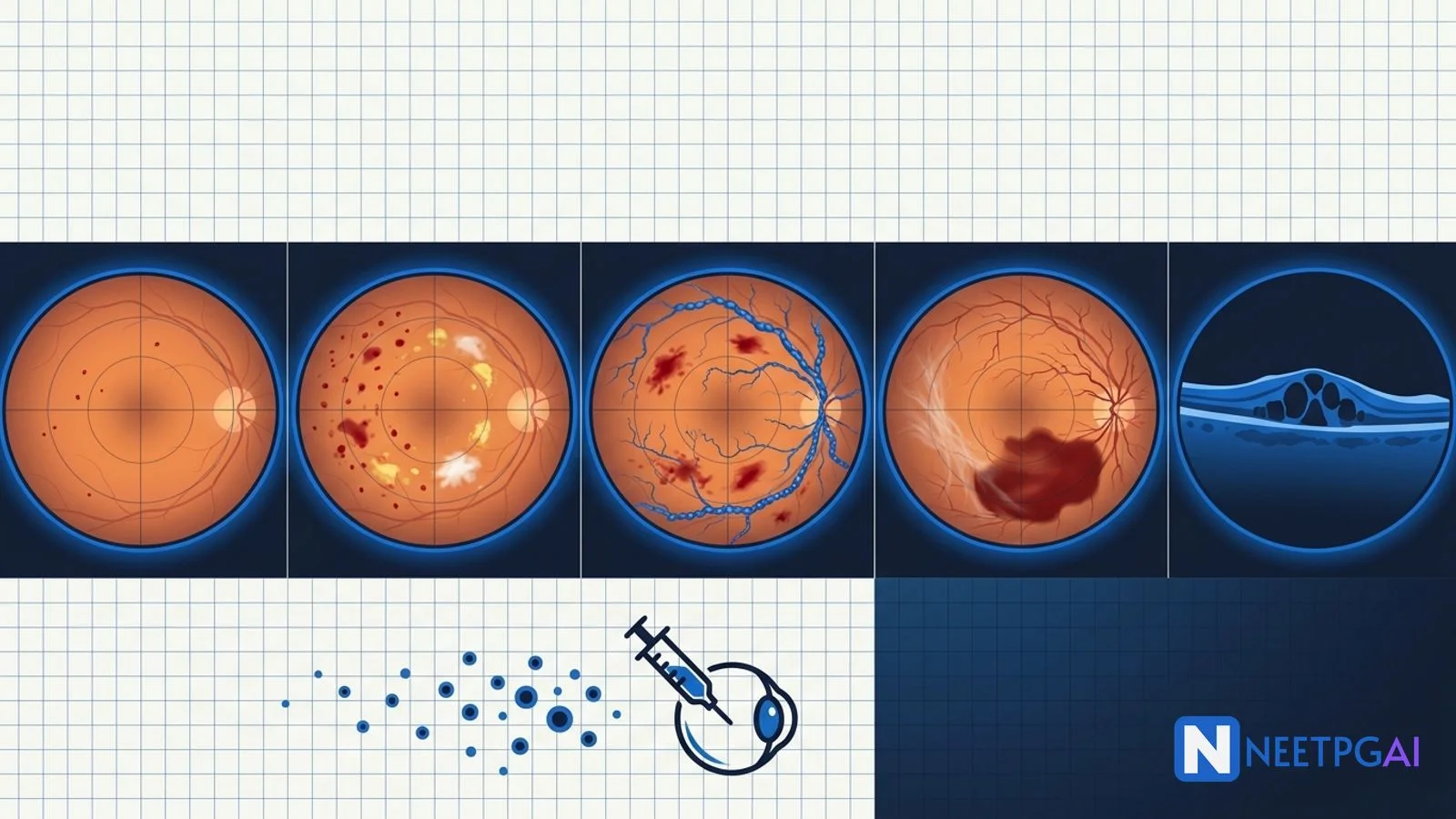
    Image MCQ: Fundoscopy & Retinal Disorders for NEET PG (Diabetic, Hypertensive, CRAO, CRVO, AMD)
    29 Apr 2026
    image mcq
    ophthalmology

    Image MCQ: Fundoscopy & Retinal Disorders for NEET PG (Diabetic, Hypertensive, CRAO, CRVO, AMD)

    5 high-yield fundoscopy image MCQs for NEET PG: diabetic retinopathy, hypertensive retinopathy, CRAO cherry-red spot, CRVO blood-and-thunder, age-related macular degeneration.

    Read more
    ophthalmology
    Free AI tutor trial · No card required

    Stuck on a Ophthalmology concept? Ask the AI tutor.

    Trained on standard textbooks (Harrison's, Robbins, KD Tripathi, BD Chaurasia, Bailey & Love). Drop your email — we'll send a one-tap link to start asking questions. 3 free messages per day, ongoing.

    • Cite-anchored answers (chapter + page when applicable)
    • Mermaid diagrams and clinical pearls inline
    • NEET PG-tuned, never generic ChatGPT

    Why aspirants choose NEETPGAI for Ophthalmology

    AI-first preparation built specifically for the NEET PG question pattern.

    Textbook-quality AI explanations

    Every Ophthalmology MCQ comes with a detailed Claude-authored explanation citing standard references (Harrison's, Bailey & Love, Robbins, Park's etc.) — never a one-line answer key.

    SM-2 spaced repetition

    Wrong answers auto-schedule for review at expanding intervals (1d → 3d → 7d → 21d). Most aspirants need only half the practice volume to retain the same recall.

    PYQ-aligned question patterns

    Every Ophthalmology question is generated against the NMC syllabus and validated against the last 5 years of NEET PG / INI-CET previous year questions.

    24/7 AI Tutor for Ophthalmology doubts

    Stuck on a tricky topic? Ask the AI Tutor anytime — it answers in seconds with diagrams, mnemonics, and clinical pearls tailored to NEET PG.

    Ready to test yourself?

    Test your Ophthalmology knowledge with AI-powered MCQs and detailed explanations — no signup required to try.

    Practice Ophthalmology MCQs

    Ophthalmology preparation FAQs

    Common questions from NEET PG aspirants preparing Ophthalmology.

    Sources & references
    1. NEETPGAI PYQ Database — Ophthalmology module (N = 618 approved questions)
    2. NMC NEET PG Syllabus 2026 — Ophthalmology (37 topics)
    3. Khurana AK. Comprehensive Ophthalmology, 7th Edition. New Age International Publishers, New Delhi.
    4. Parson's Diseases of the Eye, 23rd Edition. Elsevier India.
    5. WHO Programme for the Prevention of Blindness — Trachoma Grading System (TF/TI/TS/TT/CO)
    6. ETDRS Report No. 10 — Early Treatment Diabetic Retinopathy Study Research Group. Ophthalmology, 1991.

    Ready to master Ophthalmology?

    Sign up free and practice all 939+ MCQs with AI-powered explanations tailored to your performance.

    Create Free Account
    High-yield topic tactics
    • Corneal Ulcer (Bacterial and Fungal): Memorise the causative organisms by context — Pseudomonas aeruginosa in contact lens wearers, Fusarium and Aspergillus in agricultural workers (exactly the Tamil Nadu labourer scenario). Know the slit-lamp signs that differentiate bacterial (hypopyon, rapid progression) from fungal (feathery margins, satellite lesions, dry texture).
    • Diabetic Retinopathy: Use the ETDRS/ICMR classification — NPDR (mild/moderate/severe by the 4-2-1 rule) vs. PDR. Know the indications for pan-retinal photocoagulation (PRP) vs. intravitreal anti-VEGF (bevacizumab/ranibizumab). Clinically significant macular oedema (CSME) criteria are a direct NEET PG question target.
    • Glaucoma: Draw the visual field defect for POAG (nasal step → arcuate scotoma → tubular vision) at least 5 times from memory. Know that the first-line drug for POAG is a prostaglandin analogue (latanoprost 0.005%), while acute angle-closure is managed with IV acetazolamide + pilocarpine + laser peripheral iridotomy.
    • Cataract Surgery and IOLs: Know the SRK-II formula variables (A-constant, axial length, keratometry). The most common IOL used in India is a foldable hydrophilic acrylic lens placed in the capsular bag. Posterior capsule opacification (PCO) is the most common late complication of phacoemulsification.

    Weekly rhythm

    • Week 1–2: Anterior segment (Cornea, Conjunctiva, Trachoma, Lens/Cataract).
    • Week 3–4: Glaucoma + Uveitis + Orbit/Cellulitis.
    • Week 5–6: Posterior segment (Retinal Detachment, Diabetic Retinopathy, Hypertensive Retinopathy, CRVO/CRAO).
    • Week 7 onward: Mixed PYQ sets + timed mock blocks.

    Mistakes to avoid

    • Do not skip the grading systems — WHO trachoma grades (TF, TI, TS, TT, CO) and Scheie's classification of hypertensive retinopathy appear directly in single-best-answer stems.
    • Do not confuse the optic disc findings in POAG (increased cup-disc ratio >0.6, notching at inferior pole) with papilloedema (blurred disc margins, no cupping) — this distinction is tested every year.
    • Avoid reading Ophthalmology in isolation; link it to Medicine (diabetic retinopathy, hypertensive retinopathy, thyroid eye disease) and Microbiology (trachoma serovars D–K, herpes simplex keratitis).

    Revision rhythm

    • First revision at Day 7 after initial reading (covers ~70% retention).
    • Second revision at Day 21 using flashcard-style recall, not re-reading.
    • Spaced-repetition tools like NEETPGAI compress the final revision cycle to 7–10 days without losing accuracy.