
## Corneal Cross-Linking and Astigmatism Changes Corneal cross-linking (CXL) is used to halt the progression of keratoconus by increasing corneal rigidity through collagen cross-linking. However, it can cause unexpected refractive changes. ### CXL Mechanism and Astigmatism: - **Key Point:** CXL involves riboflavin-UVA exposure that creates cross-links between collagen fibers, primarily in the anterior 300 μm of the cornea. - The cross-linking process is not uniform across all meridians; it is influenced by the topography of the cornea and the distribution of riboflavin. - In keratoconus with existing astigmatism, the steeper meridian may undergo selective flattening due to the biomechanical changes induced by cross-linking. ### Why Astigmatism Increased: - **Clinical Pearl:** In this case, the astigmatism increased from +1.50 D to +2.25 D along the same axis (180°). - This suggests **selective flattening of the vertical meridian** (the steeper meridian), which increases the refractive power difference between the two meridians. - The anterior stroma, where CXL primarily acts, undergoes selective stiffening that can alter the corneal curvature profile. - This is a **biomechanical effect** of the cross-linking process, not a complication. ### Why Stability Matters: - Stable corneal thickness and no progression of keratoconus confirm that CXL achieved its primary goal of halting ectasia. - The increased astigmatism is a refractive consequence of the biomechanical changes, not disease progression. ### High-Yield: **Transient increase in astigmatism post-CXL is not uncommon and may stabilize or partially reverse over 12-24 months as corneal remodeling continues.** 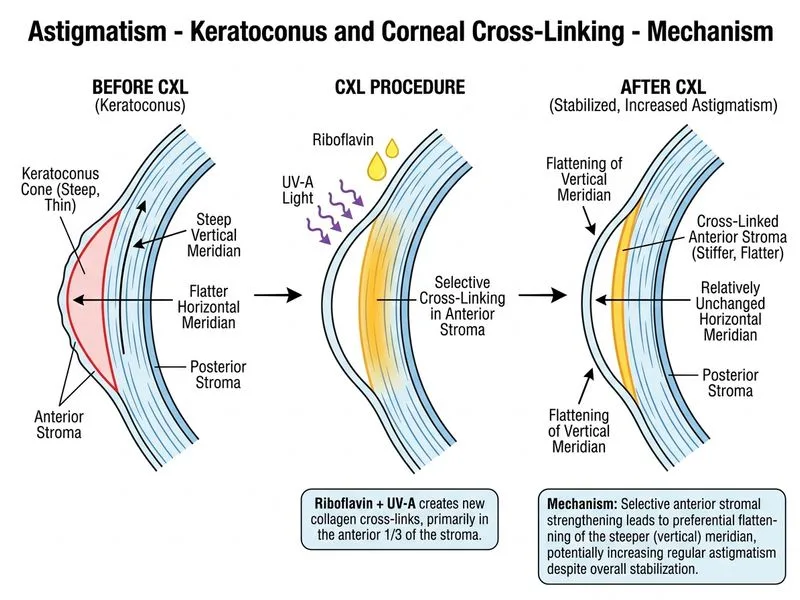
Sign up free to access AI-powered MCQ practice with detailed explanations and adaptive learning.