
## Induced Astigmatism Post-LASIK: Decentration Induced astigmatism after refractive surgery is a known complication that can result from several mechanisms. In this case, the appearance of new astigmatism (perpendicular to the original axis) months after surgery points to a specific cause. ### Decentered Ablation: - **Key Point:** When the laser ablation zone is not centered on the visual axis (decentration), it creates asymmetric corneal flattening. - Decentration typically induces astigmatism in the axis perpendicular to the direction of decentration. - The patient had cylinder axis at 180° (horizontal); induced astigmatism at 90° (vertical) suggests decentration in the superior-inferior direction. - This is a **mechanical complication** that occurs during the ablation phase, not a biological response. ### Why This Timing? - The induced astigmatism appears at 6 months, which is consistent with the stabilization of corneal remodeling post-LASIK. - Decentration effects become apparent as the cornea stabilizes and the refractive error becomes measurable. ### Clinical Pearl: **Decentration >0.5 mm is associated with clinically significant induced astigmatism.** Modern wavefront-guided LASIK reduces this risk by tracking eye movements and centering on the visual axis rather than the pupil center. 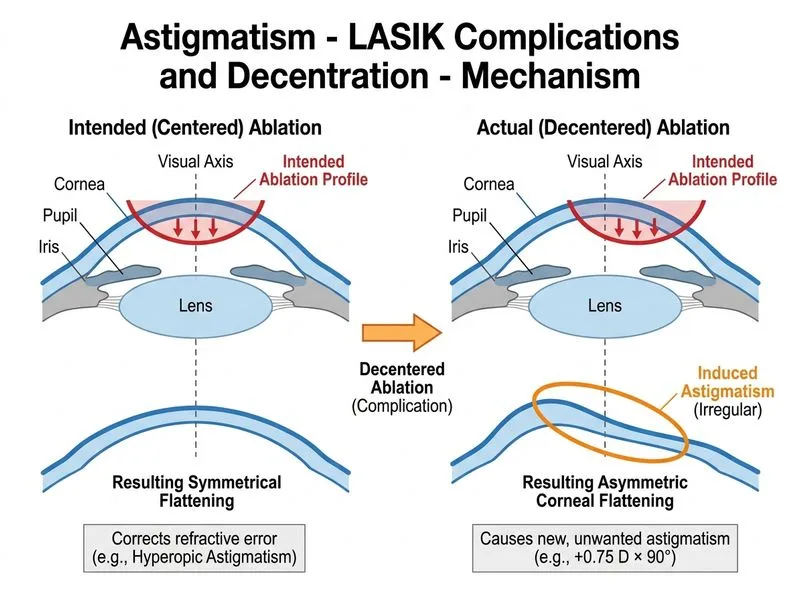
Sign up free to access AI-powered MCQ practice with detailed explanations and adaptive learning.