
## Astigmatism in Children: Head Tilt and Compensatory Mechanisms Children with significant astigmatism, particularly oblique astigmatism, often develop compensatory head postures to optimize visual clarity. ### Oblique Astigmatism: - **Key Point:** Oblique astigmatism (cylinder axis between 30° and 150°, or between 210° and 330°) is less common than with-the-rule or against-the-rule astigmatism. - In this case, the cylinder axis is at 45°, which is oblique. ### Head Tilt Mechanism: - **Clinical Pearl:** Children instinctively tilt their heads to align the meridian of least blur with the visual field meridians. - The visual field has natural meridians of better acuity (horizontal and vertical). - By tilting the head, the child rotates the cylinder axis relative to these meridians, effectively reducing the perceived blur. - This is a **natural compensatory mechanism** that improves visual clarity without requiring conscious effort. ### Why Cycloplegia Doesn't Change This: - Cycloplegic refraction paralyzes accommodation but does not change the refractive error itself. - The astigmatism persists, so the compensatory head tilt persists. - This confirms that the head tilt is a response to refractive error, not accommodative lag. ### Clinical Significance: - **High-Yield:** Unexplained head tilt in a child should prompt refraction to rule out astigmatism. - Early correction of astigmatism can eliminate the need for compensatory head postures and prevent postural problems. 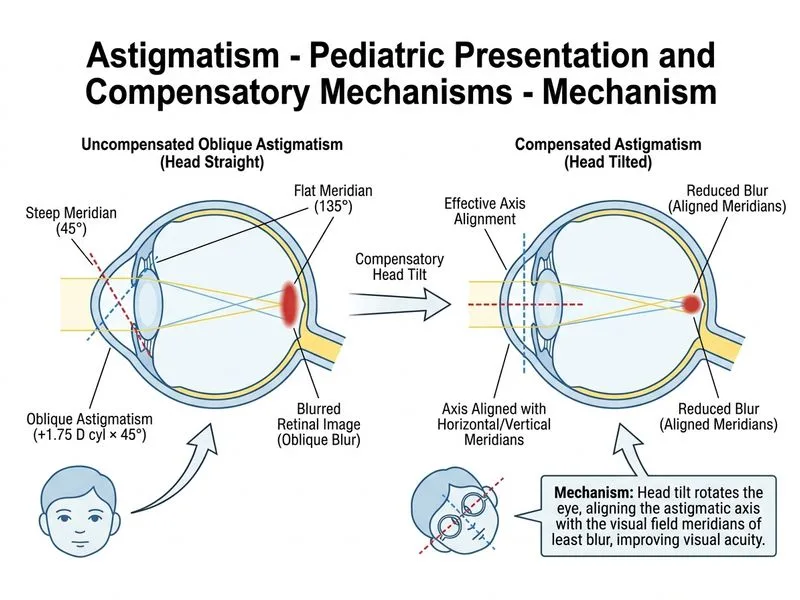
Sign up free to access AI-powered MCQ practice with detailed explanations and adaptive learning.