
NEETPGAI
FeaturesBlogComparePricing
Log inStart Free
NEETPGAI

AI-powered NEET PG preparation platform. Master all 19 subjects with adaptive MCQs, AI tutoring, and spaced repetition.

Product

  • Features
  • Subjects
  • Previous Year Questions
  • Compare
  • Pricing
  • Blog

Features

  • Adaptive MCQ Practice
  • AI Tutor
  • Mock Tests
  • Spaced Repetition

Resources

  • Blog
  • Study Guides
  • NEET PG Updates
  • Contact & support

Legal

  • Privacy Policy
  • Terms of Service

Stay updated

© 2026 NEETPGAI. All rights reserved.
    Subjects/Anatomy/Axillary Nerve and Quadrangular Space
    Axillary Nerve and Quadrangular Space
    hard
    bone Anatomy

    During a difficult shoulder dislocation reduction, a 35-year-old man develops acute loss of sensation over the lateral aspect of the shoulder and upper arm, along with weakness of shoulder abduction. The axillary artery remains palpable and intact. Which anatomical relationship explains this nerve injury?

    A. The axillary nerve is a terminal branch of the posterior cord that travels with the radial nerve in the spiral groove
    B. The axillary nerve runs medial to the radial nerve and is injured during reduction maneuvers
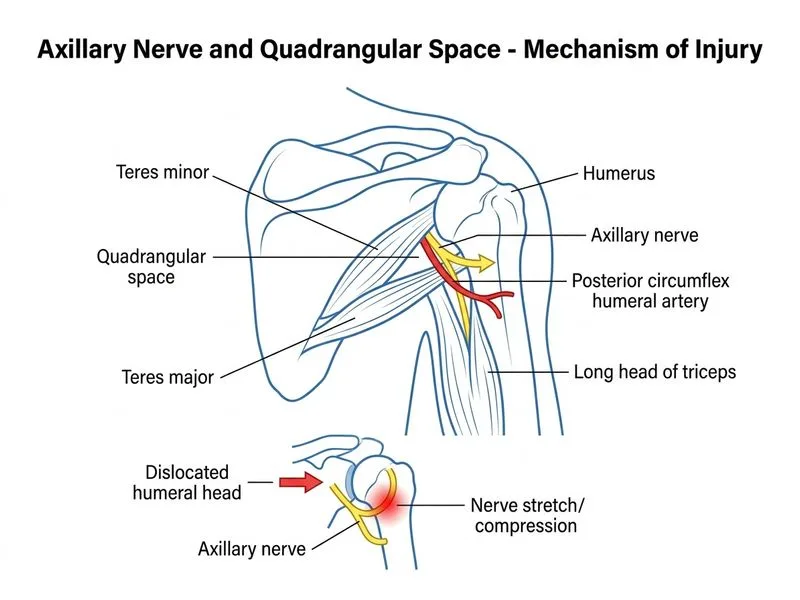
    C. The axillary nerve passes posteriorly through the quadrangular space bounded by the teres major, teres minor, long head of triceps, and humerus
    D. The axillary nerve lies anterior to the axillary artery in the axilla and is compressed by swelling

    Explanation

    ## Axillary Nerve Anatomy and Injury Mechanism **Anatomical Course of the Axillary Nerve:** - **Origin:** Terminal branch of the posterior cord (C5–C6) - **Path:** Exits the axilla posteriorly through the **quadrangular space** (also called the axillary nerve space) - **Boundaries of quadrangular space:** - **Superior:** Teres minor - **Inferior:** Teres major - **Medial:** Long head of triceps - **Lateral:** Surgical neck of humerus **Clinical Significance:** - The nerve is vulnerable during shoulder dislocation reduction because the humeral head displacement stretches the nerve as it passes through the quadrangular space - The nerve can also be injured by fractures of the surgical neck of the humerus - Posterior circumflex humeral artery accompanies the nerve but is separate from the axillary artery proper **Key Point:** The axillary nerve's posterior course through the quadrangular space makes it vulnerable to traction injuries during shoulder manipulation, while the axillary artery (which runs anterior and medial) remains intact. **Mnemonic:** "TTLH" = Teres minor (superior), Teres major (inferior), Long head of triceps (medial), Humerus (lateral) ![Axillary Nerve and Quadrangular Space diagram](https://mmcphlazjonnzmdysowq.supabase.co/storage/v1/object/public/blog-images/explanation/1974.webp)
    Practice similar questions

    Sign up free to access AI-powered MCQ practice with detailed explanations and adaptive learning.

    Start Practicing Free More Anatomy Questions