
Free practice + topic-wise study material with AI explanations.
Build conceptual clarity. Focus on Pathology, Pharmacology, and PSM.
Quick answer
Anatomy in NEET PG 2027 tests your ability to translate structural knowledge into clinical decision-making. A question will describe a 28-year-old with a traction injury and ask you to localise the lesion to the upper trunk of the brachial plexus (C5–C6), or present a 55-year-old with shoulder pain and ask which rotator cuff muscle — supraspinatus, in over 90% of full-thickness tears — is most commonly involved. The subject spans 76 topics across 10 body systems, and the paper typically draws 18–22 questions from this pool.
Clinically, Anatomy intersects with Surgery (femoral triangle hernias, saphenous vein cutdown), Orthopaedics (nerve injuries in fractures — radial nerve in mid-shaft humerus fractures, axillary nerve in shoulder dislocations), Neurology (trigeminal neuralgia at the trigeminal ganglion in Meckel's cave), and ENT (facial nerve course through the parotid gland). Understanding these intersections prevents you from treating Anatomy as an isolated pre-clinical subject.
The syllabus shape is heavily upper-limb weighted: Brachial Plexus, Radial Nerve, Median Nerve, and Ulnar Nerve together account for roughly 4–5 questions per paper historically. Lower-limb topics — Femoral Triangle, Sciatic Nerve, Hip Joint, Knee Joint — contribute another 3–4 questions. Cranial nerves, particularly the Trigeminal (CN V) and Facial (CN VII), are perennial favourites and appear in both pure anatomy and clinical neurology crossover questions.
A common misconception is that BD Chaurasia alone is sufficient. It is the primary Indian reference, but its clinical correlation chapters are thin. You need to supplement with the clinical anatomy sections of Bailey and Love's Short Practice of Surgery (27th edition) for surgical anatomy, and Snell's Clinical Anatomy by Regions for nerve lesion tables. Another misconception is spending equal time on all 76 topics — the bottom 40 topics contribute fewer than 3 questions combined across recent papers, so proportional allocation is non-negotiable.
200 textbook-style one-liners auto-extracted from approved Anatomy MCQ explanations. Drop your email and we'll send the PDF — no spam, you can reply to unsubscribe.
These 12 topics historically carry a disproportionate share of Anatomy questions on NEET PG. Tap any to start practising — the Anatomy filter is pre-selected for you.
Upper Limb
Brachial Plexus
Start practising
Upper Limb
Radial Nerve — Course and Lesions
Start practising
Upper Limb
Median Nerve — Course and Lesions
Start practising
Upper Limb
Ulnar Nerve — Course and Lesions
Start practising
Upper Limb
Rotator Cuff and Shoulder Joint
Start practising
Lower Limb
Femoral Triangle
Start practising
Lower Limb
Sciatic Nerve and its Branches
Start practising
Lower Limb
Hip Joint
Start practising
Lower Limb
Knee Joint
Start practising
Head and Neck
Cranial Nerves — Overview
Start practising
Head and Neck
Trigeminal Nerve
Start practising
Head and Neck
Facial Nerve
Start practising
Five repeatable tactics that NEET PG toppers consistently use for Anatomy. Below: a deeper play-by-play.
Build a strong foundation
Read each high-yield topic from one standard textbook before opening any question bank.
Practice in tight loops
After every chapter, attempt 20–30 topic-tagged MCQs while the concepts are still fresh.
Schedule spaced reviews
Push wrong answers into SM-2 review queues — short, frequent, expanding intervals beat marathon revisions.
Mine the last 5 years of PYQs
Map every PYQ to its parent topic. Recurring themes are louder signal than weightage tables.
Stress-test with mock tests
A subject-wise mock every fortnight surfaces blind spots before the real exam does.
Time budget
Primary textbook
Supplementary references
Daily and weekly rhythm
Mistakes to avoid
Revision rhythm
Put this into a 30-minute session today
We'll pre-select Anatomy and serve a mixed difficulty set.
A 52-year-old man from Mumbai presents with acute-onset diplopia and vertigo. On neurological examination, he has ipsilateral abducens nerve (CN VI) palsy, ipsilateral facial nerve (CN VII) palsy, and contralateral hemiparesis affecting the arm and leg. Sensation is intact. MRI shows an acute infarct in the ventral mid-pons. Which of the following best explains the ipsilateral CN VI and CN VII palsies in this patient?
See the options, answer & explanation
The full question — answer choices, correct answer, and AI explanation — is free the moment you sign in.
9 in-depth Anatomy guides curated for NEET PG aspirants.
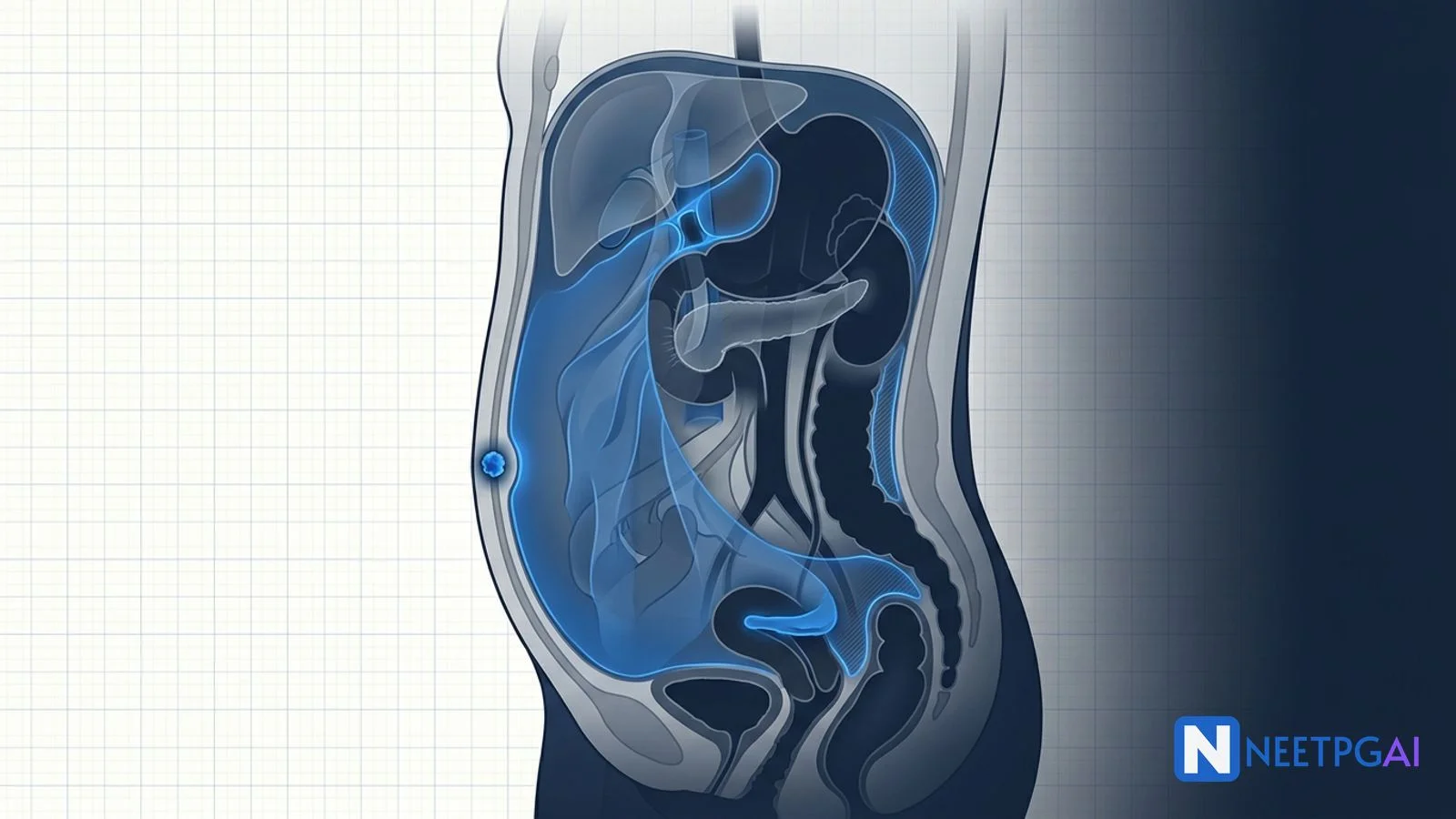
Master peritoneum, epiploic foramen, mesenteries, omenta, SAD PUCKER retroperitoneal organs, and ascites SAAG for NEET PG 2027 Anatomy MCQs with India context.
Read more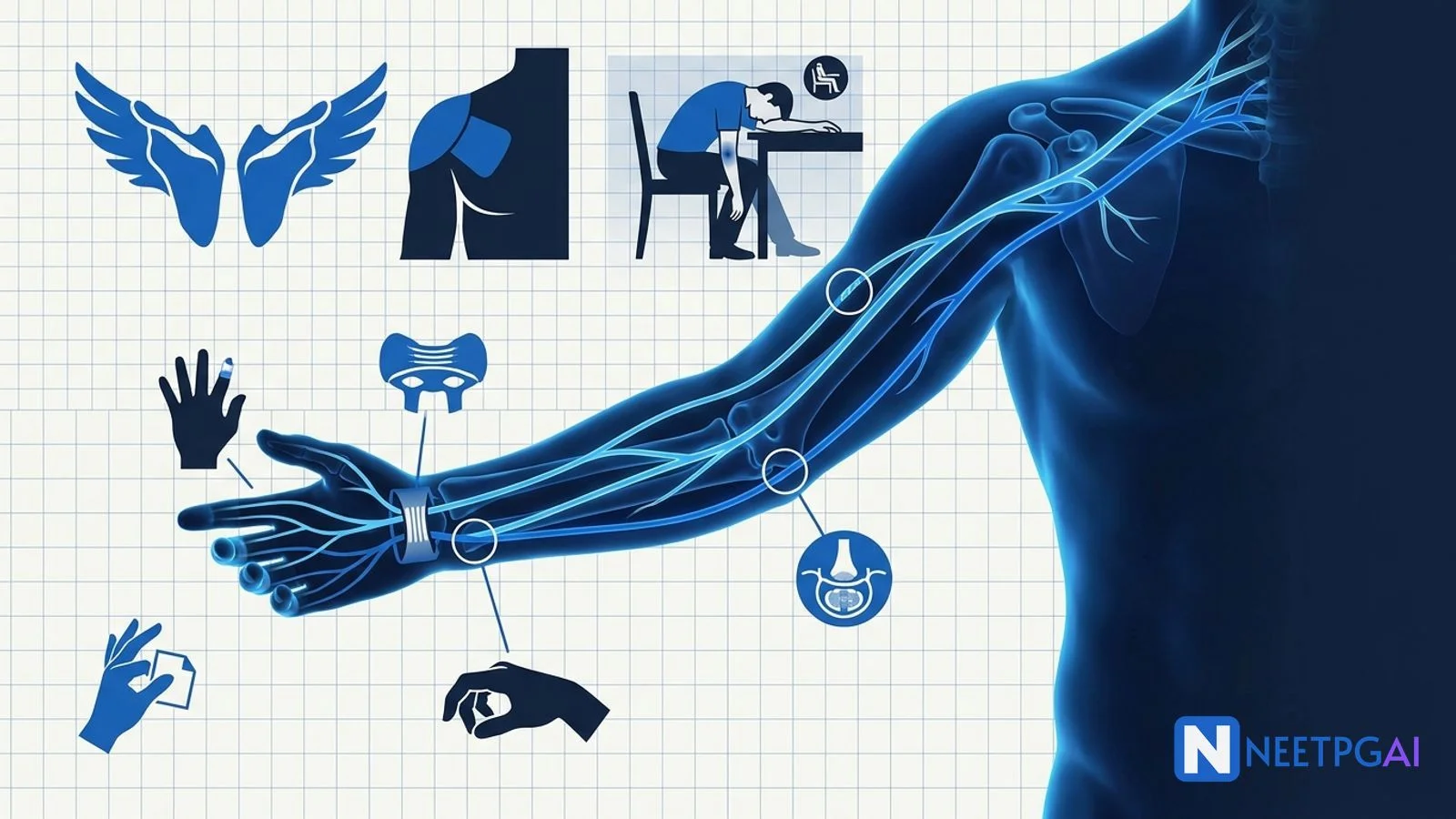
Master median, ulnar, radial, axillary, and long thoracic nerve palsies with signs, deformities, and India-specific injury patterns for NEET PG 2027 Anatomy MCQs.
Read more
Master 6 pharyngeal arches, pouch derivatives, DiGeorge, thyroglossal duct cyst, and cleft lip-palate embryology for NEET PG 2027 Anatomy MCQs with India context.
Read moreTrained on standard textbooks (Harrison's, Robbins, KD Tripathi, BD Chaurasia, Bailey & Love). Drop your email for a one-tap link to your free account — the full 28,000+ MCQ bank, real previous-year questions, mock tests, revision and analytics, at no cost. The AI Tutor is part of Pro.
AI-first preparation built specifically for the NEET PG question pattern.
Every Anatomy MCQ comes with a detailed Claude-authored explanation citing standard references (Harrison's, Bailey & Love, Robbins, Park's etc.) — never a one-line answer key.
Wrong answers auto-schedule for review at expanding intervals (1d → 3d → 7d → 21d). Most aspirants need only half the practice volume to retain the same recall.
Every Anatomy question is generated against the NMC syllabus and validated against the last 5 years of NEET PG / INI-CET previous year questions.
Stuck on a tricky topic? Ask the AI Tutor anytime — it answers in seconds with diagrams, mnemonics, and clinical pearls tailored to NEET PG.
Ready to test yourself?
Test your Anatomy knowledge with AI-powered MCQs and detailed explanations — no signup required to try.
Common questions from NEET PG aspirants preparing Anatomy.
Sign up free and practice all 1443+ MCQs with AI-powered explanations tailored to your performance.
Create Free Account