
## HER2 as a Proto-Oncogene in Breast Cancer **Key Point:** HER2 (human epidermal growth factor receptor 2, also called ERBB2) is a proto-oncogene that drives breast cancer through a gain-of-function mechanism. Gene amplification increases protein expression, leading to excessive growth signaling. ### HER2 Gene Amplification: Mechanism 1. **Gene Amplification Process** - HER2 gene is amplified (multiple extra copies) in ~15–20% of breast cancers - Amplification occurs via unequal crossing over or extrachromosomal DNA (double minutes) - Results in 10–100× increase in HER2 gene copy number 2. **Protein Overexpression** - Increased gene copies → increased mRNA → increased HER2 receptor protein - Receptor accumulates on cell membrane - Even without ligand, receptors can dimerize and autophosphorylate 3. **Constitutive Signaling Activation** - HER2 homodimers or heterodimers (with HER1, HER3, HER4) form - Autophosphorylation of intracellular tyrosine kinase domain - Activation of downstream pathways: PI3K/AKT (survival), MAPK/ERK (proliferation) - Continuous growth signals independent of external ligand ### Distinction: Oncogene Gain-of-Function **High-Yield:** HER2 amplification is a classic example of an oncogene acting dominantly. Only ONE amplified allele is needed to drive transformation (contrast with tumor suppressors, which require BOTH alleles to be lost). ### Clinical Significance **Mnemonic:** HER2+ breast cancer = **HERCEPTIN-responsive** (trastuzumab, a monoclonal antibody against HER2) - HER2+ tumors are more aggressive (higher grade, faster growth) - Associated with worse prognosis if untreated - Trastuzumab (Herceptin) blocks HER2 signaling, improving survival - Pertuzumab (Perjeta) blocks HER2–HER3 heterodimerization - Tyrosine kinase inhibitors (lapatinib, neratinib) inhibit intracellular signaling ### Comparison: HER2 vs. Other Breast Cancer Drivers | Feature | HER2 | ER/PR | TP53 | BRCA1/2 | |---------|------|-------|------|----------| | **Gene type** | Proto-oncogene | Tumor suppressor | Tumor suppressor | Tumor suppressor | | **Alteration** | Amplification (gain) | Overexpression (ligand-driven) | Mutation (loss) | Mutation (loss) | | **Mechanism** | Constitutive signaling | Hormone-dependent signaling | Loss of checkpoint | Loss of DNA repair | | **Frequency in BC** | 15–20% | 60–70% | 20–30% | 5–10% | | **Targeted therapy** | Trastuzumab, pertuzumab | Tamoxifen, aromatase inhibitors | None (p53 restoration in trials) | PARP inhibitors | **Clinical Pearl:** HER2 status (by IHC and/or FISH) is mandatory in all invasive breast cancers to guide treatment selection. HER2+ disease is now considered a distinct molecular subtype with specific therapeutic options. ### Pathologic Findings in HER2+ Breast Cancer - Often **invasive ductal carcinoma** (as in this case) - High nuclear grade (Nottingham grade 2–3) - High mitotic rate - May have associated in situ carcinoma - Lymph node involvement more common at diagnosis 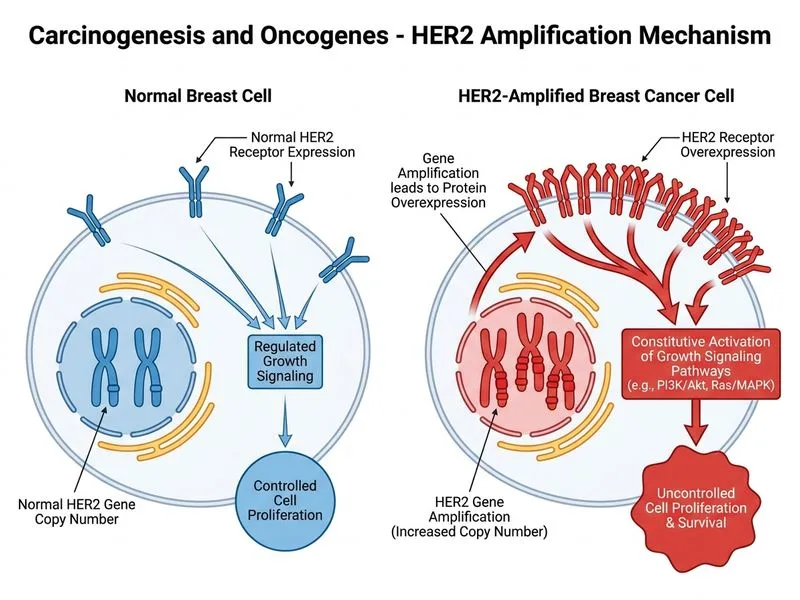
Sign up free to access AI-powered MCQ practice with detailed explanations and adaptive learning.