NEETPGAI
BlogComparePricing
Log inStart Free
NEETPGAI

AI-powered NEET PG preparation platform. Master all 19 subjects with adaptive MCQs, AI tutoring, and spaced repetition.

Product

  • Subjects
  • Previous Year Questions
  • Compare
  • Pricing
  • Blog

Features

  • Adaptive MCQ Practice
  • AI Tutor
  • Mock Tests
  • Spaced Repetition

Resources

  • Blog
  • Study Guides
  • NEET PG Updates
  • Help Center

Legal

  • Privacy Policy
  • Terms of Service

Stay updated

© 2026 NEETPGAI. All rights reserved.
    Practice 2,677+ Pathology MCQs
    Free signup · 10 MCQs/day · AI explanations
    Start Free
    SubjectsPathology
    Para-clinical
    AI-powered

    Pathology for NEET PG 2026

    Free practice + topic-wise study material with AI explanations.

    107 daysto NEET PG 2026
    Exam date: 30 Aug 2026
    Your prep stageIntegration Phase
    Foundation
    180+ days
    Deep Study
    90-180 days
    Revision
    30-90 days
    Final Sprint
    <30 days

    Start full-length mocks. Identify and fix weak areas.

    1. 1Prioritise the 71 high-yield topics — they account for ~70% of Pathology questions every year.
    2. 2Practice 2,677+ topic-tagged MCQs with detailed AI explanations to build pattern recognition.
    3. 3Use SM-2 spaced repetition — wrong answers auto-schedule for review at expanding intervals.
    4. 4Revise PYQs from the last 5 years to spot recurring themes and adjust your priorities.
    5. 5Take subject-wise mock tests every 2 weeks to benchmark recall under exam conditions.
    Start Free PracticeGenerate AI Study Plan

    Pathology at a glance

    Live from MCQ bank
    2,677practice MCQs
    Updated daily as new questions are SME-approved.
    71
    HY
    high-yield topics
    ~70% of NEET PG Pathology marks come from these.
    105total topics
    Across 14 canonical systems.
    100% free to start. No credit card. 10 MCQs/day on the free tier.
    About Pathology in NEET PG

    What you need to know about Pathology

    Quick answer

    Pathology is the morphological and mechanistic backbone of clinical medicine — it explains *why* disease happens, not just *what* it looks like. At 25% weightage (range 22–28%), it is the single highest-scoring subject in NEET PG 2026, and the exam tests your ability to map histological findings to diagnoses, link molecular events (oncogenes, tumor suppressor genes) to clinical syndromes, and interpret lab indices for anemias. You will face image-based slides (Masson's trichrome, PAS, Prussian blue), photomicrograph pattern recognition, and multi-step clinical vignettes that require you to integrate morphology with pathophysiology — not just recall definitions. Prioritise the 12 high-yield topics, especially Carcinogenesis/Oncogenes, Tumor Markers, and the Anemias cluster, which together account for a disproportionate share of recalled questions. Allocate at least 6–8 weeks of your preparation calendar to Pathology alone. Spaced-repetition tools like NEETPGAI — with 1,768 approved Pathology questions — compress the revision cycle to 7–10 days.

    Pathology in NEET PG 2026 — What the Subject Actually Tests

    Pathology at the NEET PG level is not a histology memorisation exercise. The exam expects you to reason from a clinical vignette or a described slide to a diagnosis, then extend that diagnosis to its molecular basis, complications, or associated markers. A question may describe pseudopalisading necrosis with microvascular proliferation and ask you to grade the tumour (WHO Grade 4 Glioblastoma), or it may show a Masson's trichrome-stained liver section and ask you to distinguish bridging fibrosis from cirrhosis. That two-step reasoning — morphology to diagnosis to implication — is the core skill being tested across all 105 syllabus topics.

    The subject intersects directly with clinical practice in ways that matter during your MBBS internship and beyond. Understanding the Reed-Sternberg cell is not academic trivia; it determines how you interpret a lymph node biopsy report and counsel a patient about Hodgkin lymphoma staging. Similarly, knowing the peripheral smear findings in Iron Deficiency Anemia (microcytic hypochromic cells, pencil cells, target cells) versus Megaloblastic Anemia (hypersegmented neutrophils, macro-ovalocytes) is a skill you use on ward rounds. NEET PG 2026 rewards this clinical anchoring heavily.

    The syllabus spans 14 body systems and 105 topics, but the distribution is uneven. General Pathology — covering Carcinogenesis, Oncogenes, Tumor Suppressor Genes (RB1, TP53, APC, BRCA1/2), Grading and Staging, Paraneoplastic Syndromes, and Tumor Markers (AFP, CEA, CA-125, PSA, Beta-hCG) — contributes roughly 30–35% of Pathology questions. Hematopathology, particularly the Anemias cluster and Acute Leukemias, contributes another 20–25%. Systemic Pathology (GI, renal, hepatic, pulmonary, CNS) fills the remainder. The 12 high-yield topics listed for NEET PG 2026 are not arbitrary — they map directly to the highest-frequency question clusters in recalled papers from 2019–2024.

    A common misconception is that Pathology can be prepared by reading Robbins cover-to-cover in sequence. Most aspirants who do this run out of time before reaching Hematopathology and Neuropathology — the very chapters that carry heavy exam weight. Another misconception is that image-based questions require a separate "atlas" preparation; in reality, 80% of image questions test a handful of recurring patterns (caseating vs. non-caseating granulomas, patterns of necrosis, specific staining reactions) that appear repeatedly in Robbins itself and in PYQ banks. Treating image questions as a separate category wastes time you do not have.

    Free PDF · NEET PG 2026

    Pathology High-Yield One-Liners

    200 textbook-style one-liners auto-extracted from approved Pathology MCQ explanations. Drop your email and we'll send the PDF — no spam, you can reply to unsubscribe.

    Highest-yield topics

    Pathology — focus areas that win the most marks

    These 12 topics historically carry a disproportionate share of Pathology questions on NEET PG. Tap any to start practising — the Pathology filter is pre-selected for you.

    Neoplasia

    Tumor Markers

    Start practising

    Neoplasia

    Grading and Staging

    Start practising

    Neoplasia

    Paraneoplastic Syndromes

    Start practising

    Neoplasia

    Carcinogenesis and Oncogenes

    Start practising

    Neoplasia

    Tumor Suppressor Genes

    Start practising

    Hematopathology

    Anemias Overview

    Start practising

    Hematopathology

    Iron Deficiency Anemia

    Start practising

    Hematopathology

    Megaloblastic Anemia

    Start practising

    Hematopathology

    Hemolytic Anemias

    Start practising

    Hematopathology

    Sickle Cell Disease

    Start practising

    Hematopathology

    Thalassemias

    Start practising

    Hematopathology

    Acute Leukemias

    Start practising

    Preparation strategy

    How to prepare Pathology — tactics that work

    Five repeatable tactics that NEET PG toppers consistently use for Pathology. Below: a deeper play-by-play.

    Build a strong foundation

    Read each high-yield topic from one standard textbook before opening any question bank.

    Practice in tight loops

    After every chapter, attempt 20–30 topic-tagged MCQs while the concepts are still fresh.

    Schedule spaced reviews

    Push wrong answers into SM-2 review queues — short, frequent, expanding intervals beat marathon revisions.

    Mine the last 5 years of PYQs

    Map every PYQ to its parent topic. Recurring themes are louder signal than weightage tables.

    Stress-test with mock tests

    A subject-wise mock every fortnight surfaces blind spots before the real exam does.

    Preparation Strategy for Pathology — NEET PG 2026

    Time Budget

    • Total allocation: 6–8 weeks for first read; 2 dedicated revision cycles of 5–7 days each before the exam.
    • Daily target: 3–4 hours on Pathology during the primary preparation phase; 1.5–2 hours during integrated revision.
    • Weekly PYQ target: Solve at least 80–100 Pathology questions per week from the NEETPGAI bank (1,768 questions available); review every explanation, not just wrong answers.

    Primary Textbook

    • Robbins & Cotran Pathologic Basis of Disease, 10th Edition (Indian reprint) — this is non-negotiable. Read Chapter 7 (Neoplasia) first, not last. It covers Carcinogenesis, Oncogenes (RAS, MYC, HER2), Tumor Suppressor Genes (TP53, RB1), Tumor Markers, Grading/Staging, and Paraneoplastic Syndromes — your single densest high-yield cluster.
    • Supplementary: Harsh Mohan's Textbook of Pathology, 8th Edition — use it for quick tabular summaries, especially for Anemias (Chapter 12) and Leukemias (Chapter 13). It is faster to revise than Robbins and aligns well with the Indian exam pattern.

    Put this into a 30-minute session today

    We'll pre-select Pathology and serve a mixed difficulty set.

    Try a 10-MCQ set
    Syllabus map
    Pathology — full topic list
    105 topics across 14 systems · 71 marked high-yield
    • Tumor Markers
      High-yield
    • Grading and Staging
      High-yield
    • Paraneoplastic Syndromes
      High-yield
    • Carcinogenesis and Oncogenes
      High-yield
    • Tumor Suppressor Genes
      High-yield
    • Metastasis Mechanisms
      Moderate
    • Benign vs Malignant Tumors
      Moderate
    • Cancer Epidemiology
      Low-yield
    • Cell Cycle, Checkpoints, and Cyclins
      Moderate
    • Anemias Overview
      High-yield
    • Iron Deficiency Anemia
      High-yield
    • Megaloblastic Anemia
      High-yield
    • Hemolytic Anemias
      High-yield
    • Sickle Cell Disease
      High-yield
    • Thalassemias
      High-yield
    • Acute Leukemias
      High-yield
    • Chronic Leukemias
      High-yield
    • Lymphomas — Hodgkin
      High-yield
    • Lymphomas — Non-Hodgkin
      High-yield
    • Multiple Myeloma
      High-yield
    • Coagulation Disorders
      High-yield
    • DIC
      High-yield
    • Platelet Disorders
      Moderate
    • Aplastic Anemia
      Moderate
    • Peripheral Blood Smear Findings
      High-yield
    • Hereditary Hemolytic Anemias — Membrane Defects
      Moderate
    • Burkitt Lymphoma and High-Grade B-Cell Lymphomas
      Moderate
    • Hypersensitivity Reactions
      High-yield
    • SLE and Autoimmune Disorders
      High-yield
    • Rheumatoid Arthritis Pathology
      High-yield
    • Amyloidosis
      High-yield
    • Transplant Rejection
      Moderate
    • Primary Immunodeficiencies
      Moderate
    • HIV Pathology
      Moderate
    • Reversible vs Irreversible Injury
      High-yield
    • Apoptosis vs Necrosis
      High-yield
    • Free Radical Injury
      Moderate
    • Cellular Adaptations — Hyperplasia, Hypertrophy
      High-yield
    • Metaplasia and Dysplasia
      High-yield
    • Intracellular Accumulations
      Low-yield
    • Apoptosis — Intrinsic and Extrinsic Pathways
      High-yield
    • Acute Inflammation
      High-yield
    • Chronic Inflammation
      High-yield
    • Granulomatous Inflammation
      High-yield
    • Wound Healing
      High-yield
    • Chemical Mediators
      Moderate
    • Atherosclerosis
      High-yield
    • Myocardial Infarction Pathology
      High-yield
    • Valvular Heart Disease
      High-yield
    • Rheumatic Heart Disease
      High-yield
    • Cardiomyopathies
      Moderate
    • Vasculitis Syndromes
      High-yield
    • Aortic Aneurysms
      Moderate
    • Peptic Ulcer Disease
      High-yield
    • Gastric Carcinoma
      High-yield
    • Inflammatory Bowel Disease
      High-yield
    • Colorectal Carcinoma
      High-yield
    • Esophageal Pathology
      Moderate
    • Polyps — Adenomatous vs Hyperplastic
      Moderate
    • Crohn Disease and Ulcerative Colitis — Comparative Pathology
      High-yield
    • Hepatitis — Viral
      High-yield
    • Alcoholic Liver Disease
      High-yield
    • Cirrhosis
      High-yield
    • Hepatocellular Carcinoma
      High-yield
    • Wilson Disease
      Moderate
    • Hemochromatosis
      Moderate
    • Glomerulonephritis — Nephritic
      High-yield
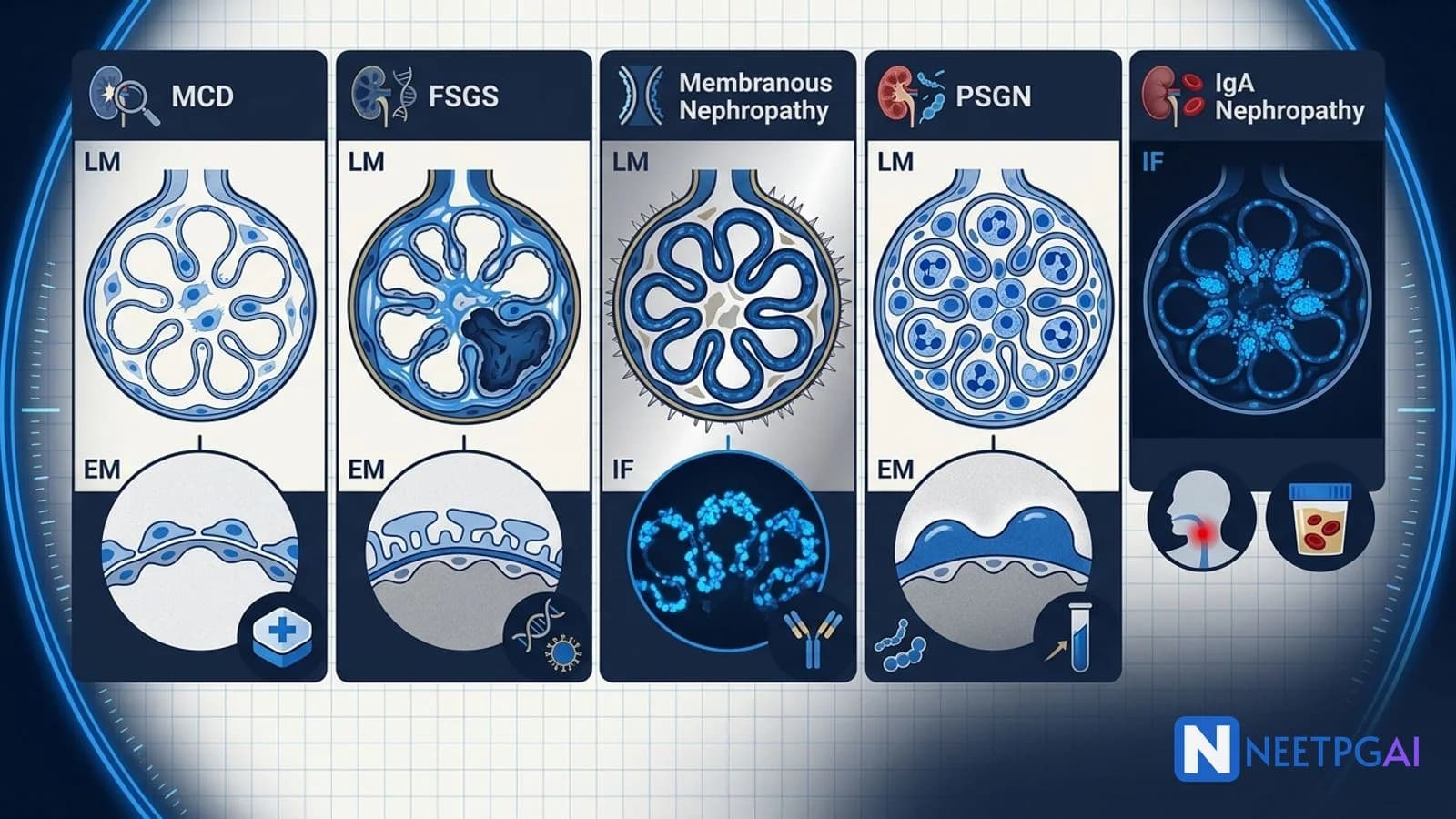
    • Glomerulonephritis — Nephrotic
      High-yield
    • Acute Tubular Necrosis
      High-yield
    • Renal Cell Carcinoma
      High-yield
    • Wilms Tumor
      Moderate
    • Pyelonephritis
      Moderate
    • COPD Pathology
      High-yield
    • Asthma Pathology
      Moderate
    • Pneumonia — Lobar vs Bronchopneumonia
      High-yield
    • Tuberculosis Pathology
      High-yield
    • Lung Cancer — Small Cell
      High-yield
    • Lung Cancer — Non-Small Cell
      High-yield
    • Pulmonary Embolism
      High-yield
    • Interstitial Lung Disease
      Moderate
    • COPD — Emphysema and Chronic Bronchitis
      High-yield
    • Thyroid Neoplasms
      High-yield
    • Thyroiditis
      High-yield
    • Diabetes Mellitus Pathology
      High-yield
    • Pituitary Tumors
      Moderate
    • MEN Syndromes
      High-yield
    • Adrenal Disorders
      Moderate
    • Cervical Carcinoma and HPV
      High-yield
    • Endometrial Carcinoma
      High-yield
    • Ovarian Tumors — Germ Cell
      High-yield
    • Ovarian Tumors — Epithelial
      High-yield
    • Breast Carcinoma
      High-yield
    • Fibroadenoma vs Phyllodes
      Moderate
    • CNS Tumors — Gliomas
      High-yield
    • Meningiomas
      Moderate
    • Neurodegenerative Diseases
      Moderate
    • Bone Tumors — Osteosarcoma
      High-yield
    • Bone Tumors — Ewing
      Moderate
    • Soft Tissue Sarcomas
      Low-yield
    • Skin Pathology — Inflammatory and Neoplastic
      Moderate
    • Thrombosis and Embolism
      High-yield
    • Shock — Types and Mechanisms
      High-yield
    • Edema Mechanisms
      Moderate
    • Calcification — Dystrophic vs Metastatic
      Moderate
    • Prostate Pathology
      High-yield
    Today's NEET PG Pathology MCQ

    Test yourself in 60 seconds

    New question every day
    Apoptosis vs Necrosis
    medium

    A 45-year-old woman with a history of chronic liver disease undergoes liver biopsy for assessment of hepatic necroinflammation. Histology shows scattered hepatocyte death with preserved architecture in some areas and complete tissue disorganization in others. Which investigation would best differentiate between apoptotic hepatocyte loss and coagulative necrosis in the same specimen?

    Tap an option to reveal the answer and AI explanation. New question rotates daily at midnight IST.

    Study guides

    Pathology study guides

    6 in-depth Pathology guides curated for NEET PG aspirants.
    1 / 2
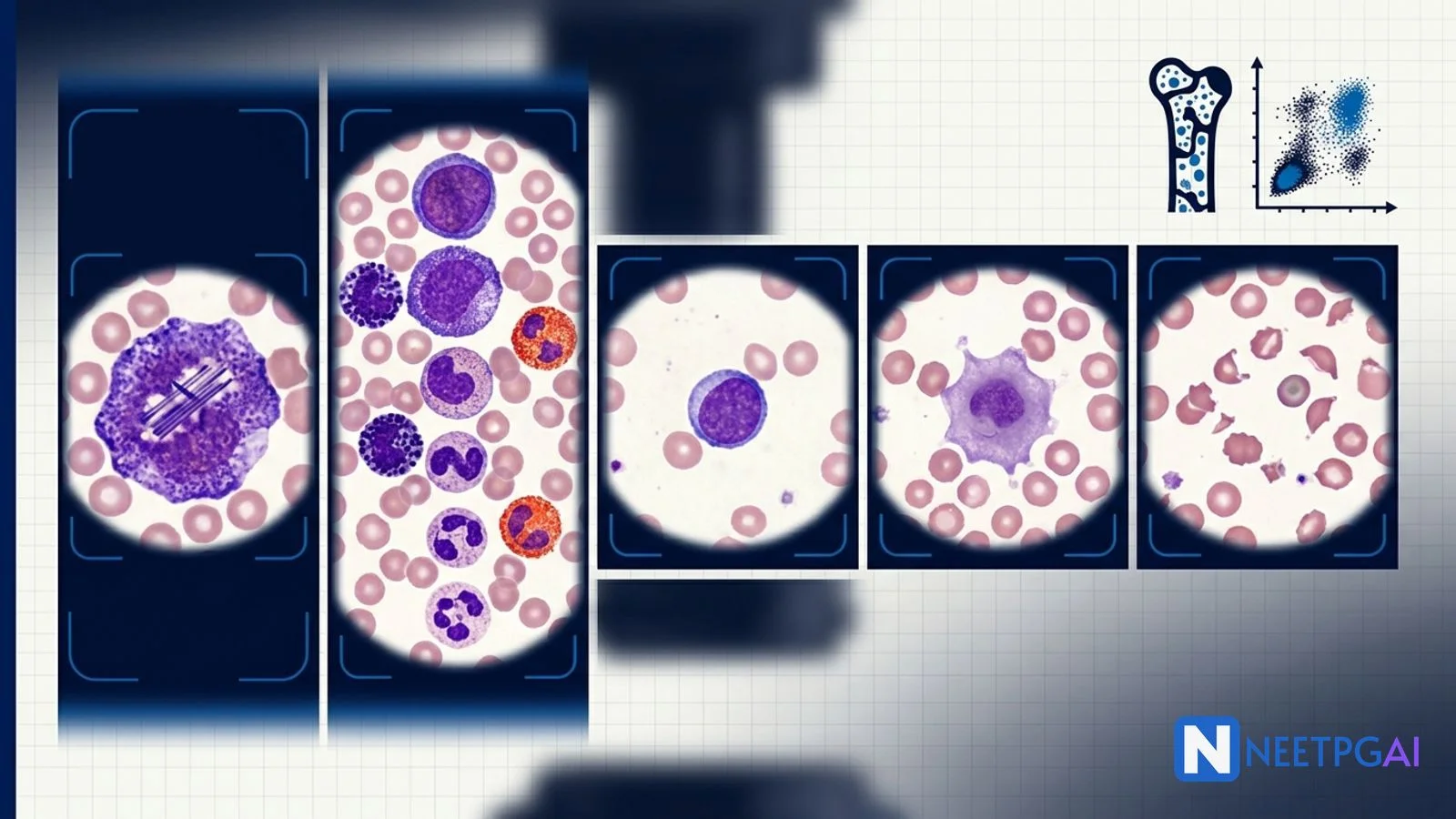
    Image MCQ: Peripheral Blood Smear for NEET PG (AML M3 Auer Rods, CML, ALL, ITP, HUS/TTP)
    5 May 2026
    image mcq
    pathology

    Image MCQ: Peripheral Blood Smear for NEET PG (AML M3 Auer Rods, CML, ALL, ITP, HUS/TTP)

    5 high-yield peripheral blood smear image MCQs for NEET PG: AML M3 (APL) Auer rods + faggot cells, CML granulocyte spectrum, ALL lymphoblasts, ITP megathrombocytes, HUS/TTP schistocytes.

    Read more
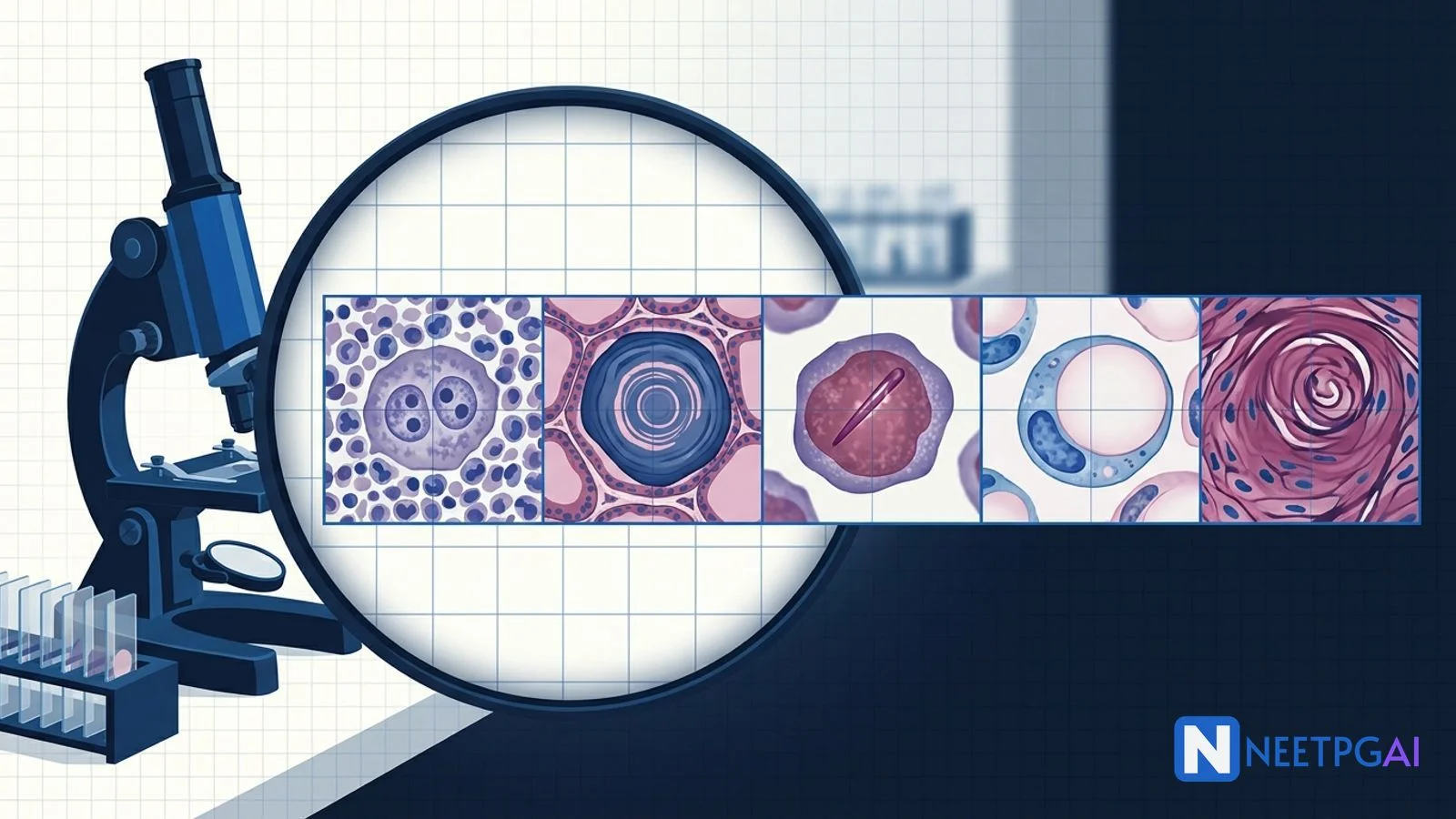
    Image MCQ: Histopathology Hallmarks of Tumors for NEET PG (Reed-Sternberg, Psammoma, Auer Rods, Signet Ring, Keratin Pearls)
    27 Apr 2026
    image mcq
    pathology

    Image MCQ: Histopathology Hallmarks of Tumors for NEET PG (Reed-Sternberg, Psammoma, Auer Rods, Signet Ring, Keratin Pearls)

    5 high-yield histopathology image MCQs for NEET PG: Reed-Sternberg cells, psammoma bodies, Auer rods, signet ring cells, keratin pearls. Image clues, options, answers, teaching pearls.

    Read more
    NEET PG Pathology High-Yield Topics — Complete Guide 2026
    8 Apr 2026
    pathology
    neet pg

    NEET PG Pathology High-Yield Topics — Complete Guide 2026

    Master every high-yield pathology topic for NEET PG 2026: cell injury, inflammation, neoplasia, hematopathology, immunopathology, genetic disorders, and systemic pathology with tumor markers, staining patterns, and diagnostic criteria.

    Read more
    pathology
    Free AI tutor trial · No card required

    Stuck on a Pathology concept? Ask the AI tutor.

    Trained on standard textbooks (Harrison's, Robbins, KD Tripathi, BD Chaurasia, Bailey & Love). Drop your email — we'll send a one-tap link to start asking questions. 3 free messages per day, ongoing.

    • Cite-anchored answers (chapter + page when applicable)
    • Mermaid diagrams and clinical pearls inline
    • NEET PG-tuned, never generic ChatGPT

    Why aspirants choose NEETPGAI for Pathology

    AI-first preparation built specifically for the NEET PG question pattern.

    Textbook-quality AI explanations

    Every Pathology MCQ comes with a detailed Claude-authored explanation citing standard references (Harrison's, Bailey & Love, Robbins, Park's etc.) — never a one-line answer key.

    SM-2 spaced repetition

    Wrong answers auto-schedule for review at expanding intervals (1d → 3d → 7d → 21d). Most aspirants need only half the practice volume to retain the same recall.

    PYQ-aligned question patterns

    Every Pathology question is generated against the NMC syllabus and validated against the last 5 years of NEET PG / INI-CET previous year questions.

    24/7 AI Tutor for Pathology doubts

    Stuck on a tricky topic? Ask the AI Tutor anytime — it answers in seconds with diagrams, mnemonics, and clinical pearls tailored to NEET PG.

    Ready to test yourself?

    Test your Pathology knowledge with AI-powered MCQs and detailed explanations — no signup required to try.

    Practice Pathology MCQs

    Pathology preparation FAQs

    Common questions from NEET PG aspirants preparing Pathology.

    Sources & references
    1. NEETPGAI PYQ Database — Pathology module (N = 1,768 approved questions)
    2. NMC NEET PG Syllabus 2026 — Pathology section (14 systems, 105 topics)
    3. Robbins & Cotran Pathologic Basis of Disease, 10th Edition — Kumar, Abbas, Aster (Elsevier India reprint)
    4. Harsh Mohan — Textbook of Pathology, 8th Edition (Jaypee Brothers, New Delhi)
    5. WHO Classification of Tumours of the Central Nervous System, 5th Edition (2021) — used for CNS tumour grading anchor
    6. ICMR National Cancer Registry Programme (NCRP) — India-specific tumour marker and incidence data referenced in Indian-edition Robbins annotations

    Ready to master Pathology?

    Sign up free and practice all 2677+ MCQs with AI-powered explanations tailored to your performance.

    Create Free Account
    Topic-Wise Tactical Notes
    • Carcinogenesis and Oncogenes / Tumor Suppressor Genes: Map each gene to its cancer (RB1 → Retinoblastoma + Osteosarcoma; TP53 → Li-Fraumeni; APC → FAP/Colorectal; BCR-ABL → CML). Draw a one-page flowchart. This single page will answer 4–6 questions in NEET PG 2026.
    • Tumor Markers: Make a two-column table — marker on the left, associated tumour(s) on the right. Include AFP (Hepatocellular carcinoma, Yolk sac tumour), CA-125 (Ovarian serous carcinoma), PSA (Prostate), CEA (Colorectal, Pancreatic), Beta-hCG (Choriocarcinoma, Testicular). Memorise exceptions (AFP elevated in ataxia-telangiectasia).
    • Anemias cluster (IDA, Megaloblastic, Hemolytic, Sickle Cell, Thalassemias): Use a master comparison table covering MCV, MCH, reticulocyte count, peripheral smear finding, serum ferritin, LDH, and specific confirmatory test (e.g., Hb electrophoresis for Sickle Cell; Schilling test for B12 deficiency). This cluster alone can yield 5–8 questions.
    • Acute Leukemias: Know the FAB classification (M0–M7 for AML; L1–L3 for ALL), Auer rods (AML-M3/APL), TdT positivity (ALL), and the t(15;17) translocation in APL that predicts ATRA response.
    • Granulomatous inflammation: Distinguish caseating (TB — Mycobacterium tuberculosis, Langhans giant cells) from non-caseating (Sarcoidosis, Crohn's disease, Berylliosis). NEET PG 2026 will test this distinction in a clinical vignette format.

    Weekly Rhythm

    • Days 1–5: Read 1–2 Robbins chapters; make margin notes or flashcards for every named entity, stain, and gene.
    • Day 6: Solve 80–100 PYQs mapped to those chapters on NEETPGAI; note every topic you got wrong.
    • Day 7: Revise only the weak areas identified on Day 6 using Harsh Mohan tables.

    Common Mistakes to Avoid

    • Skipping Neuropathology (CNS tumour grading, demyelinating diseases) — it contributes 3–5 questions and is frequently under-prepared.
    • Confusing Grading (histological differentiation, I–IV) with Staging (anatomical spread, TNM) — NEET PG 2026 will test this distinction directly.
    • Reading Pathology in isolation without linking to Pharmacology (e.g., ATRA in APL, Imatinib in CML with BCR-ABL) — integrated questions are increasing in frequency.
    • Ignoring special stains: PAS (glycogen, fungi), Prussian blue (hemosiderin/iron), Congo red (amyloid), Ziehl-Neelsen (AFB) — at least 2–3 image questions per paper hinge on stain identification.