
## Mechanisms of Oncogene Activation **Key Point:** The BCR-ABL fusion gene in chronic myeloid leukemia (CML) is the classic example of oncogene activation via chromosomal translocation. ### BCR-ABL Fusion — Philadelphia Chromosome t(9;22) 1. **Translocation event:** The ABL gene from chromosome 9 translocates to the BCR gene on chromosome 22 2. **Fusion protein:** Creates a constitutively active tyrosine kinase (BCR-ABL) 3. **Mechanism:** The BCR promoter drives continuous ABL kinase expression, independent of normal regulation 4. **Result:** Uncontrolled tyrosine kinase activity → chronic myeloid leukemia 5. **Therapeutic relevance:** Tyrosine kinase inhibitors (imatinib, dasatinib) specifically target BCR-ABL ### Four Major Mechanisms of Oncogene Activation | Mechanism | Definition | Example | | --- | --- | --- | | **Translocation** | Chromosomal rearrangement creating fusion gene or juxtaposing oncogene to strong promoter | BCR-ABL (CML), t(8;14) MYC (Burkitt lymphoma) | | **Amplification** | Increased gene copy number | HER2 amplification (breast cancer), MYC amplification (neuroblastoma) | | **Point mutation** | Single nucleotide change activating protein function | KRAS G12V (pancreatic cancer), BRAF V600E (melanoma) | | **Insertional mutagenesis** | Viral or retroviral insertion disrupting or activating gene | HPV integration (cervical cancer), HTLV-1 (T-cell leukemia) | **High-Yield:** Translocations are especially important in hematologic malignancies. The Philadelphia chromosome is found in ~95% of CML cases and is diagnostic. **Mnemonic:** **TAMP** — Translocation, Amplification, Mutation, Promoter insertion (viral) **Clinical Pearl:** Detection of BCR-ABL by PCR or FISH is standard in CML diagnosis and is used to monitor treatment response (minimal residual disease). 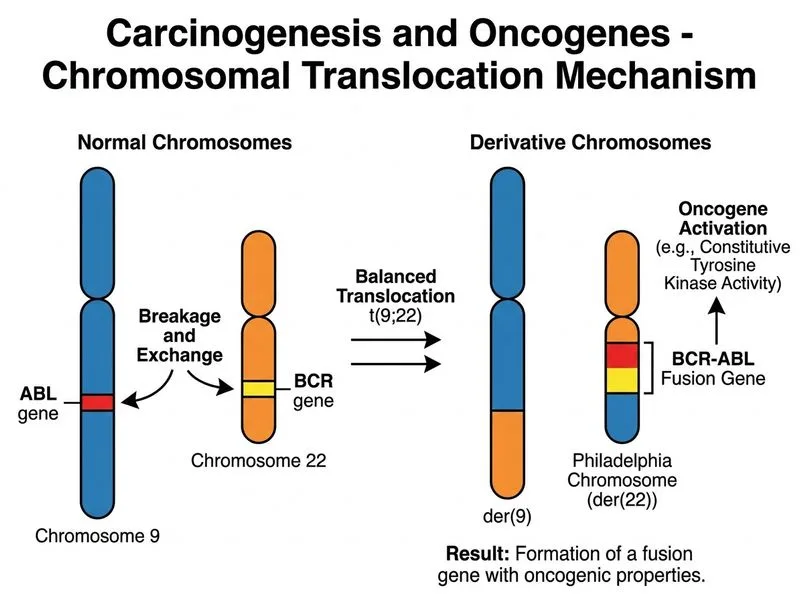
Sign up free to access AI-powered MCQ practice with detailed explanations and adaptive learning.