
## BRCA1 Loss and Breast Cancer Predisposition ### BRCA1 Function and Classification **Key Point:** BRCA1 is a **tumour suppressor gene**, not an oncogene. Its primary role is in homologous recombination (HR) DNA repair, particularly in response to double-strand breaks (DSBs). ### Molecular Role of BRCA1 1. **DNA Repair Protein** - Part of the BRCA1-PALB2-BRCA2 complex - Facilitates homologous recombination repair of DSBs - Essential for maintaining genomic stability 2. **Cell Cycle Checkpoint Control** - Interacts with p53 and CHK2 - Activates G1/S and G2/M checkpoints in response to DNA damage - Triggers apoptosis if damage cannot be repaired 3. **Transcriptional Regulation** - Modulates expression of genes involved in DNA repair and apoptosis ### Consequences of BRCA1 Loss ```mermaid flowchart TD A[BRCA1 Mutation/Loss]:::outcome --> B[Defective Homologous Recombination]:::outcome B --> C[Accumulation of Unrepaired DSBs]:::outcome C --> D[Genomic Instability]:::outcome D --> E[Mutations in p53, PTEN, other TSGs]:::outcome E --> F[Malignant Transformation]:::urgent A --> G[Loss of Checkpoint Control]:::outcome G --> F ``` ### High-Yield Features of BRCA1-Associated Breast Cancer | Feature | Characteristic | |---------|----------------| | Age of onset | Earlier (often <50 years) | | Tumour type | Often triple-negative (ER−, PR−, HER2−) | | Histology | Invasive ductal carcinoma, high grade | | Genomic signature | High mutational burden, HRD (homologous recombination deficiency) | | Contralateral risk | ~50% lifetime risk of second breast cancer | | Ovarian cancer risk | ~40% lifetime risk | **High-Yield:** BRCA1-mutant tumours show **homologous recombination deficiency (HRD)**, making them sensitive to: - PARP inhibitors (olaparib, rucaparib) - Platinum-based chemotherapy ### Why Loss Leads to Cancer 1. **Two-hit model:** BRCA1 mutations are inherited; somatic loss of the wild-type allele in breast epithelium creates a null state 2. **Mutator phenotype:** Without functional HR, cells accumulate mutations at a high rate 3. **Secondary hits:** These mutations often inactivate p53, activate KRAS, or dysregulate other oncogenes 4. **Checkpoint failure:** Loss of BRCA1-mediated G1/S and G2/M arrest allows cells with DNA damage to progress through the cell cycle **Clinical Pearl:** BRCA1-associated cancers are often diagnosed at a younger age and with higher grade because the genomic instability accelerates accumulation of oncogenic mutations. [cite:Robbins 10e Ch 7] 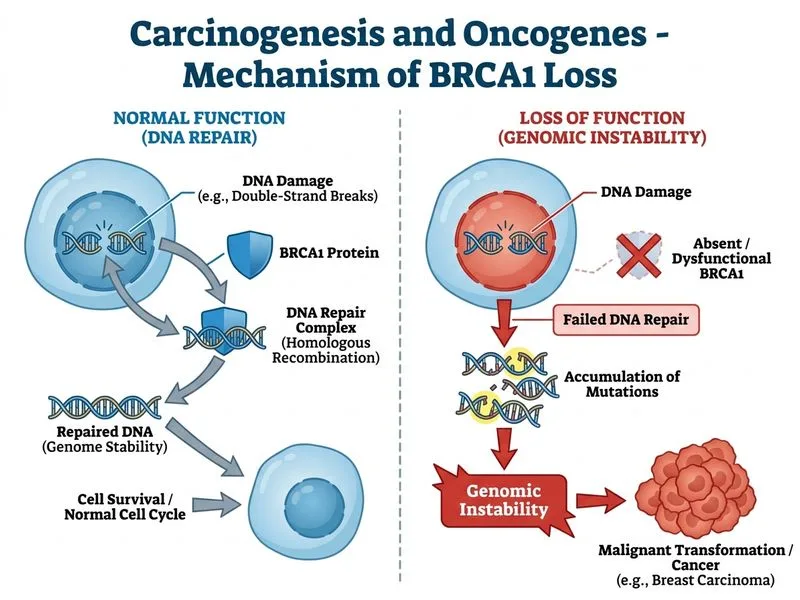
Sign up free to access AI-powered MCQ practice with detailed explanations and adaptive learning.