
## Vascular Remodeling in Portal Hypertension **Key Point:** Chronic portal hypertension triggers **hyperplasia** of vascular smooth muscle cells — an increase in cell number — as a primary adaptive response to sustained hemodynamic stress in the portal venous system. ### Mechanism of Smooth Muscle Hyperplasia in Portal Hypertension Chronic elevation of portal pressure activates: 1. Endothelial shear stress sensors (mechanoreceptors) 2. Release of growth factors (PDGF, FGF, VEGF) from endothelial cells 3. Activation of smooth muscle cell proliferation pathways (MAPK, Rho/ROCK signaling) 4. Increased smooth muscle cell number (hyperplasia) and enhanced contractility 5. Vascular wall thickening and increased resistance **Clinical Pearl:** In portal hypertension, smooth muscle hyperplasia occurs in both large portal venules and small hepatic arterioles. This adaptive response paradoxically **increases** vascular resistance, perpetuating portal hypertension — a maladaptive feedback loop. ### Hyperplasia vs. Hypertrophy in Vascular Smooth Muscle | Feature | Hyperplasia | Hypertrophy | | --- | --- | --- | | **Cell number** | Increased | Unchanged | | **Individual cell size** | Normal or slightly increased | Markedly increased | | **Mechanism** | Growth factor-driven proliferation | Mechanical load/stretch | | **Portal HTN context** | Primary response | Minor contribution | | **Reversibility** | Partial with pressure relief | Better reversibility | **High-Yield:** The biopsy finding of "increased smooth muscle cells in the walls" explicitly indicates **increased cell number** (hyperplasia), not just larger cells (hypertrophy). The presence of extensive fibrosis confirms chronic liver disease with vascular remodeling. ### Distinction from Fibrosis **Mnemonic — VASCULAR REMODELING IN CIRRHOSIS: SMOOTH MUSCLE HYPERPLASIA + FIBROSIS** - **S**mooth muscle hyperplasia (increased cell number) - **M**yofibroblast activation (from stellate cells — contributes to fibrosis, not smooth muscle) - **O**rganization of extracellular matrix - **O**utcome: increased vascular resistance Myofibroblasts (derived from hepatic stellate cells) are responsible for fibrosis production, not for the smooth muscle layer of blood vessels. [cite:Robbins 10e Ch 3, Ch 20] 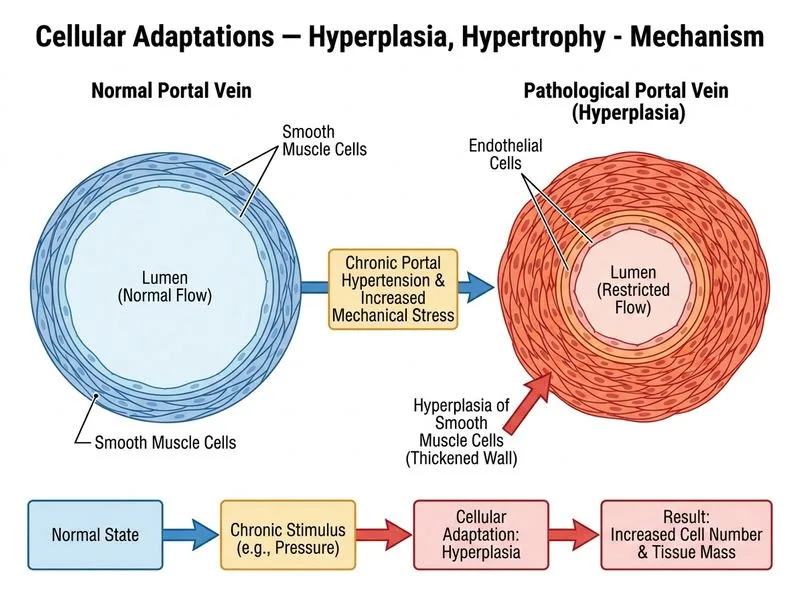
Sign up free to access AI-powered MCQ practice with detailed explanations and adaptive learning.