
## Transverse Lie and Mode of Delivery Transverse lie is an absolute indication for cesarean section at term. Vaginal delivery is not possible with a transverse lie, as neither the head nor buttocks are in the pelvis. ## Management Algorithm for Transverse Lie ```mermaid flowchart TD A["Transverse lie at 37-38 weeks"]:::outcome --> B{"Patient desires vaginal delivery?"}:::decision B -->|"Yes, no contraindications"| C["Offer ECV under tocolysis"]:::action B -->|"Declines ECV or contraindicated"| D["Plan cesarean at 39 weeks"]:::action C --> E{"ECV successful?"}:::decision E -->|"Yes"| F["Expectant management, plan vaginal delivery"]:::action E -->|"No"| D D --> G["Cesarean section at 39 weeks"]:::action G --> H["Reduces perinatal morbidity/mortality"]:::outcome ``` **Key Point:** Transverse lie at term is an absolute indication for cesarean section. Vaginal delivery with transverse lie carries high risk of: - Cord prolapse (especially with rupture of membranes) - Fetal hypoxia and death - Obstructed labour - Uterine rupture - Maternal hemorrhage **High-Yield:** ECV should be offered at 37–38 weeks if the patient desires vaginal delivery and there are no contraindications (placenta previa, previous cesarean, abnormal CTG, etc.). If ECV is declined or unsuccessful, cesarean section at 39 weeks is mandatory. **Clinical Pearl:** Spontaneous version from transverse to cephalic lie occurs in <10% of cases after 37 weeks. Bed rest does not improve the likelihood of version and is not recommended. **Mnemonic:** **TRANSVERSE LIE = CESAREAN** (unless ECV successful and patient in labour with cephalic presentation). ## Why This Patient Requires Cesarean Section 1. Transverse lie confirmed on ultrasound 2. Patient declined ECV (the only chance for vaginal delivery) 3. Anterior placenta does not preclude ECV, but patient has refused 4. Cesarean section at 39 weeks is the standard of care [cite:RCOG Green-top Guideline 20; ACOG Practice Bulletin 13] 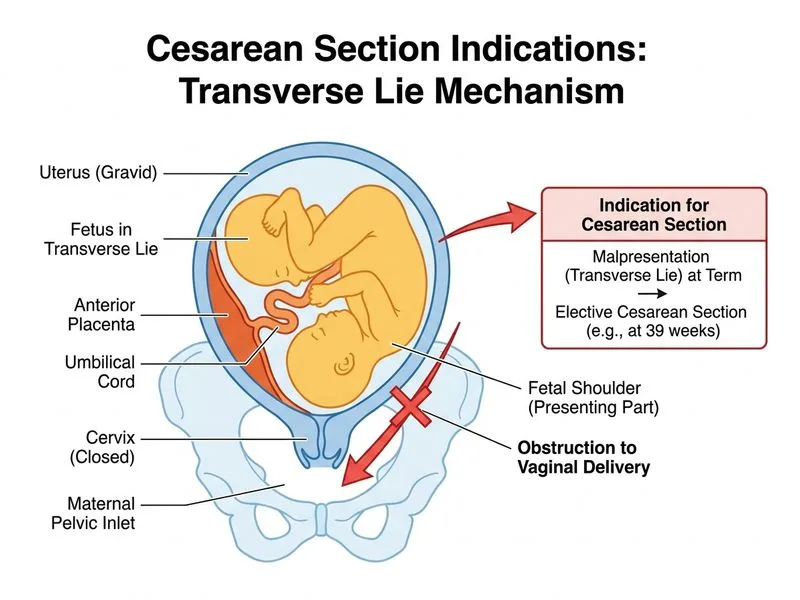
Sign up free to access AI-powered MCQ practice with detailed explanations and adaptive learning.