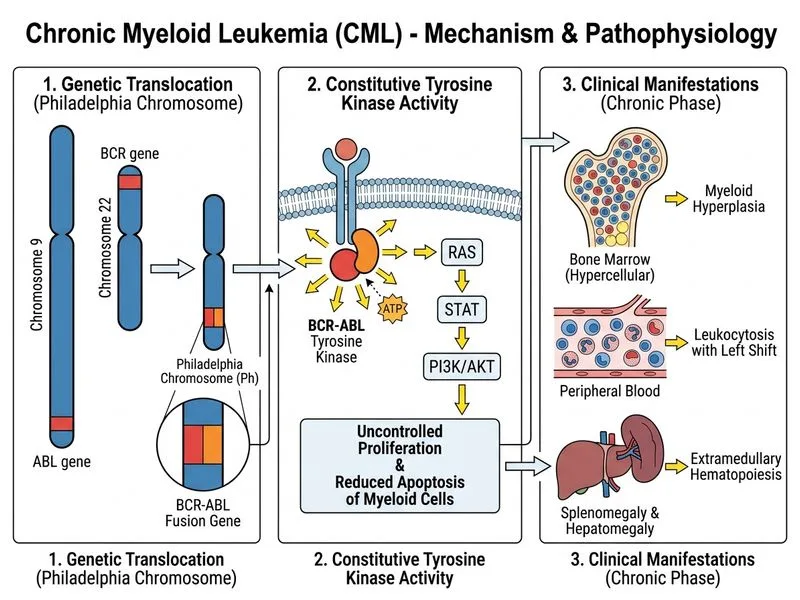
## Diagnosis: Chronic Myeloid Leukemia (CML) in Chronic Phase ### Clinical Presentation **Key Point:** The constellation of marked splenomegaly, gradual onset fatigue, and massive leukocytosis with a left shift (but <30% blasts) in a middle-aged patient is pathognomonic for CML. ### Diagnostic Criteria Met | Feature | Finding | Significance | |---------|---------|---------------| | **WBC count** | 185,000/μL | Marked elevation; >50,000/μL typical in CML | | **Differential** | Left shift (metamyelocytes, myelocytes present) | Myeloid predominance with maturation | | **Blast percentage** | <5% | Chronic phase (if ≥20%, would be accelerated/blast crisis) | | **Splenomegaly** | 8 cm | Present in 90% of CML; extramedullary hematopoiesis | | **LAP score** | 15 (LOW) | **Hallmark of CML**—distinguishes from leukemoid reaction (LAP high) | | **Philadelphia chromosome** | **POSITIVE** | **Pathognomonic**—t(9;22) → BCR-ABL fusion gene | | **Platelets** | 420,000/μL | Often elevated in CML (thrombocytosis) | ### Pathophysiology **High-Yield:** The Philadelphia chromosome t(9;22) produces the BCR-ABL tyrosine kinase, which drives constitutive myeloid proliferation and suppresses apoptosis. This is the defining molecular lesion of CML. **Clinical Pearl:** LAP (leukocyte alkaline phosphatase) is LOW in CML because BCR-ABL-driven blasts have reduced enzyme activity. In contrast, leukemoid reactions (infection, inflammation) show HIGH LAP—this is the key discriminator. ### Phases of CML ```mermaid flowchart TD A[Philadelphia chromosome positive]:::outcome --> B{Blast percentage}:::decision B -->|<5% blasts| C[Chronic Phase]:::action B -->|5-30% blasts| D[Accelerated Phase]:::action B -->|≥30% blasts| E[Blast Crisis]:::urgent C --> F[Median survival: 5-6 years untreated<br/>10+ years with TKI]:::outcome D --> G[Median survival: 6-12 months]:::outcome E --> H[Median survival: 3-6 months<br/>Often AML or ALL phenotype]:::urgent ``` **Key Point:** This patient is in **chronic phase** (blasts <5%, LAP low, Ph+ present). ### Treatment **High-Yield:** First-line therapy is tyrosine kinase inhibitor (TKI): imatinib, dasatinib, or nilotinib. Imatinib (Gleevec) is the gold standard first-line agent, achieving complete hematologic remission in >95% of chronic-phase patients. [cite:Robbins 10e Ch 13] 
Sign up free to access AI-powered MCQ practice with detailed explanations and adaptive learning.