NEETPGAI
FeaturesNEET PGFMGEINI-CETBlogPricing
Log inStart Free
NEETPGAI

AI-powered NEET PG preparation platform. Master all 19 subjects with adaptive MCQs, AI tutoring, and spaced repetition.

Product

  • Features
  • Subjects
  • Previous Year Questions
  • NEET PG Preparation
  • FMGE Preparation
  • INI-CET Preparation
  • Compare
  • Pricing
  • Blog

Features

  • Adaptive MCQ Practice
  • AI Tutor
  • Mock Tests
  • Spaced Repetition

Resources

  • Blog
  • Study Guides
  • NEET PG Updates
  • Contact & support

Legal

  • Privacy Policy
  • Terms of Service

Stay updated

© 2026 NEETPGAI. All rights reserved.
    Subjects/Pathology/Chronic Leukemias
    Chronic Leukemias
    medium
    microscope Pathology

    A 58-year-old man from Delhi presents with a 6-month history of fatigue and abdominal discomfort. On examination, he has splenomegaly. CBC shows WBC 85,000/µL with 60% neutrophils, 15% metamyelocytes, 10% myelocytes, and 5% blasts. Bone marrow aspirate confirms chronic myeloid leukemia (CML) in chronic phase. Cytogenetics shows t(9;22). What is the most appropriate next step in management?

    A. Perform BCR-ABL quantitative PCR (qPCR) and start imatinib mesylate
    B. Start interferon-alpha and monitor with bone marrow biopsy every month
    C. Start hydroxyurea immediately and repeat CBC in 2 weeks
    D. Refer for allogeneic stem cell transplantation without further testing

    Explanation

    Practice similar questions

    Sign up free to access AI-powered MCQ practice with detailed explanations and adaptive learning.

    Start Practicing Free More Pathology Questions

    Join our NEET PG community

    Daily MCQs, study tips, and topper strategies on Telegram.

    Join on Telegram →

    Diagnosis and Baseline Assessment

    Key Point
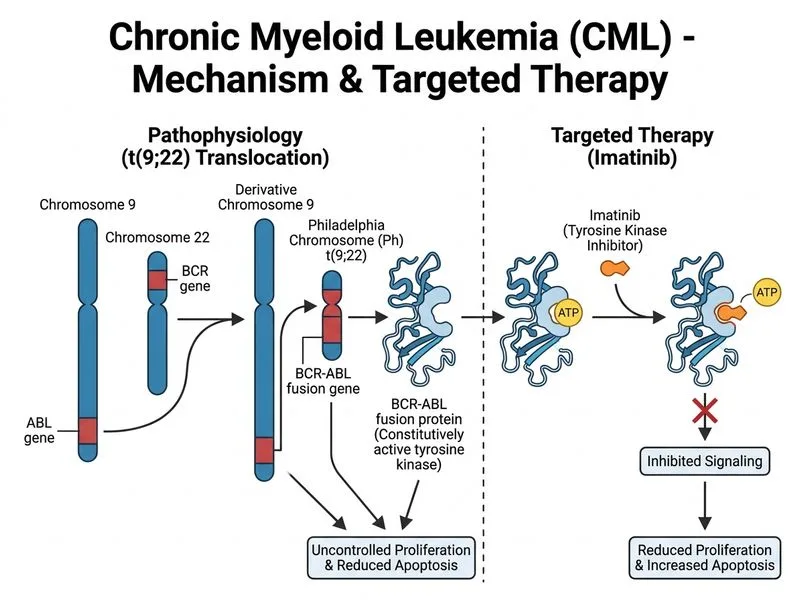
    CML diagnosis is confirmed by t(9;22) cytogenetics and/or BCR-ABL fusion. Before initiating tyrosine kinase inhibitor (TKI) therapy, baseline BCR-ABL transcript quantification is mandatory for monitoring response and detecting resistance mutations.

    Management Algorithm for CML in Chronic Phase

    Loading diagram...

    Why Baseline qPCR is Essential

    Table
    AspectSignificance
    Baseline transcript levelPredicts TKI response and prognosis
    Monitoring timepoints3, 6, 12 months, then annually
    Milestone criteriaBCR-ABL ≤10% IS at 3 months = optimal response
    Resistance detectionIdentifies kinase domain mutations early
    High-YieldNEET PG
    Imatinib mesylate is the first-line TKI for CML chronic phase, with a dose of 400 mg daily. Baseline qPCR establishes the starting point for assessing molecular response.
    Clinical Pearl
    The International Scale (IS) standardizes BCR-ABL reporting across laboratories, enabling comparison of results over time and between institutions.

    Why Other Options Are Incorrect

    • Hydroxyurea alone: Cytoreductive but does not target BCR-ABL; no longer standard of care for CML.
    • Direct SCT without TKI trial: Allogeneic transplant is reserved for TKI-resistant disease or advanced phases; chronic phase patients should receive TKI first.
    • Interferon-alpha: Historical therapy, now obsolete; inferior to TKI and associated with significant toxicity.

    Harrison 21e Ch 104

    Loading illustration…Chronic Leukemias diagram