
## Vitamin K-Dependent vs Independent Coagulation Factors **Key Point:** Vitamin K is essential for the γ-carboxylation of glutamic acid residues in the N-terminal region of certain coagulation factors, enabling them to bind calcium and phospholipid surfaces. ### Vitamin K-Dependent Factors (PIVKA) | Factor | Synthesis Site | Vitamin K Role | | --- | --- | --- | | II (Prothrombin) | Liver | Required for γ-carboxylation | | VII (Proconvertin) | Liver | Required for γ-carboxylation | | IX (Christmas factor) | Liver | Required for γ-carboxylation | | X (Stuart-Prower) | Liver | Required for γ-carboxylation | ### Vitamin K-Independent Factors - **Factor V** — synthesized in liver; does NOT require vitamin K for activation - **Factor VIII** — synthesized in endothelium; vitamin K-independent - **Factor XI, XII, XIII** — vitamin K-independent - **Fibrinogen** — vitamin K-independent - **von Willebrand factor** — vitamin K-independent **High-Yield:** The mnemonic **"PIVKA"** (Proteins Induced by Vitamin K Absence) refers to factors II, VII, IX, X. These are the ONLY four factors requiring vitamin K. All others are vitamin K-independent. **Clinical Pearl:** In warfarin overdose or vitamin K deficiency, factor VII is depleted first (shortest half-life ~6 hours), followed by factors IX, X, and II. Factor V remains normal, which is why a prolonged PT with normal factor V level suggests vitamin K deficiency rather than liver synthetic failure (where factor V would also be low). **Warning:** Do not confuse factor V deficiency (rare, autosomal recessive) with vitamin K deficiency. Factor V is NOT vitamin K-dependent and is unaffected by warfarin or vitamin K depletion. 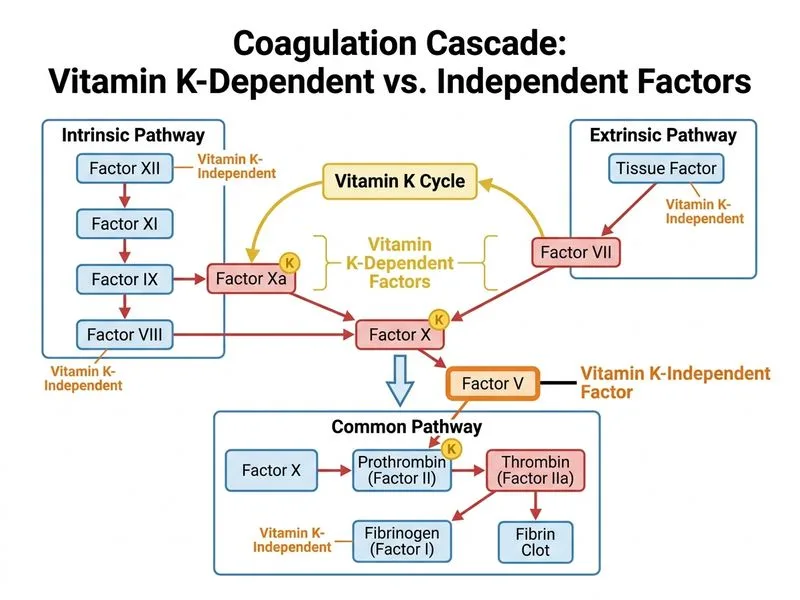
Sign up free to access AI-powered MCQ practice with detailed explanations and adaptive learning.