
## COPD Management Strategy by Severity **Key Point:** This patient has GOLD stage 2 (moderate) COPD based on FEV₁ 40–59% predicted with no recent exacerbations. Management follows a stepwise approach based on symptom burden and exacerbation history. ### GOLD Classification & Treatment Algorithm | GOLD Stage | FEV₁ (% predicted) | Exacerbation History | Recommended Initial Therapy | |---|---|---|---| | 1 (Mild) | ≥80 | None | SABA as needed | | 2 (Moderate) | 50–79 | None | LABA or LAMA monotherapy | | 2 (Moderate) | 50–79 | ≥1/year | LABA + ICS or LAMA | | 3 (Severe) | 30–49 | ≥1/year | LABA + ICS or triple therapy | | 4 (Very Severe) | <30 | ≥2/year | LABA + ICS ± LAMA | **High-Yield:** For patients without exacerbations, either a LABA or LAMA monotherapy is appropriate first-line. LAMAs (tiotropium, glycopyrronium) are preferred in many guidelines due to superior bronchodilation and lower cardiovascular risk compared to LABAs. ### Why LAMA Monotherapy? 1. **No exacerbation history** — ICS is not indicated without ≥1 exacerbation per year 2. **Moderate airflow obstruction** — requires long-acting bronchodilator, not SABA 3. **LAMA efficacy** — superior to LABA in reducing hyperinflation and dyspnea in non-exacerbating COPD 4. **Cost-effective** — monotherapy is simpler and cheaper than combination inhalers **Clinical Pearl:** Pursed-lip breathing and barrel chest indicate significant air trapping. LAMAs reduce dynamic hyperinflation more effectively than LABAs, improving exercise capacity and quality of life. **Mnemonic:** GOLD 2, No Exacerbations → **LAMA or LABA mono** (not ICS, not triple). Add ICS only if exacerbations occur. 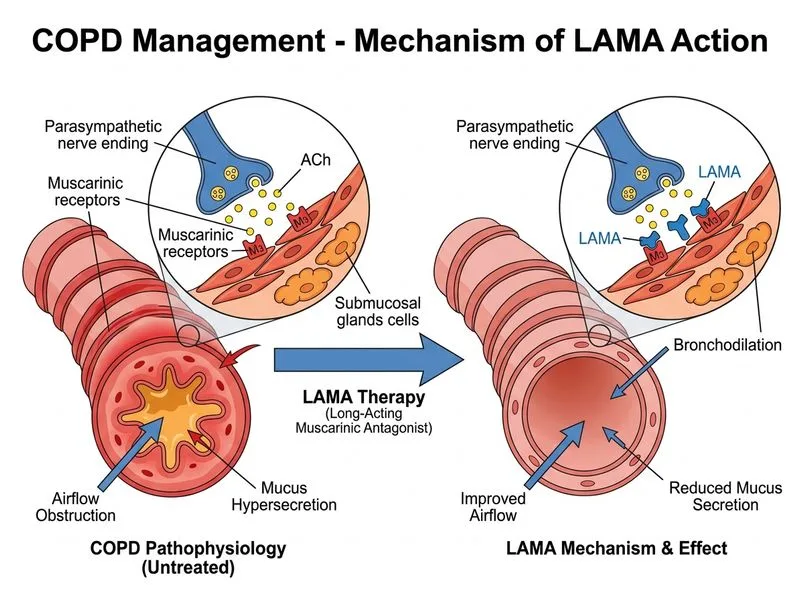
Sign up free to access AI-powered MCQ practice with detailed explanations and adaptive learning.