Corneal Ulcer — Bacterial and Fungal MCQ — NEET PG Practice Question | NEETPGAI
Corneal Ulcer — Bacterial and Fungal
medium
eye Ophthalmology
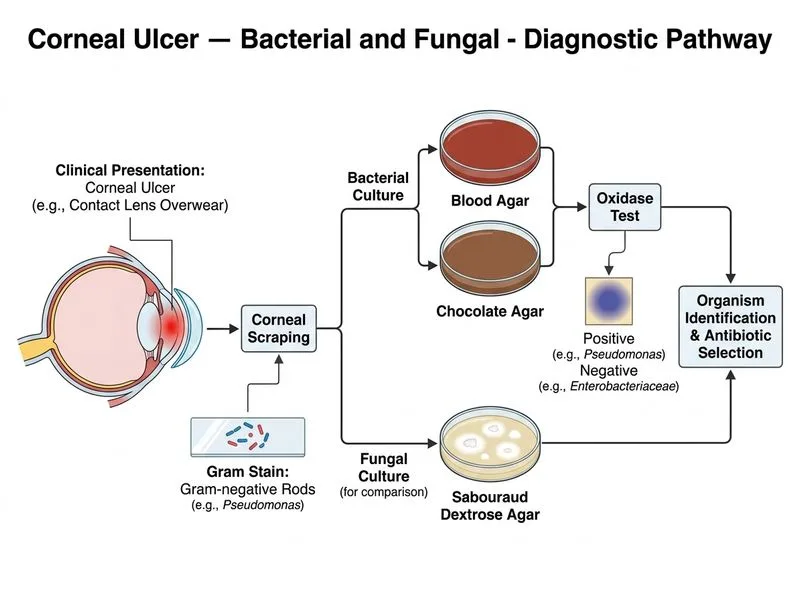
A 38-year-old man with a history of contact lens overwear presents with a 5-day history of corneal ulcer. Slit-lamp examination shows a central, well-demarcated ulcer with a greenish tinge and mucopurulent discharge. Gram stain of corneal scraping shows Gram-negative rods. Which additional investigation would be most useful to confirm the organism and guide antibiotic selection?
A. Culture on blood agar and chocolate agar with oxidase test
B. Anterior segment OCT with polarization-sensitive imaging
C. Confocal microscopy with immunofluorescence
D. Culture on Sabouraud dextrose agar with lactophenol cotton blue stain
Explanation
Organism Identification in Gram-Negative Corneal Ulcer
Key Point
In a contact lens–associated corneal ulcer with Gram-negative rods, culture on blood agar and chocolate agar with oxidase testing is the most appropriate next investigation to identify Pseudomonas aeruginosa and guide fluoroquinolone therapy.
Clinical Context
The presentation is classic for Pseudomonas aeruginosa infection:
Contact lens overwear (major risk factor)
Greenish tinge (pyoverdine pigment)
Mucopurulent discharge
Gram-negative rod morphology
Rapid progression (5 days)
High-YieldNEET PG
Pseudomonas is the most common Gram-negative corneal pathogen in contact lens wearers and causes aggressive, sight-threatening ulcers.
Diagnostic Algorithm for Gram-Negative Rods
Loading diagram...
Differential Identification of Gram-Negative Rods
Table
Organism
Oxidase
Pigment
Odor
Culture Medium
Key Feature
Pseudomonas aeruginosa
+
Green/blue
Fruity
Blood, chocolate
Motile, mucoid colonies
Moraxella
+
None
None
Blood, chocolate
Diplococcus, oxidase +
Enterobacteriaceae
−
Variable
None
Blood, MacConkey
Lactose fermentation
Neisseria
+
None
None
Chocolate (fastidious)
Gram-negative diplococcus
Mnemonic for Oxidase-Positive Gram-Negative Rods:P-M-N = Pseudomonas, Moraxella, Neisseria
Why Oxidase Test Is Critical
1.
Pseudomonas is oxidase-positive → requires fluoroquinolone monotherapy (moxifloxacin 0.5% or ciprofloxacin 0.3%)
2.
Moraxella is oxidase-positive but less aggressive → also responds to fluoroquinolones
3.
Enterobacteriaceae are oxidase-negative → require cephalosporin ± aminoglycoside
Clinical Pearl
Oxidase-positive Gram-negative rods in a contact lens ulcer = Pseudomonas until proven otherwise. Start fluoroquinolone immediately; delay risks corneal perforation and vision loss.
Why Other Investigations Are Inappropriate
Sabouraud agar: For fungal pathogens, not Gram-negative bacteria
Confocal microscopy: Adjunctive imaging, does not identify organism or guide therapy
AS-OCT with polarization: Structural assessment, not microbiological diagnosis
Kanski Clinical Ophthalmology 9e Ch 6; Robbins Pathologic Basis of Disease 10e Ch 8
Loading illustration…
Practice similar questions
Sign up free to access AI-powered MCQ practice with detailed explanations and adaptive learning.