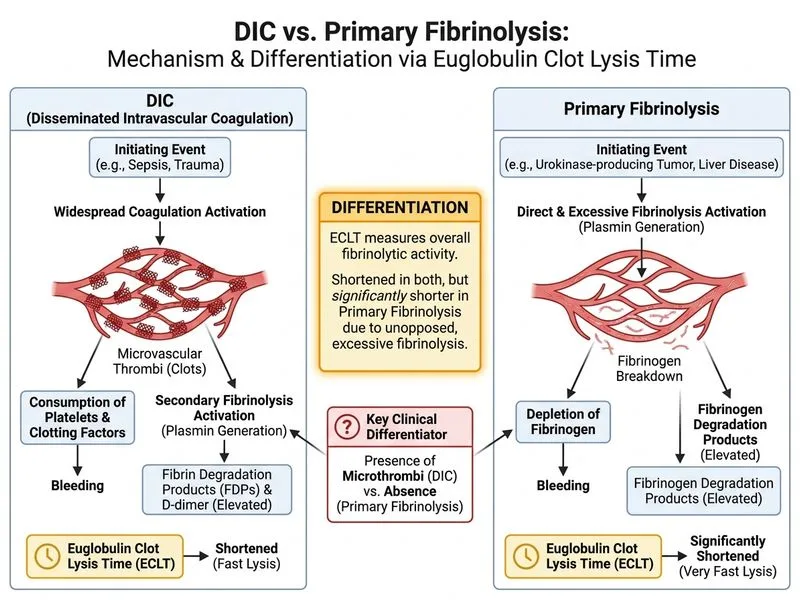
A 42-year-old man with sepsis secondary to gram-negative bacteremia develops acute onset petechiae, bleeding from gums, and hemoptysis. Coagulation profile shows: platelet 28,000/μL, fibrinogen 110 mg/dL, PT 22 seconds, aPTT 48 seconds, D-dimer >10 μg/mL (normal <0.5). Which investigation would be most useful to differentiate DIC from primary fibrinolysis in this patient?
A. Thrombin time (TT)
B. Euglobulin clot lysis time
C. Bleeding time
D. Factor V level
Explanation
Differentiating DIC from Primary Fibrinolysis
Key Point
Factor V level is the most useful investigation to differentiate DIC from primary fibrinolysis. In DIC, Factor V is consumed by thrombin-mediated coagulation activation, whereas in primary fibrinolysis, Factor V levels remain normal because there is no thrombin generation or factor consumption.
Pathophysiology: DIC vs Primary Fibrinolysis
Table
Feature
DIC
Primary Fibrinolysis
Platelet count
↓↓ (consumption)
Normal or mild ↓
Fibrinogen
↓↓ (consumption + lysis)
↓↓ (lysis only)
PT / aPTT
↑↑ (factor consumption)
Normal or mild ↑
Factor V level
↓↓ (consumed)
Normal (not consumed)
D-dimer / FDP
↑↑
↑↑
ECLT
Normal / mildly shortened
Markedly shortened
Why Factor V is the Key Differentiator
High-YieldNEET PG
In DIC, widespread thrombin generation leads to consumption of coagulation factors including Factor V (a labile coagulation factor). In primary fibrinolysis, plasmin degrades fibrinogen and fibrin but does not significantly consume Factor V, so levels remain normal.
DIC: Factor V ↓↓ (due to thrombin-mediated consumption + plasmin degradation)
Primary fibrinolysis: Factor V normal (no thrombin generation, no consumption)
This distinction is well-established in standard hematology references (Harrison's Principles of Internal Medicine, 21e, Ch. 111; Robbins & Cotran Pathologic Basis of Disease, 10e, Ch. 12).
Clinical Pearl
Factor V is a labile factor that is rapidly consumed in DIC. Its measurement is practical, widely available in clinical laboratories, and is the most commonly tested differentiating investigation in NEET PG / INI-CET examinations.
Why Other Options Are Less Useful
1.
Euglobulin clot lysis time (ECLT): Measures fibrinolytic activity and is markedly shortened in primary fibrinolysis. However, ECLT is rarely available in routine clinical laboratories, is not standardized, and is not the primary differentiating test taught in standard Indian PG curricula. It is a research/specialized test.
2.
Thrombin time (TT): Prolonged in both DIC and primary fibrinolysis (due to low fibrinogen and FDP interference) → non-discriminatory.
3.
Bleeding time: Measures platelet plug formation; does not assess coagulation factor levels or fibrinolytic activity → irrelevant for this differentiation.
Practical Algorithm
Platelet count ↓↓ + Factor V ↓↓ → DIC
Platelet count normal + Factor V normal + markedly elevated FDP → Primary fibrinolysis
High-Yield Mnemonic: "Factor V Vanishes in DIC" — Factor V is consumed in DIC but preserved in primary fibrinolysis, making it the single most useful differentiating test in standard PG examinations.
Harrison 21e Ch. 111; Robbins & Cotran 10e Ch. 12; Wintrobe's Clinical Hematology 14e
Loading illustration…
Practice similar questions
Sign up free to access AI-powered MCQ practice with detailed explanations and adaptive learning.