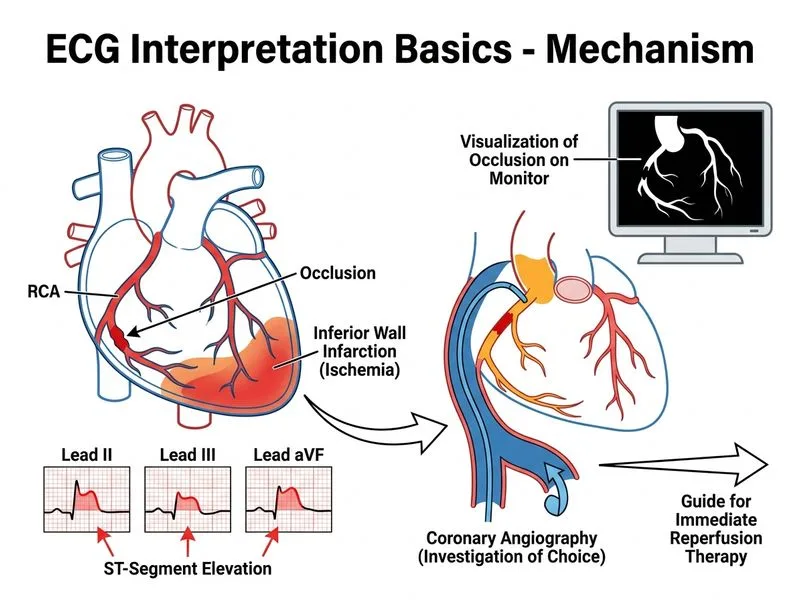
A 58-year-old man with hypertension and diabetes presents to the emergency department with acute onset chest pain radiating to the left arm, associated with diaphoresis. His initial 12-lead ECG shows ST-segment elevation in leads II, III, and aVF. What is the investigation of choice to confirm acute myocardial infarction and guide immediate reperfusion therapy?
A. Cardiac troponin I (high-sensitivity assay) and serial ECG
B. Coronary angiography
C. Transthoracic echocardiography
D. Chest X-ray and D-dimer
Explanation
Investigation of Choice in Acute STEMI
Key Point
In a patient with clinical symptoms of acute coronary syndrome (ACS) and diagnostic ST-segment elevation on 12-lead ECG, coronary angiography is the gold-standard investigation and the definitive next step for both diagnosis confirmation and immediate therapeutic intervention (primary percutaneous coronary intervention [PCI]).
Why Coronary Angiography?
1.
Diagnostic accuracy: Directly visualizes coronary anatomy and identifies the culprit lesion responsible for the infarction (in this case, likely right coronary artery or left circumflex given inferior STEMI pattern).
2.
Therapeutic capability: Allows immediate revascularization (balloon angioplasty ± stent placement) within the critical time window (door-to-balloon time <90 minutes).
3.
Prognostic information: Assesses collateral flow, extent of disease, and left ventricular function in real time.
High-YieldNEET PG
In STEMI with ST elevation on ECG, do NOT delay for biomarkers or other investigations — proceed directly to coronary angiography (or thrombolysis if PCI-capable facility unavailable within 120 minutes).
Comparison of Investigations in Acute STEMI
Table
Investigation
Role in STEMI
Timing
Limitation
Coronary angiography
Gold standard; diagnostic + therapeutic
Immediate (door-to-balloon <90 min)
Invasive; not available in all centers
Cardiac troponin
Confirms myocardial necrosis; risk stratification
Serial (0, 3, 6 hrs); delayed rise
Not diagnostic of ACS type; delays reperfusion decision
Excludes alternative diagnoses (pneumonia, PE, aortic dissection)
Initial screening
Non-specific; does not guide reperfusion
Clinical Pearl
The presence of ST-segment elevation on ECG is sufficient to diagnose STEMI and initiate reperfusion therapy — do not wait for troponin confirmation, which may take hours. Troponin is used for risk stratification and prognostication, not for diagnosis in the acute setting.
Mnemonic: "STEMI = Straight To Emergent angiography for Myocardial Infarction" — emphasizes that ST elevation mandates immediate catheterization, not serial biomarkers.
Loading illustration…
Practice similar questions
Sign up free to access AI-powered MCQ practice with detailed explanations and adaptive learning.