
## Diagnosis: Atrial Fibrillation with Rapid Ventricular Response ### ECG Features of Atrial Fibrillation | Feature | Atrial Fibrillation | Atrial Flutter | Sinus Tachycardia | MAT | |---------|-------------------|-----------------|-------------------|-----| | **P waves** | Absent; irregular baseline (fibrillation waves) | Sawtooth pattern (flutter waves) | Visible, upright | ≥3 morphologies | | **RR intervals** | Irregularly irregular | Regular (if fixed AV block) or irregular | Regular | Irregular | | **Baseline** | Chaotic, undulating | Sawtooth pattern | Isoelectric | Isoelectric | | **QRS** | Narrow (unless aberrancy) | Narrow | Narrow | Narrow | | **Rate** | 100–160 bpm (uncontrolled) | 250–350 bpm (atrial) | 100–160 bpm | 100–160 bpm | **Key Point:** Atrial fibrillation is defined by the absence of organized P waves and an **irregularly irregular** ventricular rhythm. The baseline shows fine or coarse fibrillation waves (f waves) rather than discrete P waves. **High-Yield:** Rapid ventricular response in AF is defined as ventricular rate >100 bpm at rest. This patient's rate of 100–120 bpm qualifies as rapid AF and requires rate control (beta-blockers, calcium channel blockers, or digoxin). **Mnemonic: CHADS₂-VASc** — risk stratification for stroke in AF: - **C** — Congestive heart failure - **H** — Hypertension - **A** — Age ≥75 - **D** — Diabetes - **S₂** — prior Stroke/TIA/thromboembolism (×2 points) - **V** — Vascular disease - **A** — Age 65–74 - **Sc** — Sex category (female) **Clinical Pearl:** This patient has at least 1 point (hypertension) and is female (1 point), giving a CHADS₂-VASc score ≥2, which warrants anticoagulation (warfarin or DOAC) unless contraindicated. ### Management of Rapid AF 1. **Rate control** — beta-blockers (metoprolol, atenolol) or non-dihydropyridine calcium channel blockers (diltiazem, verapamil) 2. **Anticoagulation** — DOAC or warfarin based on CHADS₂-VASc score 3. **Rhythm control** — amiodarone or flecainide if symptomatic or hemodynamically unstable (consider after rate control achieved) 4. **Underlying cause** — address thyroid dysfunction, heart failure, hypertension, or other precipitants 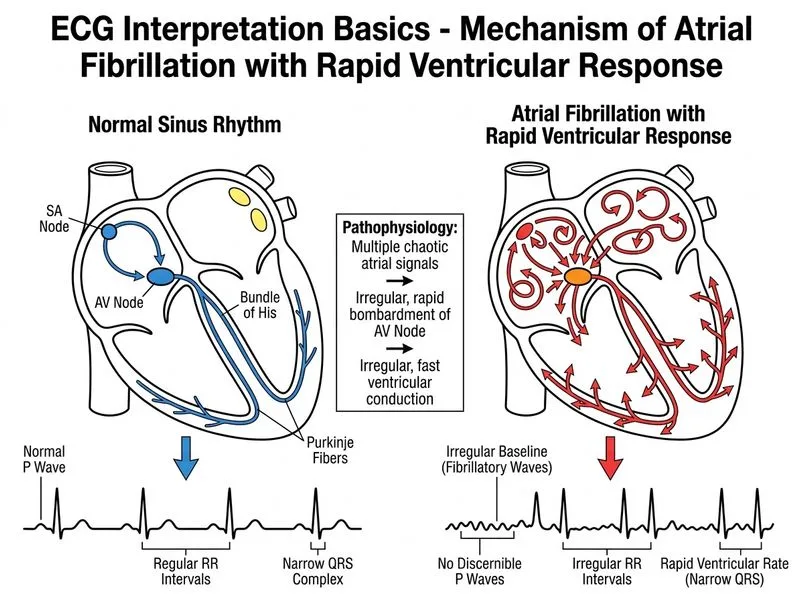
Sign up free to access AI-powered MCQ practice with detailed explanations and adaptive learning.