
## Glyceraldehyde-3-Phosphate Dehydrogenase (GAPDH) Reaction **Reaction Details:** - **Substrate:** Glyceraldehyde-3-phosphate (G-3-P) - **Products:** 1,3-bisphosphoglycerate (1,3-BPG) + NADH + H+ - **Cofactor:** NAD+ (oxidizing agent), Inorganic Phosphate (Pi), and CoA (as part of the enzyme complex) **Key Features:** | Feature | Details | |---------|----------| | **Oxidation-Reduction** | NAD+ is reduced to NADH (oxidative step) | | **Phosphorylation** | Inorganic phosphate is incorporated into the substrate at the aldehyde position, forming a high-energy acyl phosphate bond | | **Coupling** | This is a coupled oxidation-phosphorylation reaction | | **Energy** | The high-energy phosphate bond (~49 kJ/mol) is later used for ATP synthesis | **High-Yield:** GAPDH is unique because it couples oxidation (NAD+ reduction) with phosphorylation (Pi incorporation) in a single step. This is the only substrate-level phosphorylation that is coupled to oxidation in glycolysis. **Mnemonic:** "GAPDH = **G**lucose **A**ldehyde **P**hosphate **D**ehydrogenase—it's an oxidation-phosphorylation step." 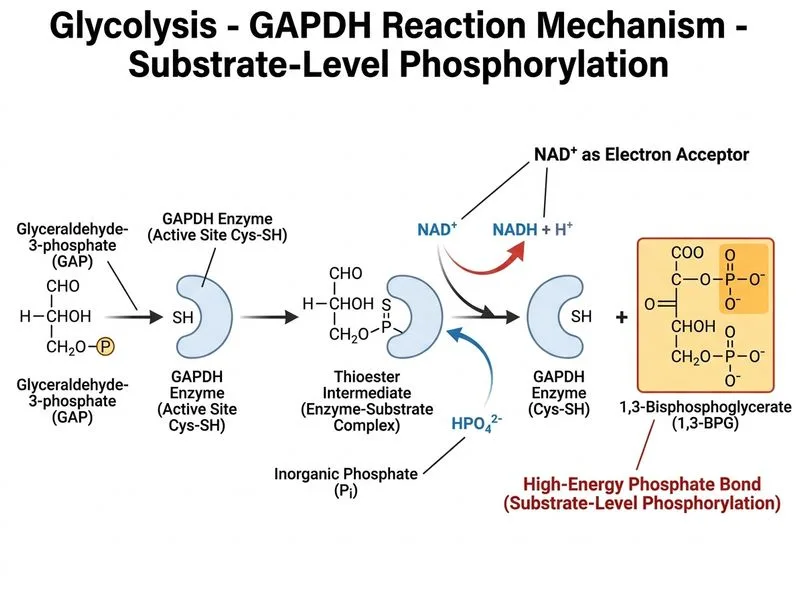
Sign up free to access AI-powered MCQ practice with detailed explanations and adaptive learning.