
## Clinical Scenario Analysis This patient presents with acute ischemic stroke (NIHSS-level deficits: hemiparesis, facial droop, dysarthria) within the **3-hour thrombolytic window**. The CT head excludes hemorrhage, making him a candidate for IV thrombolysis. ## Thrombolytic Eligibility **Key Point:** Intravenous alteplase (rt-PA) is the standard of care for acute ischemic stroke within 4.5 hours of symptom onset (FDA-approved window 3 hours; extended window 3–4.5 hours with careful patient selection). **High-Yield:** The patient meets inclusion criteria: - Time from onset: 90 minutes (well within window) - Non-contrast CT: negative for hemorrhage - Blood glucose: normal (hypoglycemia/hyperglycemia can mimic stroke but are excluded here) - No contraindications evident in the stem ## Why IV Alteplase Now? **Clinical Pearl:** "Time is brain." Every minute of delay increases infarct volume. The **golden window for thrombolysis is 3–4.5 hours**; this patient is at 90 minutes—optimal timing. Delaying for additional imaging (CTA, MRI) or observation wastes critical time and reduces reperfusion benefit. **Mnemonic: THROMBOLYSIS CRITERIA (NIHSS ≥4, no hemorrhage, no recent surgery/seizure, glucose 50–400)** ## Dosing $$\text{Alteplase dose} = 0.9 \text{ mg/kg (max 90 mg)}$$ - 10% as IV bolus over 1 minute - Remainder as infusion over 60 minutes ## Role of CTA CTA is useful for **thrombectomy candidacy** (large vessel occlusion, LVO) but should **not delay thrombolysis** in the 3-hour window. CTA can be done in parallel or after thrombolysis initiation if LVO is suspected clinically. [cite:Harrison 21e Ch 372] 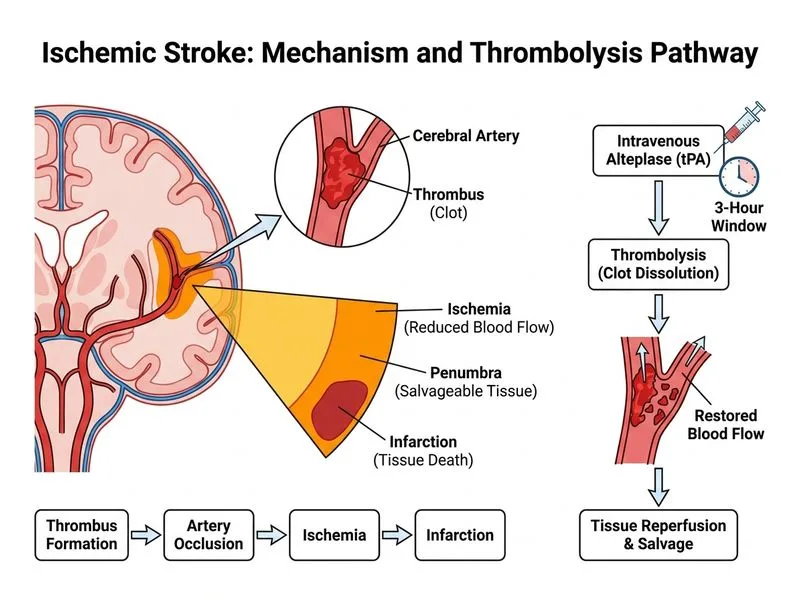
Sign up free to access AI-powered MCQ practice with detailed explanations and adaptive learning.