
## Distinguishing Features of Jejunum vs. Ileum **Key Point:** The jejunum has **fewer and thicker plicae circulares** (circular mucosal folds) that extend completely across the bowel lumen, whereas the ileum has **more numerous and thinner plicae** that are often interrupted. **Comparative Anatomy:** | Feature | Jejunum | Ileum | |---|---|---| | **Plicae circulares** | Fewer, thicker, complete | More, thinner, interrupted | | **Diameter** | Wider (3–4 cm) | Narrower (2–3 cm) | | **Wall thickness** | Thicker | Thinner | | **Mesentery** | Shorter, less fat | Longer, more fat | | **Peyer's patches** | Absent or sparse | Abundant | | **Vasa recta** | Long, few branches | Short, many branches | **Clinical Pearl:** On barium studies, the jejunum appears as a "**feathery**" or "**ladder-like**" pattern due to prominent, continuous plicae, while the ileum shows a more irregular, "**string of pearls**" appearance due to interrupted folds and Peyer's patches. **High-Yield:** This distinction is crucial for radiological diagnosis and understanding small bowel pathology. Jejunal ulcers (as in Zollinger-Ellison syndrome) are more common than ileal ulcers. 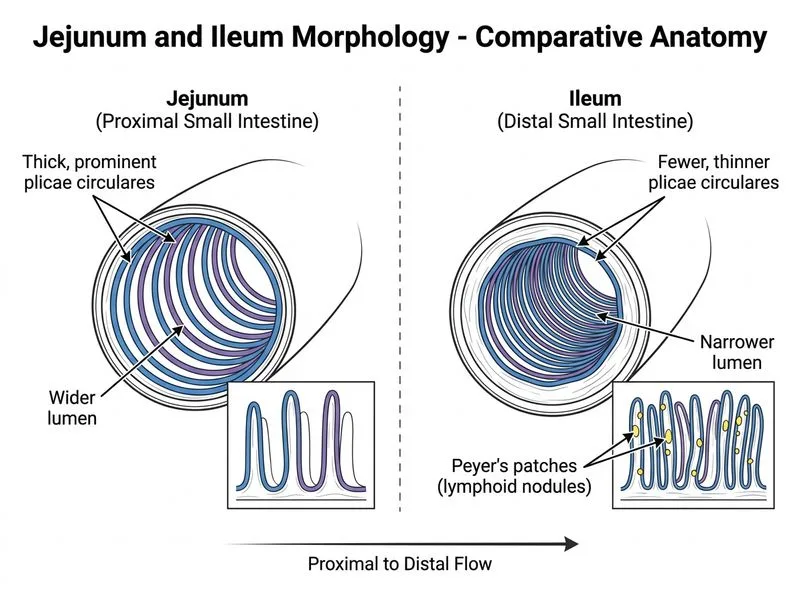
Sign up free to access AI-powered MCQ practice with detailed explanations and adaptive learning.