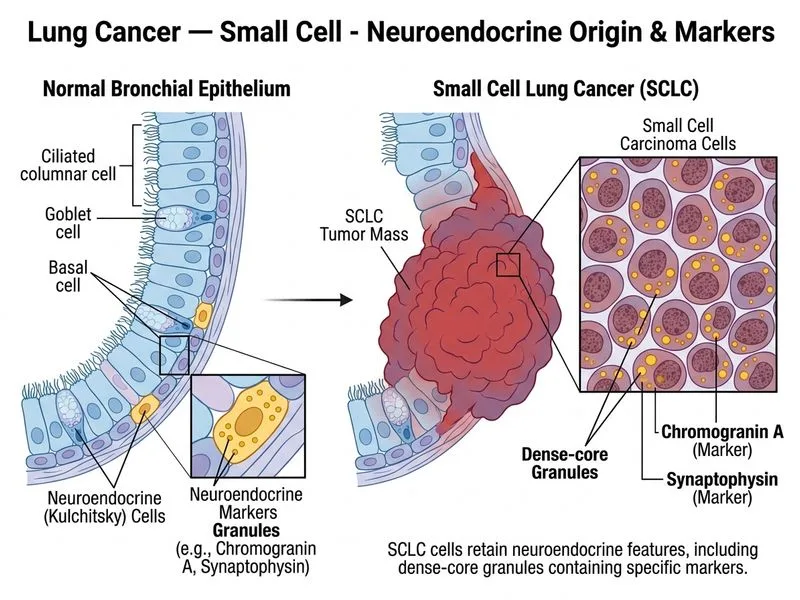
## Neuroendocrine Differentiation in SCLC **Key Point:** Small cell lung cancer is a high-grade neuroendocrine malignancy that consistently expresses neuroendocrine markers. ### Diagnostic Markers | Marker | SCLC | Non-SCLC | Adenocarcinoma | |--------|------|----------|----------------| | Chromogranin A | ✓ (>90%) | ✗ | ✗ | | Synaptophysin | ✓ (>90%) | ✗ | ✗ | | CD56 | ✓ (>90%) | ✗ | ✗ | | CEA | ✗ | ✓ | ✓ | | TTF-1 | ✓ (>90%) | ✓ | ✓ | **High-Yield:** Chromogranin A and synaptophysin are the **gold standard neuroendocrine markers** for SCLC diagnosis. These are detected by immunohistochemistry on biopsy or cytology specimens. ### Clinical Significance - **Chromogranin A** is also elevated in serum and can be used as a tumor marker for monitoring treatment response and recurrence. - **Synaptophysin** is highly specific for neuroendocrine differentiation. - Both markers help distinguish SCLC from non-small cell lung cancer (NSCLC), which typically lacks these markers. **Clinical Pearl:** SCLC also frequently co-expresses TTF-1 (thyroid transcription factor-1), which is a pan-lung cancer marker but is not specific for neuroendocrine differentiation. **Mnemonic:** **SCLC = SYN-CHRO** — **SYN**aptophysin and **CHRO**mogranin A are the hallmark markers. 
Sign up free to access AI-powered MCQ practice with detailed explanations and adaptive learning.