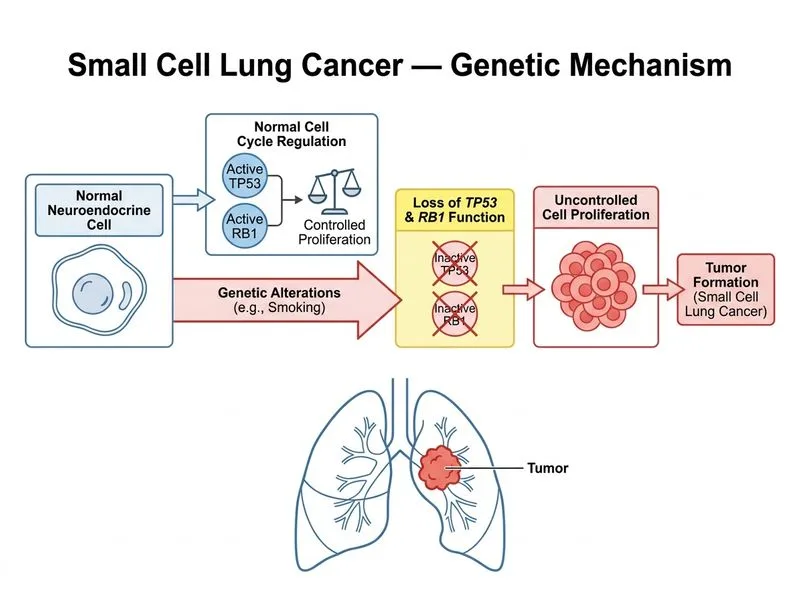
## Molecular Genetics of SCLC **Key Point:** SCLC is characterized by near-universal inactivation of **two critical tumor suppressors: TP53 and RB1**. This dual loss is the defining molecular signature of SCLC. ### Genetic Landscape of SCLC | Alteration | Frequency | Significance | |------------|-----------|---------------| | TP53 inactivation | >90% | Loss of p53-mediated apoptosis and cell cycle control | | RB1 inactivation | >90% | Loss of G1/S checkpoint control | | PTEN loss | ~40% | PI3K/AKT pathway activation | | NOTCH inactivation | ~25% | Loss of differentiation signals | | EGFR mutation | <5% | Rare in SCLC (common in adenocarcinoma) | | ALK translocation | <5% | Rare in SCLC (characteristic of NSCLC) | | KRAS mutation | ~5% | Uncommon; more typical of NSCLC adenocarcinoma | **High-Yield:** The **TP53 + RB1 dual inactivation** is present in >90% of SCLC cases and is considered the molecular hallmark. This combination drives the aggressive phenotype and rapid cell cycle progression characteristic of SCLC. ### Pathogenic Mechanism 1. **TP53 loss** → Impaired apoptosis, genomic instability, loss of p21-mediated cell cycle arrest 2. **RB1 loss** → Uncontrolled G1/S transition, loss of E2F repression, increased proliferation 3. **Combined effect** → Highly aggressive tumor with rapid doubling time and early metastasis **Clinical Pearl:** SCLC is exquisitely sensitive to initial chemotherapy (platinum + etoposide) due to high apoptotic potential when TP53 is lost. However, resistance develops rapidly, explaining the poor long-term survival despite initial response. **Mnemonic:** **SCLC = TP53 + RB1 KNOCKOUT** — Remember that SCLC is defined by loss of BOTH checkpoint guardians (p53 and Rb), not just one. 
Sign up free to access AI-powered MCQ practice with detailed explanations and adaptive learning.