
## Histological Subtypes of Classical Hodgkin Lymphoma **Key Point:** Lymphocyte-rich classical Hodgkin lymphoma (LRCHL) is defined by a rich background of small lymphocytes with sparse Reed-Sternberg (RS) cells and Hodgkin cells, and has the most favorable prognosis among all cHL subtypes. ### Comparative Features of cHL Subtypes | Subtype | Background Composition | RS Cell Density | Prognosis | Frequency | |---------|------------------------|-----------------|-----------|----------| | **Lymphocyte-rich** | Abundant small lymphocytes, eosinophils, plasma cells | Sparse | **Best** | 5% | | **Nodular sclerosis** | Fibrous bands, lacunar cells, variable cellularity | Moderate | Good | 60–70% | | **Mixed cellularity** | Mixed inflammatory infiltrate, numerous RS cells | Numerous | Intermediate | 15–25% | | **Lymphocyte-depleted** | Sparse lymphocytes, diffuse fibrosis, many RS cells | Abundant | **Worst** | <5% | **High-Yield:** The lymphocyte-rich subtype is sometimes confused with nodular lymphocyte-predominant Hodgkin lymphoma (NLPHL), but LRCHL has classical RS cells and CD30/CD15 positivity, whereas NLPHL has LP cells (CD20+, CD45+) and lacks RS cells. **Clinical Pearl:** LRCHL typically presents in early stages (I–II) with peripheral lymphadenopathy and has excellent 5-year survival rates (>90%), making it the most curable form of Hodgkin lymphoma. ### Why LRCHL Has the Best Prognosis 1. **Early-stage presentation** — often diagnosed at stage I or II 2. **Favorable biology** — sparse neoplastic burden suggests slower growth 3. **Excellent response to therapy** — chemotherapy and radiation highly effective 4. **Low risk of relapse** — fewer aggressive RS cells **Mnemonic:** **LRCHL = Limited Rare Cells, High Lymphocytes** — remember the abundant background lymphocytes and sparse neoplastic cells as the hallmark. 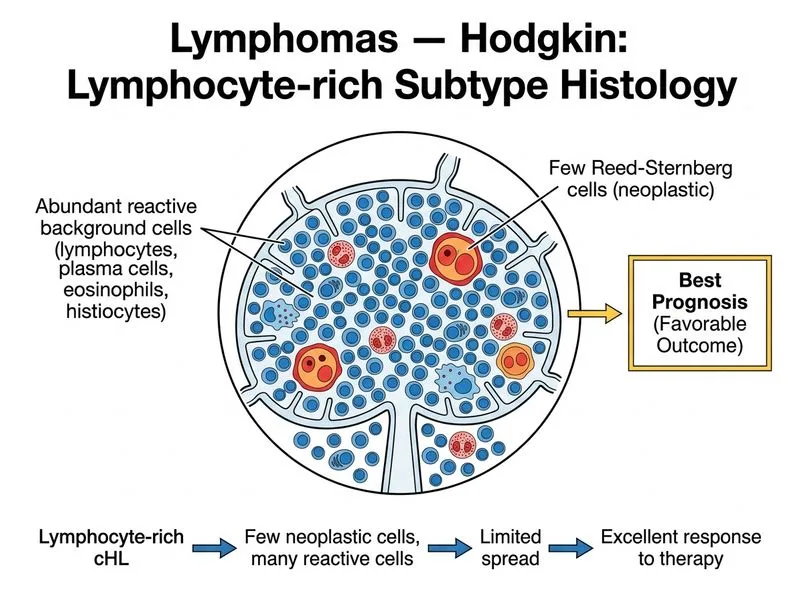
Sign up free to access AI-powered MCQ practice with detailed explanations and adaptive learning.