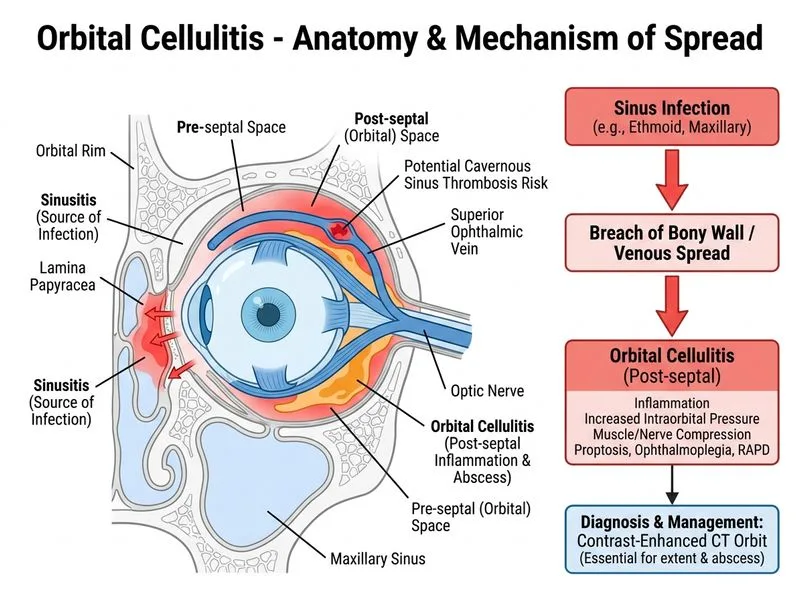
## Imaging Modality Selection in Orbital Cellulitis ### Role of CT in Orbital Cellulitis **Key Point:** Contrast-enhanced CT (CECT) orbit with both axial and coronal sections is the investigation of choice for suspected orbital cellulitis because it: - Rapidly identifies orbital inflammation and abscess formation - Demonstrates orbital fat stranding and globe displacement - Evaluates the paranasal sinuses (common source of infection) - Guides decisions about surgical drainage if abscess is present - Can be performed urgently in acute settings ### Why CT Over Other Modalities | Investigation | Advantage | Limitation in Orbital Cellulitis | |---|---|---| | **CT (CECT)** | Fast, shows bone/sinus involvement, guides drainage | Radiation exposure | | **MRI** | Superior soft-tissue resolution, no radiation | Slower, less accessible acutely, less useful for bone/sinus detail | | **Ultrasound B-scan** | Portable, no radiation | Poor visualization of posterior orbit, cannot assess sinuses | | **FFA** | Evaluates retinal perfusion | Does not image orbital structures, not diagnostic | ### Clinical Context **High-Yield:** In acute orbital cellulitis with fever, proptosis, and ophthalmoplegia, CT is preferred because: 1. Paranasal sinusitis (especially ethmoid) is the source in ~70% of cases 2. Abscess formation requires urgent drainage — CT shows the cavity and loculation 3. Imaging must be done emergently; CT is faster than MRI 4. Coronal sections specifically show medial rectus displacement and intraconal involvement **Clinical Pearl:** The presence of RAPD (relative afferent pupillary defect) in this case suggests optic nerve involvement, making imaging urgent to rule out optic neuritis or compressive abscess. ### When MRI Is Preferred MRI is reserved for: - Suspected cavernous sinus thrombosis (superior soft-tissue detail) - Chronic/recurrent cellulitis (better for granulomatous disease) - When CT is contraindicated (pregnancy, iodine allergy) [cite:Harrison 21e Ch 428] 
Sign up free to access AI-powered MCQ practice with detailed explanations and adaptive learning.