Which biochemical feature best distinguishes the oxidative phase of the pentose phosphate pathway from the non-oxidative phase?
A. Regeneration of glucose-6-phosphate from non-sugar precursors
B. Synthesis of ribose-5-phosphate for nucleotide biosynthesis
C. Isomerization and epimerization of sugar phosphates
D. Production of NADPH and CO₂ release
Explanation
Oxidative vs Non-Oxidative Phases of the Pentose Phosphate Pathway
Oxidative Phase (Irreversible)
Key Point
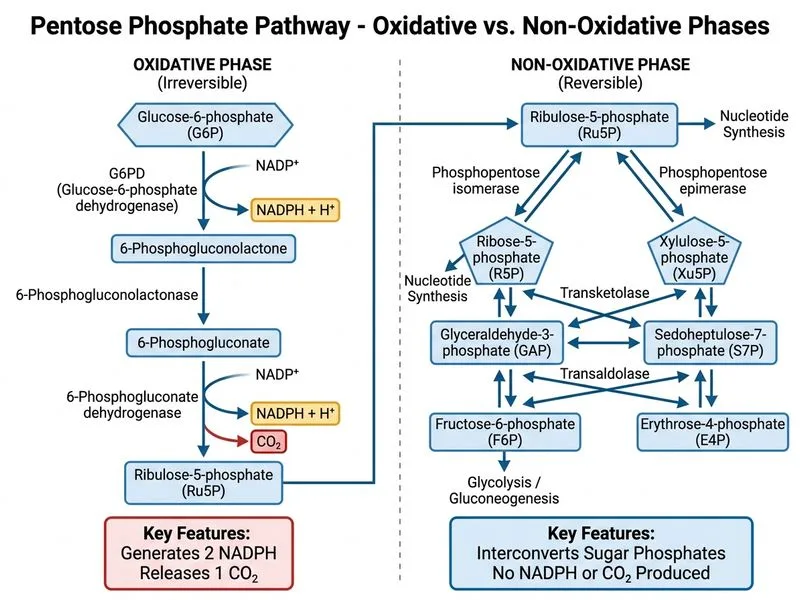
The oxidative phase is characterized by two sequential dehydrogenation reactions catalyzed by glucose-6-phosphate dehydrogenase (G6PD) and 6-phosphogluconate dehydrogenase, resulting in the release of CO₂ and generation of NADPH.
Each glucose-6-phosphate oxidized yields 2 NADPH and 1 CO₂.
Non-Oxidative Phase (Reversible)
Key Point
This phase consists of a series of reversible transketolase and transaldolase reactions that shuffle carbon skeletons between sugar phosphates without loss of carbon or generation of reducing equivalents.
G6PD deficiency affects only the oxidative phase, impairing NADPH production and causing hemolytic anemia under oxidative stress. The non-oxidative phase remains intact.
Mnemonic
NADPH CO₂ = Oxidative (the two products that leave the pathway). Transketolase/transaldolase shuffling = Non-oxidative.
Why This Distinguishes the Two Phases
The production of NADPH and release of CO₂ are unique and exclusive to the oxidative phase. These are irreversible, committed steps that define the oxidative arm. The non-oxidative phase, by contrast, is purely a rearrangement of carbon skeletons with no net loss of carbon or generation of reducing power.
Loading illustration…
Practice similar questions
Sign up free to access AI-powered MCQ practice with detailed explanations and adaptive learning.