Pharmacodynamics and Receptor Theory MCQ — NEET PG Practice Question | NEETPGAI
Pharmacodynamics and Receptor Theory
hard
pill Pharmacology
A 38-year-old woman with asthma is prescribed albuterol (salbutamol) 2 puffs every 4–6 hours as needed. After 3 months of frequent use (8–10 puffs daily), she reports that each dose now provides only 2–3 hours of bronchodilation instead of the usual 4–6 hours, and her peak flow improvement is noticeably reduced. She denies any change in inhaler technique or adherence to other medications. Pulmonary function testing shows baseline FEV₁ has declined. Which receptor-level mechanism best explains her loss of bronchodilator efficacy?
A. Desensitization and downregulation of β2-adrenergic receptors due to chronic agonist exposure
B. Competitive inhibition of albuterol by increased endogenous epinephrine from chronic stress
C. Irreversible antagonism of β2-receptors by a metabolite of albuterol
D. Pharmacokinetic tolerance from accelerated hepatic metabolism of albuterol
Explanation
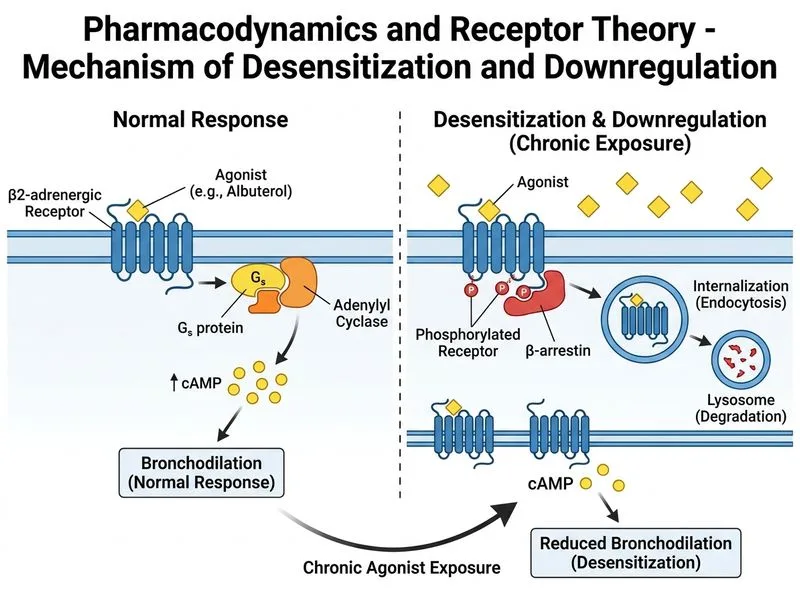
Receptor Desensitization and Downregulation in β2-Agonist Tolerance
Key Point
Chronic exposure to β2-agonists causes tachyphylaxis (loss of responsiveness) through two interconnected mechanisms: rapid desensitization (phosphorylation and uncoupling) and slower downregulation (receptor internalization and degradation).
Desensitization reduces receptor-effector coupling; same dose produces weaker signal
Reduced peak flow improvement
Downregulation decreases total receptor number; fewer receptors available to activate
Declined baseline FEV₁
Loss of basal β2-mediated bronchodilation; airway tone increases at rest
Frequency-dependent (8–10 puffs/day)
Continuous agonist exposure prevents receptor resensitization between doses
High-YieldNEET PG
This is tachyphylaxis, not tolerance. Tolerance implies pharmacokinetic changes (altered absorption, metabolism, distribution); tachyphylaxis is purely pharmacodynamic (receptor-level loss of responsiveness).
Why Frequent Use Accelerates Loss of Efficacy
With dosing every 4–6 hours and 8–10 puffs daily, the patient maintains near-continuous β2-agonist stimulation. This prevents:
Dephosphorylation of receptors between doses
Resensitization of uncoupled receptors
Upregulation to compensate for downregulation
Result: Progressive accumulation of desensitized and downregulated receptors.
Clinical Pearl: The "Paradox" of Increased Use
Increasing albuterol use to combat worsening symptoms actually accelerates tachyphylaxis, creating a vicious cycle:
More frequent use → more desensitization → less efficacy → patient uses more → worse desensitization
This is why guidelines recommend limiting SABA use to ≤2 days/week and adding a long-acting inhaled corticosteroid (ICS) if SABA use exceeds this threshold.