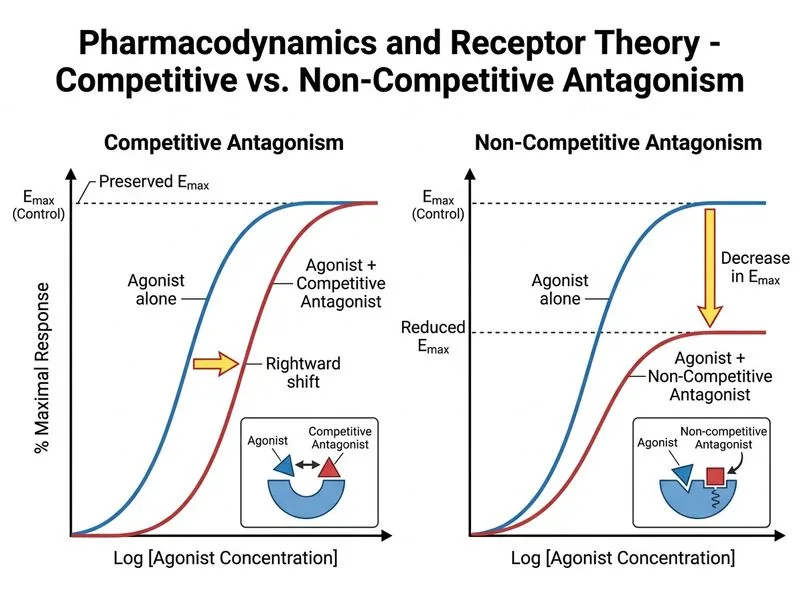
## Competitive vs. Non-Competitive Antagonism ### Dose–Response Curve Signatures **Key Point:** The dose–response curve pattern is the gold-standard discriminator between competitive and non-competitive antagonism. | Feature | Competitive Antagonist | Non-Competitive Antagonist | | --- | --- | --- | | **Binding** | Reversible; competes with agonist | Reversible or irreversible; does not compete | | **Dose–Response Curve Shift** | Rightward (increased EC₅₀) | Rightward AND downward | | **Maximum Effect (E_max)** | Preserved (100% achievable with ↑ agonist dose) | Reduced (<100% even with ↑ agonist dose) | | **Mechanism** | Occupies same binding site as agonist | Binds allosteric site or causes conformational change | | **Reversibility** | Reversible by excess agonist | NOT reversible by excess agonist | | **Schild Plot** | Linear (slope = 1) | Non-linear or slope ≠ 1 | ### Competitive Antagonism — Rightward Shift, E_max Preserved **High-Yield:** Competitive antagonists bind reversibly to the same active site as the agonist. Increasing agonist concentration overcomes the antagonism: - **Curve shifts RIGHT** (EC₅₀ increases) - **Maximum effect PRESERVED** (E_max = 100%) - **Slope unchanged** **Clinical Pearl:** Histamine H₂-receptor antagonists (cimetidine, ranitidine) are competitive antagonists of histamine at gastric parietal cells. Higher histamine concentrations (or exogenous agonist) can overcome blockade. ### Non-Competitive Antagonism — Rightward AND Downward Shift **High-Yield:** Non-competitive antagonists bind to an allosteric site (or irreversibly to the active site) and cannot be overcome by increasing agonist concentration: - **Curve shifts RIGHT** (EC₅₀ increases) - **Maximum effect REDUCED** (E_max < 100%) - **Slope unchanged** **Clinical Pearl:** Phenoxybenzamine (α-adrenergic antagonist) is a non-competitive antagonist that covalently binds α-receptors. Even maximal catecholamine doses cannot fully restore adrenergic response. ### Mnemonic **CREW** — Competitive: Reversible, Excess agonist overcomes, Wins back E_max. **NARC** — Non-competitive: Allosteric, Resistant to excess agonist, Cannot restore E_max. ### Visual Concept ```mermaid flowchart TD A[Antagonist added to agonist dose-response curve]:::outcome --> B{Curve shifts right?}:::decision B -->|Yes| C{Can excess agonist restore E_max?}:::decision C -->|Yes| D[Competitive Antagonist]:::action C -->|No| E[Non-Competitive Antagonist]:::action B -->|No| F[Allosteric modulator or other mechanism]:::outcome ``` ### Why Option 1 (Competitive) is Correct Competitive antagonists produce a **rightward shift** of the dose–response curve (increased EC₅₀) while **preserving the maximum effect** (E_max remains 100%). This is the defining pharmacodynamic signature and is readily observed in dose–response experiments. 
Sign up free to access AI-powered MCQ practice with detailed explanations and adaptive learning.