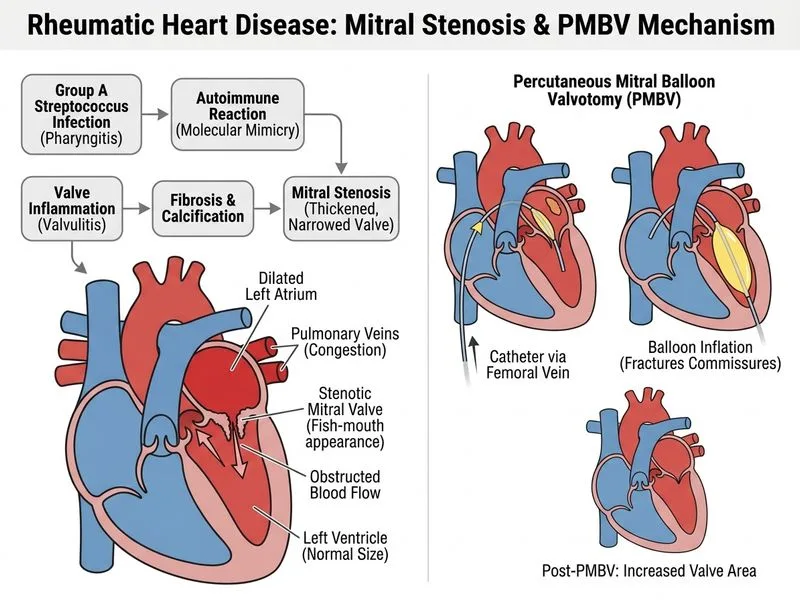
A 28-year-old woman from rural India presents with dyspnea on exertion and orthopnea for 3 months. On examination, she has an opening snap, diastolic murmur at the apex, and signs of pulmonary edema. Chest X-ray shows cardiomegaly and pulmonary congestion. Echocardiography confirms mitral stenosis with a valve area of 1.2 cm². She is currently on diuretics and digoxin. What is the most appropriate next step in management?
A. Increase the dose of diuretics and add a beta-blocker
B. Refer for percutaneous mitral balloon valvotomy (PMBV)
C. Perform cardiac catheterization to assess coronary artery involvement
D. Start anticoagulation with warfarin and continue medical management
Explanation
Clinical Context
This patient has symptomatic mitral stenosis (MS) with hemodynamically significant stenosis (valve area 1.2 cm²; normal >4 cm²) causing pulmonary edema despite medical therapy.
Indications for Percutaneous Mitral Balloon Valvotomy (PMBV)
Key Point
PMBV is the procedure of choice for symptomatic mitral stenosis with favorable valve morphology and no contraindications.
Table
Feature
Indication for PMBV
Symptoms
Symptomatic (NYHA II–IV)
Valve area
<1.5 cm²
Valve morphology
Pliable, non-calcified leaflets
LA thrombus
Absent
MR severity
Mild or none
Atrial fibrillation
May be present
High-YieldNEET PG
PMBV has superior outcomes to surgical mitral commissurotomy in suitable candidates and is the gold standard in India where rheumatic MS is endemic.
Why PMBV is Next
1.
Symptomatic despite medical therapy — diuretics and digoxin provide only symptomatic relief; they do not alter the structural stenosis.
2.
Hemodynamically significant stenosis — valve area 1.2 cm² is well below the 1.5 cm² threshold for intervention.
3.
Likely favorable anatomy — no mention of calcification, thrombus, or severe MR; typical of young Indian patients with rheumatic MS.
4.
Avoids surgery — PMBV is less invasive than open mitral commissurotomy or valve replacement.
Clinical Pearl
Opening snap and diastolic murmur indicate pliable leaflets—a favorable prognostic sign for PMBV success.
Management Algorithm
Loading diagram...
Mnemonic
PMBV FIRST — Pliable, Mitral, Balloon, Valvotomy = First-line for suitable MS.
Loading illustration…
Practice similar questions
Sign up free to access AI-powered MCQ practice with detailed explanations and adaptive learning.