
## Hemodynamic Analysis of Cardiogenic Shock ### Clinical Context This patient has **cardiogenic shock** secondary to acute MI with mechanical complication (likely acute mitral regurgitation from papillary muscle rupture, evidenced by the new holosystolic murmur). **Key Point:** Cardiogenic shock is characterized by **decreased cardiac output** and **compensatory increase in systemic vascular resistance** (cold shock). ### Hemodynamic Parameters in Cardiogenic Shock | Parameter | Cardiogenic Shock | Normal | Septic Shock (contrast) | |-----------|-------------------|--------|------------------------| | Cardiac Output | ↓ Decreased | Normal | ↑ Increased (early) | | SVR (Systemic Vascular Resistance) | ↑ Increased | Normal | ↓ Decreased | | Skin Temperature | Cold, clammy | Warm | Warm, flushed | | JVP | ↑ Elevated | Normal | Normal/low | | Lactate | ↑ Elevated | Normal | ↑ Elevated | | Pulmonary edema | Present | Absent | Absent (unless ARDS) | ### Pathophysiology of Cardiogenic Shock ```mermaid flowchart TD A[Acute MI with papillary muscle rupture]:::outcome --> B[Acute mitral regurgitation] B --> C[Decreased forward cardiac output] C --> D[Decreased systemic perfusion pressure]:::urgent D --> E[Baroreceptor reflex activation] E --> F[Sympathetic nervous system activation]:::action F --> G[Increased SVR and HR] G --> H[Increased myocardial oxygen demand]:::urgent H --> I[Worsening ischemia and shock]:::urgent C --> J[Increased LV end-diastolic pressure] J --> K[Pulmonary edema]:::outcome ``` **High-Yield:** The **compensatory increase in SVR** in cardiogenic shock is a double-edged sword: - **Benefit:** Maintains diastolic blood pressure and coronary perfusion pressure - **Cost:** Increases myocardial oxygen demand, worsening ischemia and contractility **Clinical Pearl:** Cold, clammy extremities with elevated JVP + pulmonary edema = cardiogenic shock until proven otherwise. The combination of decreased CO and increased SVR is pathognomonic. **Mnemonic: COLD SHOCK** — **C**ardiogenic, **O**utput ↓, **L**ow perfusion, **D**ecreased CO; **S**VR ↑, **H**ypotension, **O**liguria, **C**old extremities, **K**idney failure ### Why Each Hemodynamic Pattern Matters **Distributive shock** (sepsis, anaphylaxis) → ↓ SVR + ↑ CO (warm shock) **Cardiogenic shock** → ↓ CO + ↑ SVR (cold shock) **Hypovolemic shock** → ↓ CO + ↑ SVR (cold shock, but with hypovolemia) **Obstructive shock** (PE, tamponade) → ↓ CO + ↑ SVR (cold shock, but with mechanical obstruction) [cite:Robbins 10e Ch 4; Harrison 21e Ch 297] 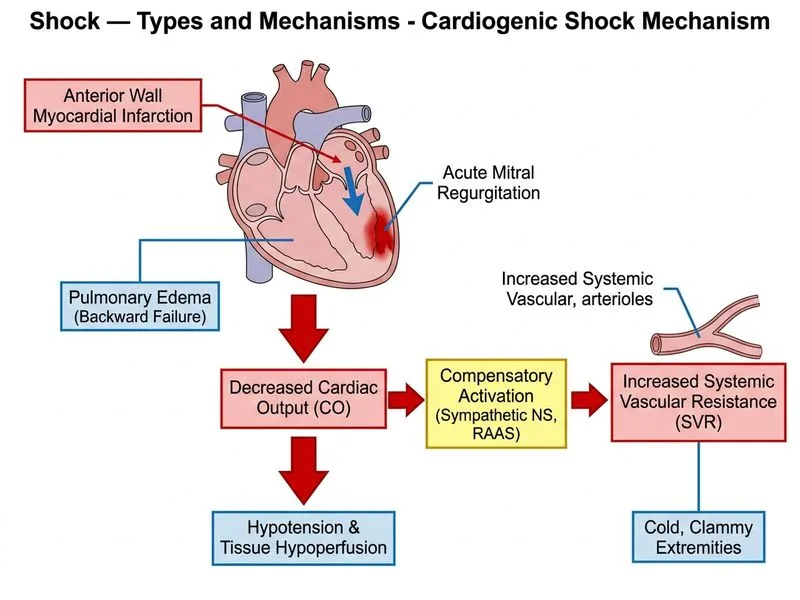
Sign up free to access AI-powered MCQ practice with detailed explanations and adaptive learning.