
## Clinical Presentation Analysis The patient presents with: - **Age 7 years** with **sickle cell disease** (confirmed by blood smear) - **Acute severe bone pain** with fever and swelling - **Periosteal new bone formation** and **areas of infarction** on X-ray - **Recurrent episodes** since early childhood ## Pathophysiology of Bone Involvement in Sickle Cell Disease **Key Point:** Acute bone infarction (vaso-occlusive crisis) is the most common acute bone complication in sickle cell disease, occurring when polymerized hemoglobin S causes sickling, vascular occlusion, and tissue ischemia. ### Mechanism of Bone Infarction 1. **Hemoglobin S polymerization** → red cell rigidity 2. **Vascular occlusion** → decreased blood flow to bone 3. **Tissue hypoxia** → bone marrow and cortical necrosis 4. **Inflammatory response** → pain, swelling, periosteal reaction ## Distinguishing Features from Osteomyelitis | Feature | Bone Infarction (SCD) | Osteomyelitis (Salmonella) | |---------|----------------------|---------------------------| | **Onset** | Acute, recurrent | Acute, often first episode | | **Fever** | Low-grade or absent | High fever (>39°C) | | **Blood cultures** | Negative | Positive for organism | | **WBC count** | Mild elevation | Marked elevation (>15,000) | | **ESR/CRP** | Mildly elevated | Markedly elevated | | **Imaging** | Infarction pattern, periosteal reaction | Localized lysis, sequestra | | **Response to antibiotics** | No improvement | Improvement | **Clinical Pearl:** Salmonella osteomyelitis in sickle cell disease occurs in ~5–10% of patients and is a *secondary* infection superimposed on bone infarction. The primary event here is vaso-occlusive infarction. ## High-Yield Facts About Sickle Cell Bone Crises **High-Yield:** - **Dactylitis** (hand-foot syndrome) is the earliest manifestation, typically in infants 6–12 months old - **Acute bone pain crisis** peaks in childhood and adolescence - **Avascular necrosis** of femoral and humeral heads is a late complication - **Periosteal new bone formation** reflects healing phase of infarction **Mnemonic: BONE CRISIS in SCD** — **B**one infarction, **O**steomyelitis (secondary), **N**ecrosis (avascular), **E**rythema; **C**risis (vaso-occlusive), **R**adiation findings (periosteal), **I**nfarction (cortical), **S**welling, **I**nflammation, **S**ickle cells (on smear) ## Why Fever Occurs in Bone Infarction Fever in acute bone infarction is due to: - Release of inflammatory cytokines from infarcted tissue - Tissue necrosis and sterile inflammation - NOT bacterial infection (unless secondary Salmonella osteomyelitis develops) [cite:Robbins 10e Ch 14] 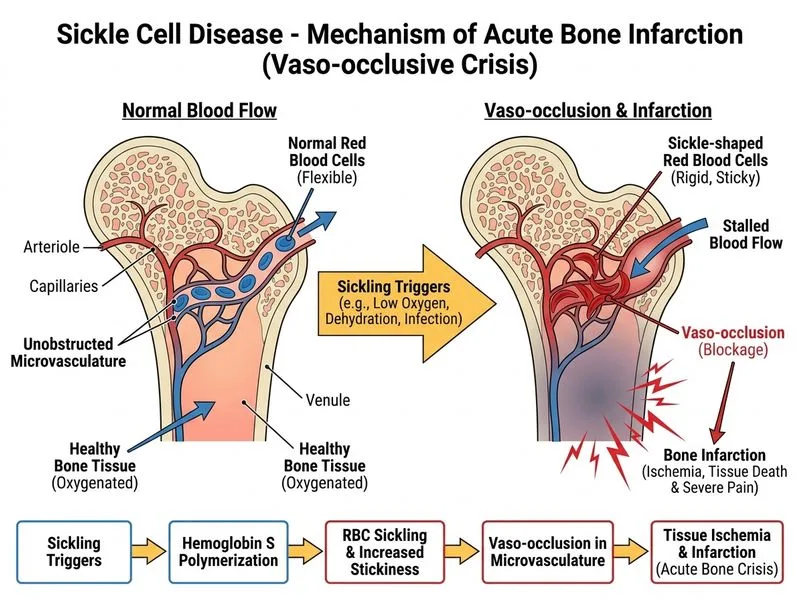
Sign up free to access AI-powered MCQ practice with detailed explanations and adaptive learning.