
## Molecular Basis of Sickle Cell Disease **Key Point:** Sickle cell disease results from a single nucleotide substitution in the β-globin gene (GAG → GTG at codon 6), causing glutamic acid (hydrophilic, negatively charged) to be replaced by valine (hydrophobic, nonpolar). ### Pathophysiological Consequence This substitution causes hemoglobin S (HbS) to polymerize under hypoxic and low pH conditions. The hydrophobic valine residue on the surface of the hemoglobin molecule promotes intermolecular interactions, leading to the formation of rigid polymers that distort red blood cells into the characteristic sickle shape. ### Clinical Relevance The change from a charged, hydrophilic amino acid to a nonpolar, hydrophobic one is critical — it fundamentally alters the protein's surface chemistry and solubility, making this substitution far more consequential than other possible amino acid changes at this position. **High-Yield:** Remember the mutation: **GAG → GTG** at codon 6 of the β-globin gene, resulting in **Glu → Val** substitution. 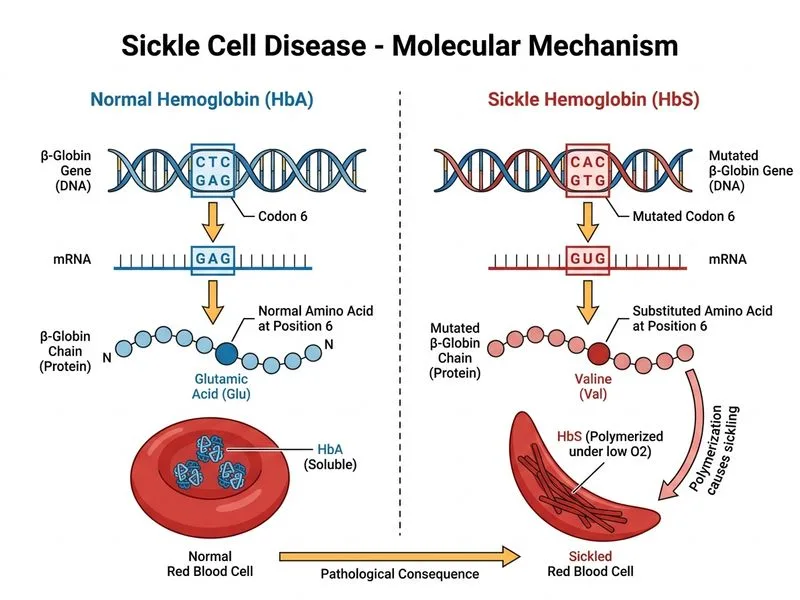
Sign up free to access AI-powered MCQ practice with detailed explanations and adaptive learning.