
The enzyme cleaves the high-energy thioester bond of succinyl-CoA and couples the energy release to GTP/ATP synthesis. This is the only direct ATP/GTP-generating step in the cycle; all other ATP comes from the electron transport chain.
| Enzyme | Substrate | Product | Cofactor | Energy Yield |
|---|---|---|---|---|
| Succinyl-CoA synthetase | Succinyl-CoA | Succinate | GTP/ATP, CoA | GTP/ATP (substrate-level) |
| Succinate dehydrogenase | Succinate | Fumarate | FAD | FADH₂ (oxidative) |
| Isocitrate dehydrogenase | Isocitrate | α-ketoglutarate | NAD⁺ | NADH (oxidative) |
| Fumarase | Fumarate | Malate | — | None (hydration) |
Loading illustration…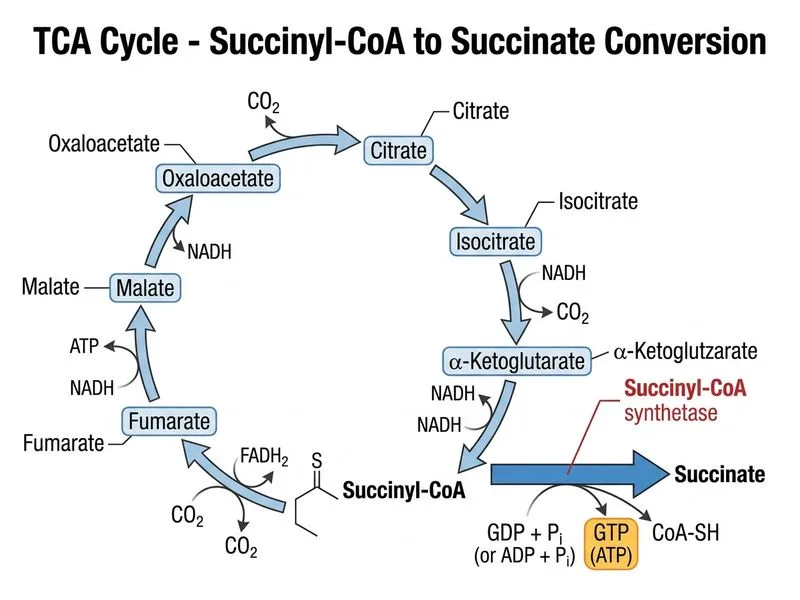
Sign up free to access AI-powered MCQ practice with detailed explanations and adaptive learning.
Daily MCQs, study tips, and topper strategies on Telegram.
Join on Telegram →