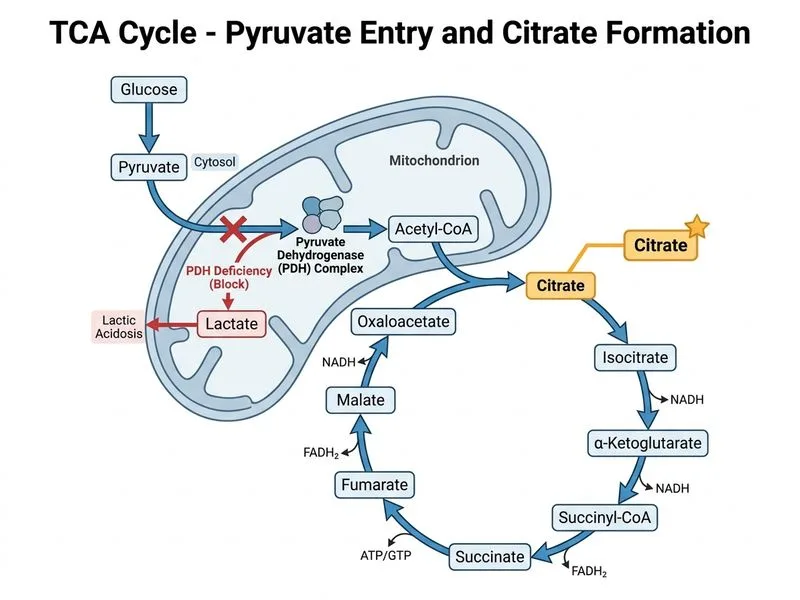
A 28-year-old woman from Delhi presents with progressive fatigue, muscle weakness, and recurrent episodes of lactic acidosis since childhood. Her mother had similar symptoms. Serum lactate is elevated at 8 mmol/L (normal <2). Pyruvate is 2.5 mmol/L (normal 0.3–0.9). MRI brain shows basal ganglia hyperintensities. Genetic testing reveals mutations in the PDHA1 gene encoding pyruvate dehydrogenase complex subunit E1α. Which of the following TCA cycle intermediates would be MOST depleted in this patient?
A. Citrate
B. Oxaloacetate
C. Acetyl-CoA
D. α-Ketoglutarate
Explanation
Pathophysiology of Pyruvate Dehydrogenase Deficiency
The Enzymatic Block
Key Point
Pyruvate dehydrogenase complex (PDH) catalyzes the irreversible conversion of pyruvate → Acetyl-CoA, the critical entry point into the TCA cycle. PDHA1 mutations cause loss of PDH function, directly preventing Acetyl-CoA formation — making Acetyl-CoA the most directly and severely depleted metabolite.
Metabolic Consequences
1.
Pyruvate accumulation → shunted to lactate (explaining lactic acidosis) and alanine
2.
Acetyl-CoA depletion → the direct product of the blocked reaction; cannot condense with oxaloacetate to form citrate
3.
Citrate secondarily depleted → because its substrate (Acetyl-CoA) is unavailable
4.
Oxaloacetate paradoxically increases → cannot be consumed (no Acetyl-CoA available for citrate synthase)
TCA Cycle Flux Analysis
Table
Parameter
Expected Change
Reason
Lactate
↑↑ (8 mmol/L)
Pyruvate shunted to lactate
Pyruvate
↑ (2.5 mmol/L)
Cannot be oxidized by PDH
Acetyl-CoA
↓↓↓ (MOST depleted)
Direct enzymatic block — product of PDH
Citrate
↓↓
Secondary depletion — no Acetyl-CoA substrate
Oxaloacetate
↑
Accumulates (no Acetyl-CoA to condense with)
ATP
↓
TCA cycle shutdown → energy crisis
Why Acetyl-CoA is MOST Depleted
High-YieldNEET PG
The PDH complex is the sole enzymatic source of Acetyl-CoA from pyruvate in mitochondria. In PDH deficiency:
Acetyl-CoA cannot be produced from pyruvate at all
Citrate is secondarily depleted, but Acetyl-CoA is the direct, immediate product of the blocked step — it is depleted first and to the greatest extent
Citrate synthase (Acetyl-CoA + OAA → Citrate) cannot proceed without its substrate
Why not Citrate (Option B)? Citrate is depleted secondarily because Acetyl-CoA is unavailable. The question asks for the most depleted intermediate — the direct product of the blocked reaction (Acetyl-CoA) is depleted before and more severely than any downstream intermediate.
Clinical Pearl
The combination of lactic acidosis + basal ganglia hyperintensities on MRI is pathognomonic for PDH deficiency — energy failure in high-metabolic tissues (brain, muscle) causes neurodegeneration. Treatment includes a ketogenic diet (bypasses PDH by providing Acetyl-CoA directly from fatty acid β-oxidation). (Harper's Illustrated Biochemistry, 31st ed., Chapter 17)
Mnemonic: "PDH blocks the door" — PDH deficiency = pyruvate cannot enter TCA → Acetyl-CoA is the bottleneck → citrate never forms → entire TCA cycle starves downstream.
Loading illustration…
Practice similar questions
Sign up free to access AI-powered MCQ practice with detailed explanations and adaptive learning.