
This multi-enzyme architecture allows sequential transfer of the acetyl group through multiple cofactors, making it a highly regulated entry point into the TCA cycle.
| Feature | Pyruvate Dehydrogenase | Isocitrate Dehydrogenase |
|---|---|---|
| Structure | Multi-enzyme complex (E1, E2, E3) | Single enzyme |
| Cofactors | TPP, lipoic acid, CoA, NAD+, FAD | NAD+ (or NADP+) only |
| Regulation | Highly regulated (phosphorylation, allosteric) | Moderately regulated (ADP, Ca²⁺ activate) |
| Location | Mitochondrial matrix (as complex) | Mitochondrial matrix |
| Product | Acetyl-CoA | α-Ketoglutarate |
Option 1 is the most fundamental and testable distinction: PDH is a multi-enzyme complex; IDH is a single enzyme. This structural difference explains all downstream differences in cofactor requirements, regulation, and clinical significance.
Loading illustration…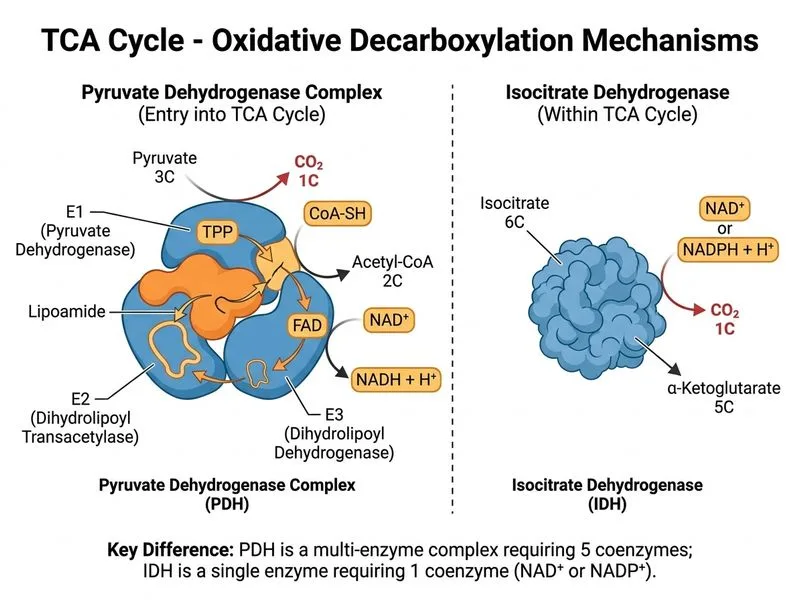
Sign up free to access AI-powered MCQ practice with detailed explanations and adaptive learning.
Daily MCQs, study tips, and topper strategies on Telegram.
Join on Telegram →