
## CA-125 in Ovarian Cancer: Prognostic and Monitoring Value ### CA-125: Overview **Key Point:** CA-125 is a high-molecular-weight glycoprotein antigen (mucin-like) that is elevated in 80–90% of epithelial ovarian cancers. It is **not diagnostic** but is invaluable for **prognosis, monitoring, and detecting recurrence**. **High-Yield:** CA-125 is elevated in: - Epithelial ovarian cancer (serous, mucinous, endometrioid, clear cell) - Other cancers: endometrial, pancreatic, gastric, lung - Benign conditions: menstruation, endometriosis, peritonitis, cirrhosis, pericarditis ### Prognostic Significance of CA-125 Decline | Parameter | Prognostic Implication | |-----------|------------------------| | **Preoperative CA-125 level** | Higher levels correlate with advanced stage and worse prognosis | | **Postoperative CA-125 decline** | Rapid normalization after surgery predicts better chemotherapy response and longer overall survival | | **Residual disease correlation** | If CA-125 remains elevated postoperatively, suggests incomplete cytoreduction (poor prognostic factor) | | **Chemotherapy response** | >50% decline in CA-125 during treatment predicts better outcome | | **Recurrence detection** | Rising CA-125 during follow-up is the earliest sign of recurrence (before imaging) | ### Clinical Interpretation in This Case **Favorable findings:** 1. **Rapid decline** from 580 to 45 U/mL (>90% reduction) within 2 weeks post-surgery 2. **Normalization** to near-normal range indicates effective cytoreduction 3. **Predicts chemotherapy response:** Patients with normalized CA-125 post-surgery have significantly better progression-free and overall survival **Clinical Pearl:** The postoperative CA-125 level is one of the strongest independent prognostic factors in ovarian cancer. A rapid decline to normal range after surgery is associated with 5-year survival rates of 40–50%, compared to <20% if CA-125 remains elevated. ### Role in Treatment Monitoring 1. **Baseline (preoperative):** Establishes tumor burden and prognosis 2. **Post-surgery:** Assesses adequacy of cytoreduction 3. **During chemotherapy:** Serial measurements track treatment response (>50% decline = good response) 4. **Follow-up:** Rising CA-125 is the earliest indicator of recurrence, often preceding imaging findings by months **Warning:** Normal postoperative CA-125 does **NOT** rule out microscopic residual disease; imaging and clinical assessment are also essential. [cite:Robbins 10e Ch 20] 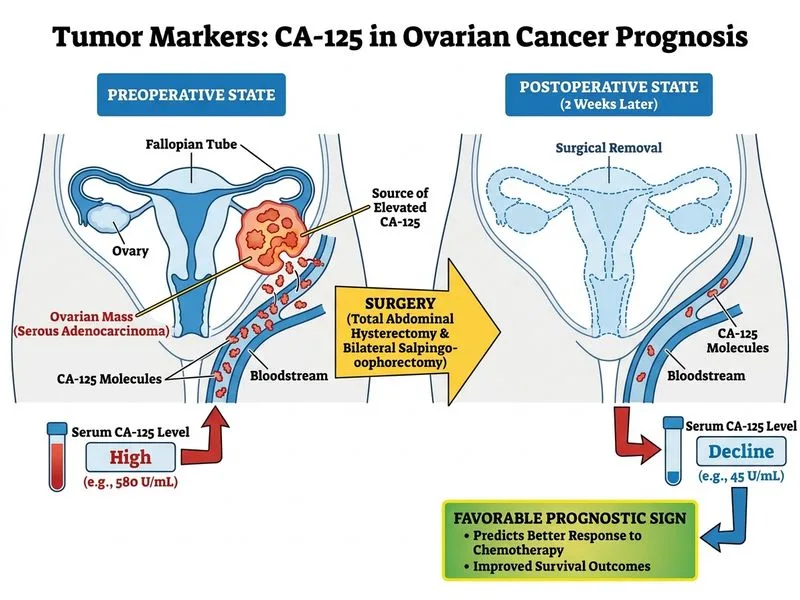
Sign up free to access AI-powered MCQ practice with detailed explanations and adaptive learning.