
## Two-Hit Hypothesis in TP53-Associated Cancer **Key Point:** This patient demonstrates Li-Fraumeni syndrome (LFS), caused by germline TP53 mutations. The classic two-hit hypothesis explains tumor development: the first hit is inherited (germline mutation), and the second hit occurs somatically in tumor cells. ### Mechanism of Tumorigenesis **High-Yield:** In germline TP53 carriers: 1. Every cell inherits one mutant TP53 allele (first hit) 2. A single somatic loss-of-function event in the remaining wild-type allele (second hit) in a cell leads to complete p53 loss 3. Without functional p53 (the "guardian of the genome"), cells escape: - G1/S checkpoint control - Apoptosis in response to DNA damage - Senescence pathways **Clinical Pearl:** This explains why LFS patients develop multiple primary cancers (sarcomas, breast, brain, adrenocortical) across different tissues—any cell can acquire the second hit. ### Why This Patient Is High-Risk | Feature | Significance | |---------|-------------| | Germline TP53 mutation | First hit present in all cells | | Retroperitoneal sarcoma at age 42 | Second hit in mesenchymal lineage | | Family history (mother: breast cancer age 38; brother: osteosarcoma age 16) | Autosomal dominant inheritance pattern | | Lifetime cancer risk in LFS | ~90% by age 70 | **Mnemonic:** **LFS = Li-Fraumeni Syndrome** — **L**oss of TP53 + **F**amilial clustering + **S**arcomas, breast, brain cancers **Warning:** Haploinsufficiency (one mutant allele alone causing disease) is NOT the mechanism in LFS; both alleles must be inactivated for tumor formation. 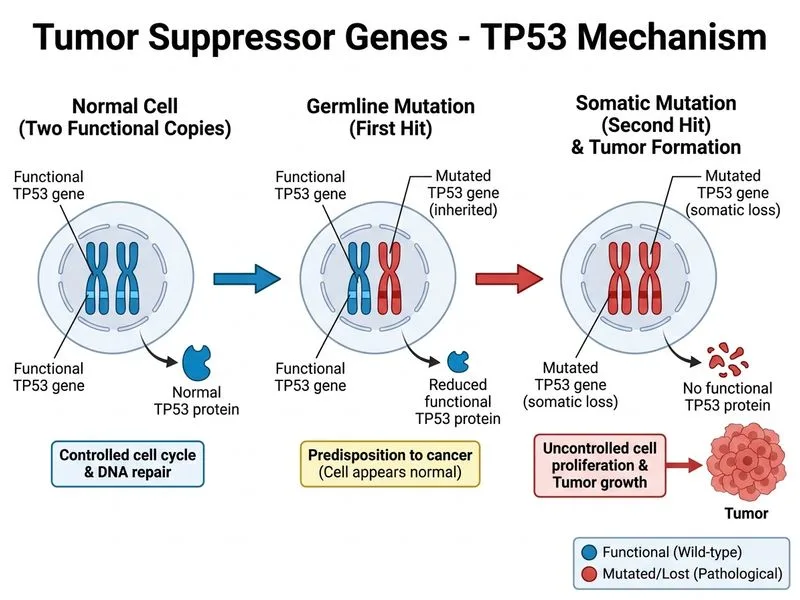
Sign up free to access AI-powered MCQ practice with detailed explanations and adaptive learning.