
## Clinical Context: Mitral Stenosis in Pregnancy This is a **high-yield, frequently tested scenario** in NEET PG. Pregnancy dramatically worsens mitral stenosis due to: - Increased cardiac output (30–50% increase) - Increased heart rate and shortened diastolic filling time - Increased blood volume and venous return - Decreased systemic vascular resistance (paradoxically increases flow across stenotic mitral valve) **Key Point:** Mitral stenosis is the **most common rheumatic valve lesion to cause hemodynamic decompensation in pregnancy**. A mitral valve area <1.5 cm² is considered **severe** and carries high risk of pulmonary edema and maternal mortality during pregnancy. ## Management Strategy in Pregnancy ### First-Line Medical Therapy 1. **Diuretics** (furosemide) — reduce pulmonary congestion 2. **Beta-blockers** (labetalol, atenolol) — reduce heart rate, increase diastolic filling time, reduce cardiac output 3. **Anticoagulation** if AF present (this patient does not have AF, so not immediately indicated unless other risk factors) **Clinical Pearl:** Beta-blockers are **safe in pregnancy** and are the preferred rate-controlling agent. Calcium channel blockers (diltiazem, verapamil) are also safe but less preferred than beta-blockers. ### Indications for Percutaneous Mitral Balloon Commissurotomy (PMBC) in Pregnancy - **Severe MS (MVA <1.5 cm²) with symptoms refractory to medical therapy** - **PMBC is safe in pregnancy** (second trimester preferred; first trimester avoided due to organogenesis) - **No left atrial thrombus** (this patient has none — favorable) - **Favorable anatomy** (Wilkins score ≤8) **High-Yield:** PMBC can be performed safely in the **second or early third trimester** if medical therapy fails. It is **preferred over surgery** in pregnancy due to lower fetal morbidity. ## Why This Answer Option 3 (rate control + diuretics + PMBC if symptoms worsen) is correct because: - It follows the **stepwise, evidence-based approach** for MS in pregnancy - Medical therapy is first-line and often sufficient if symptoms are mild-to-moderate - PMBC is reserved for **refractory symptoms** and carries acceptable risk in second trimester - The patient's favorable anatomy (no LA thrombus, likely good Wilkins score) makes her a candidate for PMBC if needed - This approach balances maternal safety with fetal well-being [cite:Harrison 21e Ch 297; Braunwald's Heart Disease 12e Ch 75] 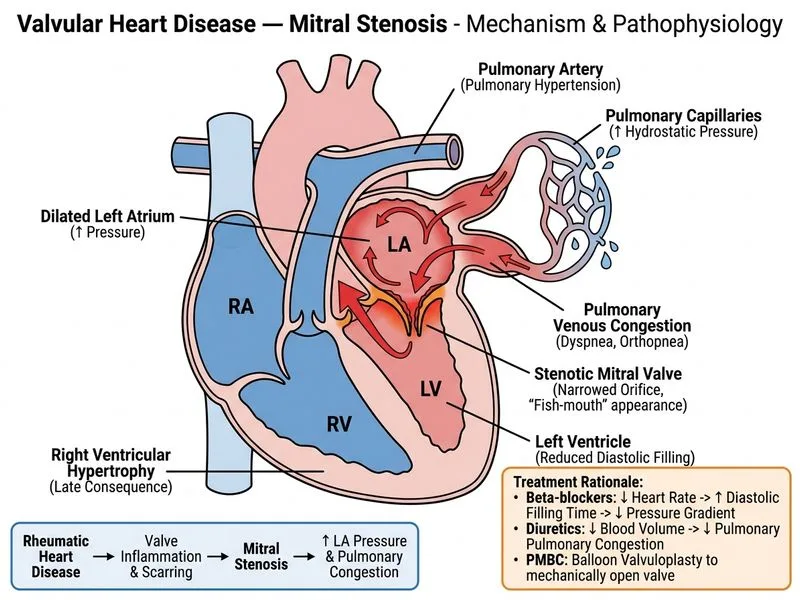
Sign up free to access AI-powered MCQ practice with detailed explanations and adaptive learning.