
## ANCA-Associated Vasculitides: Serologic Classification **Key Point:** Granulomatosis with polyangiitis (GPA) is characterized by c-ANCA (cytoplasmic pattern) with anti-proteinase 3 (anti-PR3) antibodies in 90% of generalized cases. ### ANCA Patterns and Their Associations | Vasculitis | ANCA Pattern | Antigen Target | Frequency | |---|---|---|---| | **GPA (Wegener)** | **c-ANCA** | **Anti-PR3** | **90% generalized** | | **MPA (Microscopic polyangiitis)** | p-ANCA | Anti-MPO | 60–80% | | **EGPA (Eosinophilic granulomatosis)** | p-ANCA | Anti-MPO | 40–60% | | **GPA (limited form)** | Negative | — | 10–15% | ### Pathophysiology of c-ANCA/Anti-PR3 1. Anti-PR3 antibodies bind to PR3 on neutrophil surface 2. Cross-linking activates neutrophils via Fc receptors 3. Release of proteolytic enzymes and reactive oxygen species 4. Endothelial injury and necrotizing vasculitis ### Clinical Significance - **c-ANCA/anti-PR3 positivity** strongly supports GPA diagnosis - Present in ~90% of generalized GPA with systemic involvement - May be negative in limited GPA (localized upper respiratory disease) - Titer correlates with disease activity in some patients **High-Yield:** c-ANCA = cytoplasmic = **GPA**; p-ANCA = perinuclear = **MPA/EGPA**. Remember: "c for cytoplasmic, GPA for granulomatosis." **Mnemonic:** **CGPA** — c-ANCA → GPA (Granulomatosis with Polyangiitis) **Clinical Pearl:** A patient with upper respiratory tract granulomatous inflammation, lower respiratory involvement, and glomerulonephritis who is c-ANCA/anti-PR3 positive has GPA until proven otherwise. [cite:Harrison 21e Ch 319] 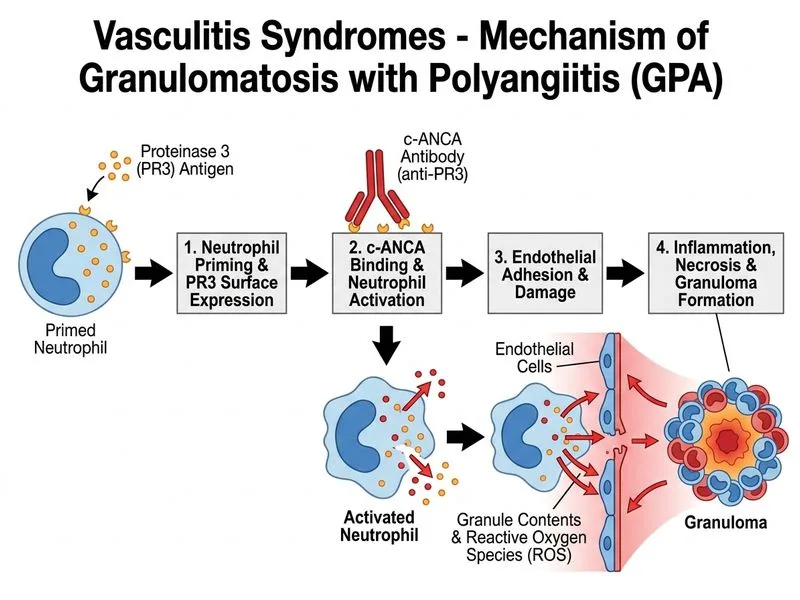
Sign up free to access AI-powered MCQ practice with detailed explanations and adaptive learning.