NEETPGAI
BlogComparePricing
Log inStart Free
NEETPGAI

AI-powered NEET PG preparation platform. Master all 19 subjects with adaptive MCQs, AI tutoring, and spaced repetition.

Product

  • Subjects
  • Previous Year Questions
  • Compare
  • Pricing
  • Blog

Features

  • Adaptive MCQ Practice
  • AI Tutor
  • Mock Tests
  • Spaced Repetition

Resources

  • Blog
  • Study Guides
  • NEET PG Updates
  • Help Center

Legal

  • Privacy Policy
  • Terms of Service

Stay updated

© 2026 NEETPGAI. All rights reserved.
    Practice 828+ Anesthesia MCQs
    Free signup · 10 MCQs/day · AI explanations
    Start Free
    SubjectsAnesthesia
    Clinical
    AI-powered

    Anesthesia for NEET PG 2026

    Free practice + topic-wise study material with AI explanations.

    107 daysto NEET PG 2026
    Exam date: 30 Aug 2026
    Your prep stageIntegration Phase
    Foundation
    180+ days
    Deep Study
    90-180 days
    Revision
    30-90 days
    Final Sprint
    <30 days

    Start full-length mocks. Identify and fix weak areas.

    1. 1Prioritise the 21 high-yield topics — they account for ~70% of Anesthesia questions every year.
    2. 2Practice 828+ topic-tagged MCQs with detailed AI explanations to build pattern recognition.
    3. 3Use SM-2 spaced repetition — wrong answers auto-schedule for review at expanding intervals.
    4. 4Revise PYQs from the last 5 years to spot recurring themes and adjust your priorities.
    5. 5Take subject-wise mock tests every 2 weeks to benchmark recall under exam conditions.
    Start Free PracticeGenerate AI Study Plan

    Anesthesia at a glance

    Live from MCQ bank
    828practice MCQs
    Updated daily as new questions are SME-approved.
    21
    HY
    high-yield topics
    ~70% of NEET PG Anesthesia marks come from these.
    35total topics
    Across 7 canonical systems.
    100% free to start. No credit card. 10 MCQs/day on the free tier.
    About Anesthesia in NEET PG

    What you need to know about Anesthesia

    Quick answer

    Anesthesia is the NEET PG subject that tests your ability to apply pharmacology, physiology, and clinical decision-making in perioperative scenarios — it contributes approximately 5% of the paper (range 3–7%), translating to roughly 10–14 questions in a 260-question paper. NEET PG 2026 will test you on drug mechanisms (Propofol, Ketamine, Succinylcholine), airway algorithms (Mallampati grading, Difficult Airway Society steps), and complication recognition (post-spinal headache, malignant hyperthermia). Prioritise the 12 high-yield topics — especially Rapid Sequence Induction, MAC values of inhalational agents, and Guedel's 4 stages — because these appear as single-best-answer stems built around clinical vignettes, not isolated facts. Revise muscle relaxant reversal agents (Neostigmine vs. Sugammadex) and ASA classification cut-offs alongside spinal anesthesia complications to cover the breadth efficiently. Spaced-repetition tools like NEETPGAI, which hosts 560 approved Anesthesia practice questions, compress the revision cycle to 7–10 days.

    Anesthesia in NEET PG 2026 is not a memory subject — it is a reasoning subject dressed in pharmacology. The 35 syllabus topics across 7 body systems demand that you understand why a drug is chosen, not just what it is. A question on Rapid Sequence Induction, for example, will test whether you know that cricoid pressure (Sellick's manoeuvre) is applied at 30–44 N of force and that Succinylcholine 1.5 mg/kg is the depolarising agent of choice precisely because its onset is 45–60 seconds — faster than any non-depolarising agent. That level of mechanistic clarity separates a 60-percentile score from a 90-percentile score.

    The subject sits at the intersection of Pharmacology (KD Tripathi, Chapters 27–30 on CNS depressants and neuromuscular blockers), Physiology (respiratory mechanics, oxygen-haemoglobin dissociation), and Surgery (preoperative assessment, ASA grading). During your MBBS internship postings in the OT, you likely saw these concepts in action — Mallampati Class III airways, failed intubation drills, spinal blocks for lower-segment caesarean sections. NEET PG rewards aspirants who can map that OT experience onto a 5-option MCQ.

    The syllabus shape is front-loaded: airway management (Mallampati, Endotracheal Intubation, Difficult Airway Algorithm, RSI, Awake Fiberoptic Intubation) and pharmacology (IV induction agents, inhalational agents, muscle relaxants) together account for roughly 60–65% of Anesthesia questions in previous NEET PG papers. Regional anesthesia — particularly spinal technique, baricity of agents, and complications like post-dural puncture headache and total spinal — forms the second major cluster. Stages of Anesthesia (Guedel's Classification) and fasting guidelines (NPO rules: 2 hours for clear fluids, 6 hours for solids per ASA 2023 guidelines) are shorter topics but appear with disproportionate frequency.

    A common misconception is treating Anesthesia as a low-priority subject because it is "only 5%." At 10–14 questions, a well-prepared aspirant can gain a net advantage of 30–42 marks over someone who skips it — a difference that shifts rank by hundreds in a competitive pool of 2+ lakh candidates. A second misconception is conflating MAC (Minimum Alveolar Concentration) with potency in a vague way: you must know specific MAC values — Desflurane 6%, Isoflurane 1.15%, Sevoflurane 2%, Halothane 0.75% — and understand that lower MAC = higher potency.

    Free PDF · NEET PG 2026

    Anesthesia High-Yield One-Liners

    200 textbook-style one-liners auto-extracted from approved Anesthesia MCQ explanations. Drop your email and we'll send the PDF — no spam, you can reply to unsubscribe.

    Highest-yield topics

    Anesthesia — focus areas that win the most marks

    These 12 topics historically carry a disproportionate share of Anesthesia questions on NEET PG. Tap any to start practising — the Anesthesia filter is pre-selected for you.

    Pre-anesthetic Evaluation

    ASA Physical Status Classification

    Start practising

    Pre-anesthetic Evaluation

    Fasting Guidelines

    Start practising

    Pre-anesthetic Evaluation

    Airway Assessment — Mallampati

    Start practising

    Airway Management

    Endotracheal Intubation

    Start practising

    Airway Management

    Difficult Airway Algorithm

    Start practising

    Airway Management

    Rapid Sequence Induction

    Start practising

    Airway Management

    Awake Fiberoptic Intubation

    Start practising

    General Anesthesia

    IV Induction Agents — Propofol, Thiopentone, Etomidate, Ketamine

    Start practising

    General Anesthesia

    Inhalational Agents — MAC and Properties

    Start practising

    General Anesthesia

    Muscle Relaxants — Depolarising and Non-depolarising

    Start practising

    General Anesthesia

    Stages of Anesthesia — Guedel's Classification

    Start practising

    Regional Anesthesia

    Spinal Anesthesia — Technique and Complications

    Start practising

    Preparation strategy

    How to prepare Anesthesia — tactics that work

    Five repeatable tactics that NEET PG toppers consistently use for Anesthesia. Below: a deeper play-by-play.

    Build a strong foundation

    Read each high-yield topic from one standard textbook before opening any question bank.

    Practice in tight loops

    After every chapter, attempt 20–30 topic-tagged MCQs while the concepts are still fresh.

    Schedule spaced reviews

    Push wrong answers into SM-2 review queues — short, frequent, expanding intervals beat marathon revisions.

    Mine the last 5 years of PYQs

    Map every PYQ to its parent topic. Recurring themes are louder signal than weightage tables.

    Stress-test with mock tests

    A subject-wise mock every fortnight surfaces blind spots before the real exam does.

    Time budget

    • Allocate 8–10 days of dedicated study for Anesthesia within your overall NEET PG 2026 schedule.
    • Daily target: 2 hours of reading + 20–25 MCQs from the NEETPGAI bank (560 questions = roughly 22–25 questions/day over 22 days if you spread it).
    • Reserve 1 full revision day at the end of each 2-week block specifically for Anesthesia pharmacology tables.

    Primary textbook

    • Morgan & Mikhail's Clinical Anesthesiology (Indian reprint, 6th edition) — use Chapters 7 (Inhalational Agents), 8 (IV Agents), 11 (Neuromuscular Blocking Drugs), and 17 (Spinal Anesthesia) as your core reading.
    • For MCQ-oriented revision, Anesthesia — A Practical Guide by Ajay Yadav (widely used in Indian PG prep) condenses tables on MAC values, drug doses, and Guedel's stages efficiently.

    Supplementary

    • KD Tripathi Essentials of Medical Pharmacology (9th edition), Chapter 27 — cross-reference for Propofol, Thiopentone, Etomidate, and Ketamine mechanisms; this also reinforces your Pharmacology paper simultaneously.

    Put this into a 30-minute session today

    We'll pre-select Anesthesia and serve a mixed difficulty set.

    Try a 10-MCQ set
    Syllabus map
    Anesthesia — full topic list
    35 topics across 7 systems · 21 marked high-yield
    • ASA Physical Status Classification
      High-yield
    • Fasting Guidelines
      High-yield
    • Airway Assessment — Mallampati
      High-yield
    • Pre-operative Cardiac Risk
      Moderate
    • Perioperative Management of Comorbidities
      Moderate
    • Bag-Mask Ventilation
      Moderate
    • Endotracheal Intubation
      High-yield
    • Supraglottic Airway Devices
      Moderate
    • Difficult Airway Algorithm
      High-yield
    • Rapid Sequence Induction
      High-yield
    • Awake Fiberoptic Intubation
      High-yield
    • IV Induction Agents — Propofol, Thiopentone, Etomidate, Ketamine
      High-yield
    • Inhalational Agents — MAC and Properties
      High-yield
    • Muscle Relaxants — Depolarising and Non-depolarising
      High-yield
    • Reversal Agents and Neuromuscular Monitoring
      Moderate
    • Stages of Anesthesia — Guedel's Classification
      High-yield
    • Induction Agent Selection in High-Risk Patients
      Moderate
    • Spinal Anesthesia — Technique and Complications
      High-yield
    • Epidural Anesthesia
      High-yield
    • Peripheral Nerve Blocks
      Moderate
    • Local Anesthetic Toxicity
      High-yield
    • Malignant Hyperthermia
      High-yield
    • Post-operative Nausea and Vomiting
      Moderate
    • Aspiration Pneumonitis
      Moderate
    • Hypotension and Hypoxia under Anaesthesia
      High-yield
    • Complications of Laparoscopic Anesthesia
      Moderate
    • Mechanical Ventilation Modes
      High-yield
    • Sedation and Analgesia in ICU
      Moderate
    • Cardiopulmonary Resuscitation — Advanced
      High-yield
    • Perioperative Fluid Therapy
      Moderate
    • Blood Transfusion in Surgery
      Moderate
    • Pain Management — Acute and Chronic
      High-yield
    • Patient-Controlled Analgesia
      High-yield
    • Opioid Pharmacology and Toxicity
      High-yield
    • Neuropathic Pain Management
      Moderate
    Today's NEET PG Anesthesia MCQ

    Test yourself in 60 seconds

    New question every day
    Inhalational Agents — MAC and Properties
    easy

    Which of the following inhalational anesthetic agents has the LOWEST MAC value?

    Tap an option to reveal the answer and AI explanation. New question rotates daily at midnight IST.

    Study guides

    Anesthesia study guides

    2 in-depth Anesthesia guides curated for NEET PG aspirants.
    Anesthesia Induction, Airway & Monitoring for NEET PG 2026
    28 Apr 2026
    anesthesia
    airway management

    Anesthesia Induction, Airway & Monitoring for NEET PG 2026

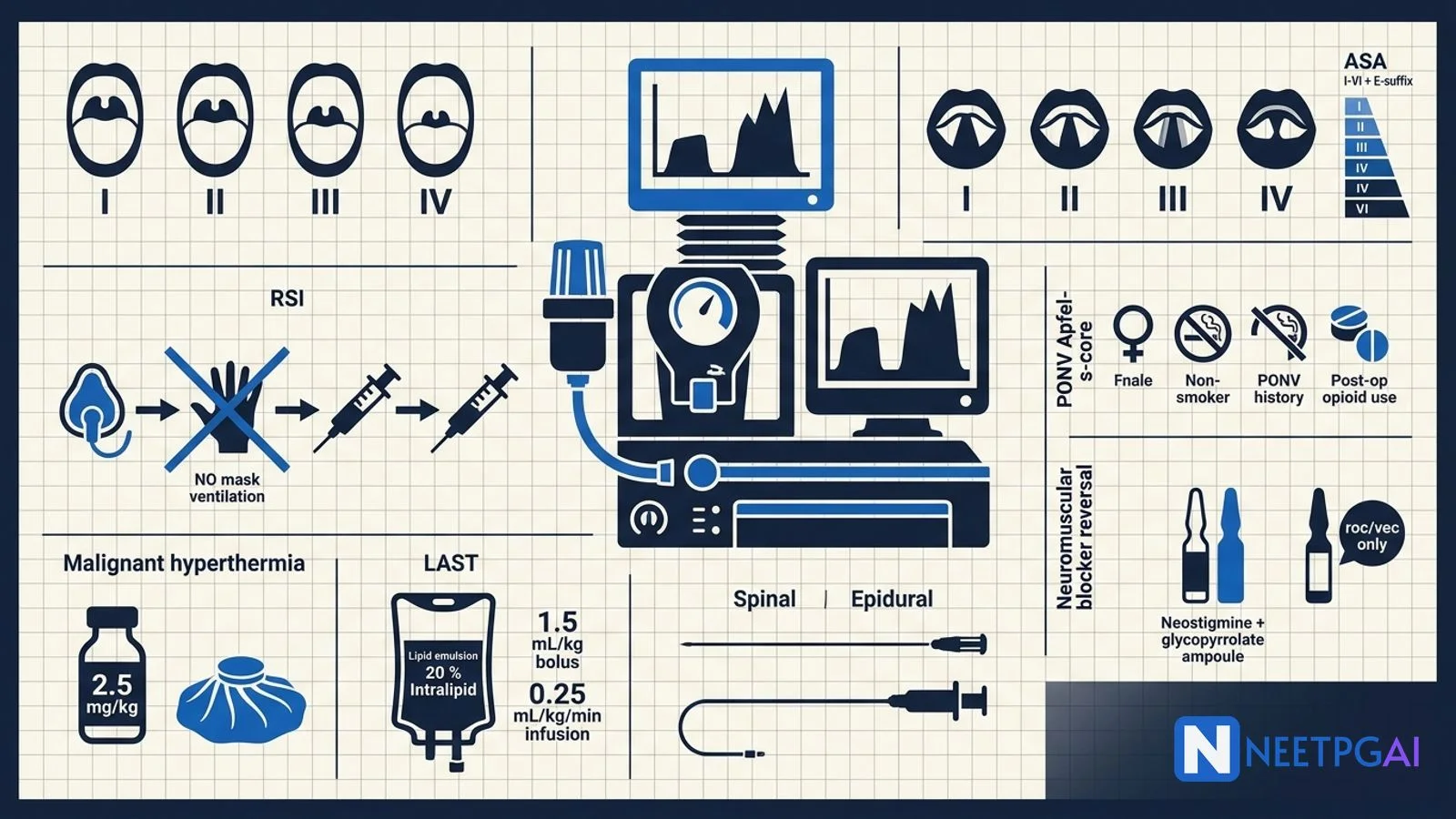
    Master anesthesia for NEET PG 2026 — ASA grading, Mallampati, induction agents, NMBs, inhalational agents, monitoring standards, and LAST management.

    Read more
    Chronic Pain & Palliative Care for NEET PG 2026
    26 Apr 2026
    anesthesia
    palliative care

    Chronic Pain & Palliative Care for NEET PG 2026

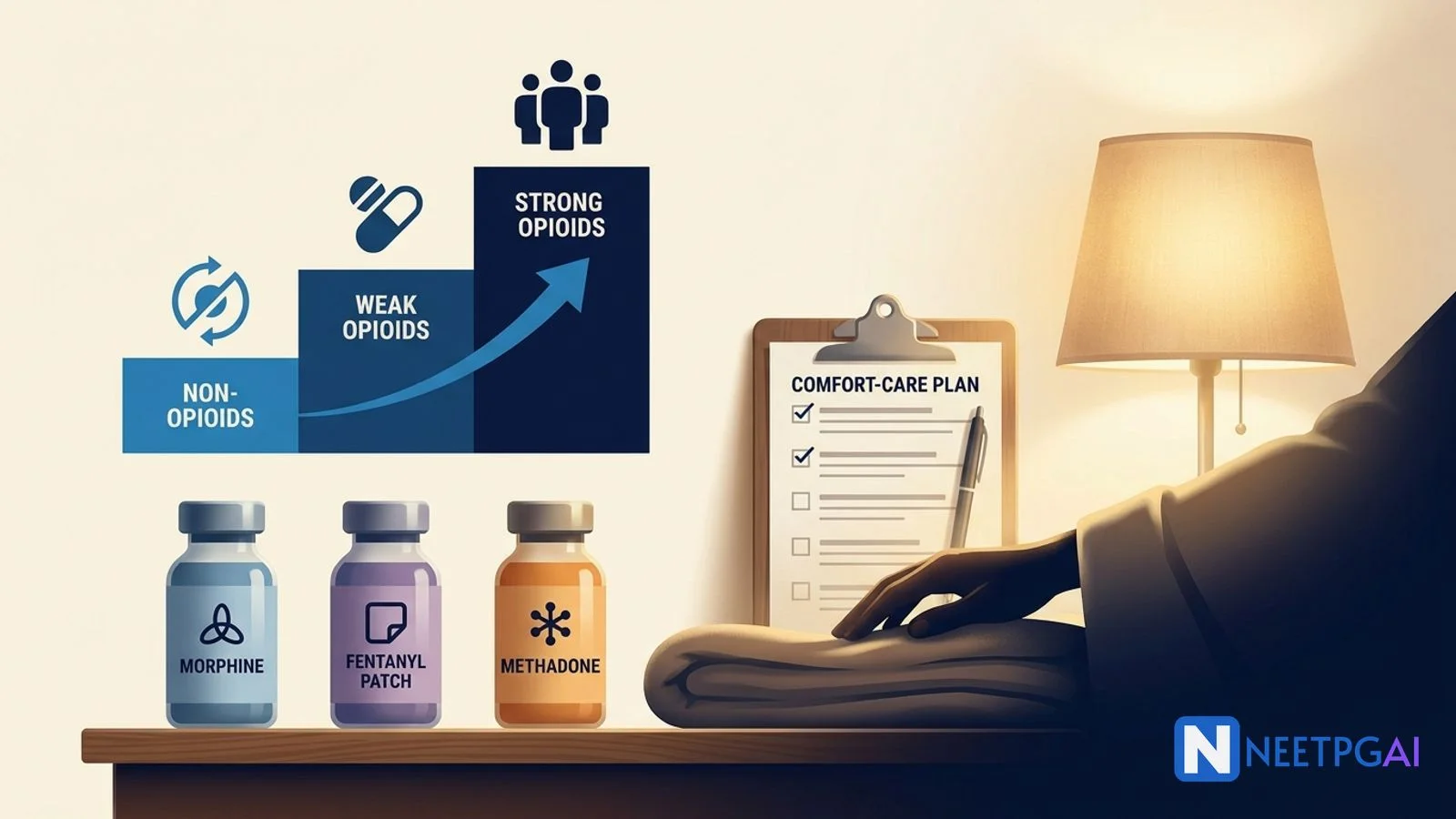
    Master the WHO analgesic ladder, opioid pharmacology, neuropathic pain, palliative principles, and end-of-life care ethics for NEET PG 2026.

    Read more
    anesthesia
    Free AI tutor trial · No card required

    Stuck on a Anesthesia concept? Ask the AI tutor.

    Trained on standard textbooks (Harrison's, Robbins, KD Tripathi, BD Chaurasia, Bailey & Love). Drop your email — we'll send a one-tap link to start asking questions. 3 free messages per day, ongoing.

    • Cite-anchored answers (chapter + page when applicable)
    • Mermaid diagrams and clinical pearls inline
    • NEET PG-tuned, never generic ChatGPT

    Why aspirants choose NEETPGAI for Anesthesia

    AI-first preparation built specifically for the NEET PG question pattern.

    Textbook-quality AI explanations

    Every Anesthesia MCQ comes with a detailed Claude-authored explanation citing standard references (Harrison's, Bailey & Love, Robbins, Park's etc.) — never a one-line answer key.

    SM-2 spaced repetition

    Wrong answers auto-schedule for review at expanding intervals (1d → 3d → 7d → 21d). Most aspirants need only half the practice volume to retain the same recall.

    PYQ-aligned question patterns

    Every Anesthesia question is generated against the NMC syllabus and validated against the last 5 years of NEET PG / INI-CET previous year questions.

    24/7 AI Tutor for Anesthesia doubts

    Stuck on a tricky topic? Ask the AI Tutor anytime — it answers in seconds with diagrams, mnemonics, and clinical pearls tailored to NEET PG.

    Ready to test yourself?

    Test your Anesthesia knowledge with AI-powered MCQs and detailed explanations — no signup required to try.

    Practice Anesthesia MCQs

    Anesthesia preparation FAQs

    Common questions from NEET PG aspirants preparing Anesthesia.

    Sources & references
    1. NEETPGAI PYQ & Practice Question Database — Anesthesia module (N = 560 approved questions)
    2. NMC NEET PG Syllabus 2026 — Anesthesiology section
    3. Morgan & Mikhail's Clinical Anesthesiology, 6th Edition — McGraw-Hill (Indian reprint)
    4. KD Tripathi — Essentials of Medical Pharmacology, 9th Edition, Chapter 27: General Anaesthetics
    5. ASA Practice Guidelines for Preoperative Fasting 2023 — Anesthesiology Journal, American Society of Anesthesiologists
    6. Ajay Yadav — Anesthesia: A Practical Guide for PG Entrance Examinations (Indian edition)

    Ready to master Anesthesia?

    Sign up free and practice all 828+ MCQs with AI-powered explanations tailored to your performance.

    Create Free Account
    High-yield topic tactics
    • Muscle Relaxants: Build a 2-column table — Depolarising (Succinylcholine: onset 45–60 s, Phase I vs. Phase II block, contraindicated in burns >24 hours, hyperkalaemia risk) vs. Non-depolarising (Rocuronium, Vecuronium, Atracurium — reversed by Neostigmine or Sugammadex). This single table covers 3–4 question types.
    • Stages of Anesthesia (Guedel's): Memorise all 4 stages and the 4 planes of Stage 3 (Surgical Anesthesia). Stage 2 (Excitement/Delirium) is the most tested — know that vomiting, laryngospasm, and breath-holding occur here.
    • Spinal Anesthesia: Know the landmark (L3–L4 or L4–L5 interspace), the drug (Bupivacaine 0.5% heavy, 2–3 mL), and the 3 major complications — post-dural puncture headache (treated with epidural blood patch), hypotension (treated with IV fluids + Ephedrine), and total spinal.
    • RSI: The 5 steps — preoxygenation, pre-treatment (optional), induction agent + Succinylcholine, cricoid pressure, intubation. Know what is NOT part of RSI (e.g., bag-mask ventilation before intubation is avoided).

    Common mistakes to avoid

    • Mixing up Ketamine's profile: it is the only IV induction agent that causes bronchodilation, increases BP, and preserves airway reflexes — making it the agent of choice in haemodynamically unstable or asthmatic patients.
    • Confusing Desflurane (highest MAC = least potent, most pungent, airway irritant — never used for inhalational induction) with Sevoflurane (sweet smell, used for inhalational induction in children).
    • Skipping fasting guidelines — the 2-4-6 rule (2 h clear fluids, 4 h breast milk, 6 h solids) appears in paediatric and obstetric vignettes.

    Revision rhythm

    • Week 1: Read Morgan & Mikhail chapters + make drug tables. Solve 25 MCQs/day.
    • Week 2: Topic-wise revision using Ajay Yadav. Focus on airway algorithms and spinal anesthesia. Solve 30 MCQs/day.
    • Final 3 days before exam: Flashcard review of MAC values, ASA grades (I–VI), Guedel's stages, and reversal agents. No new reading.