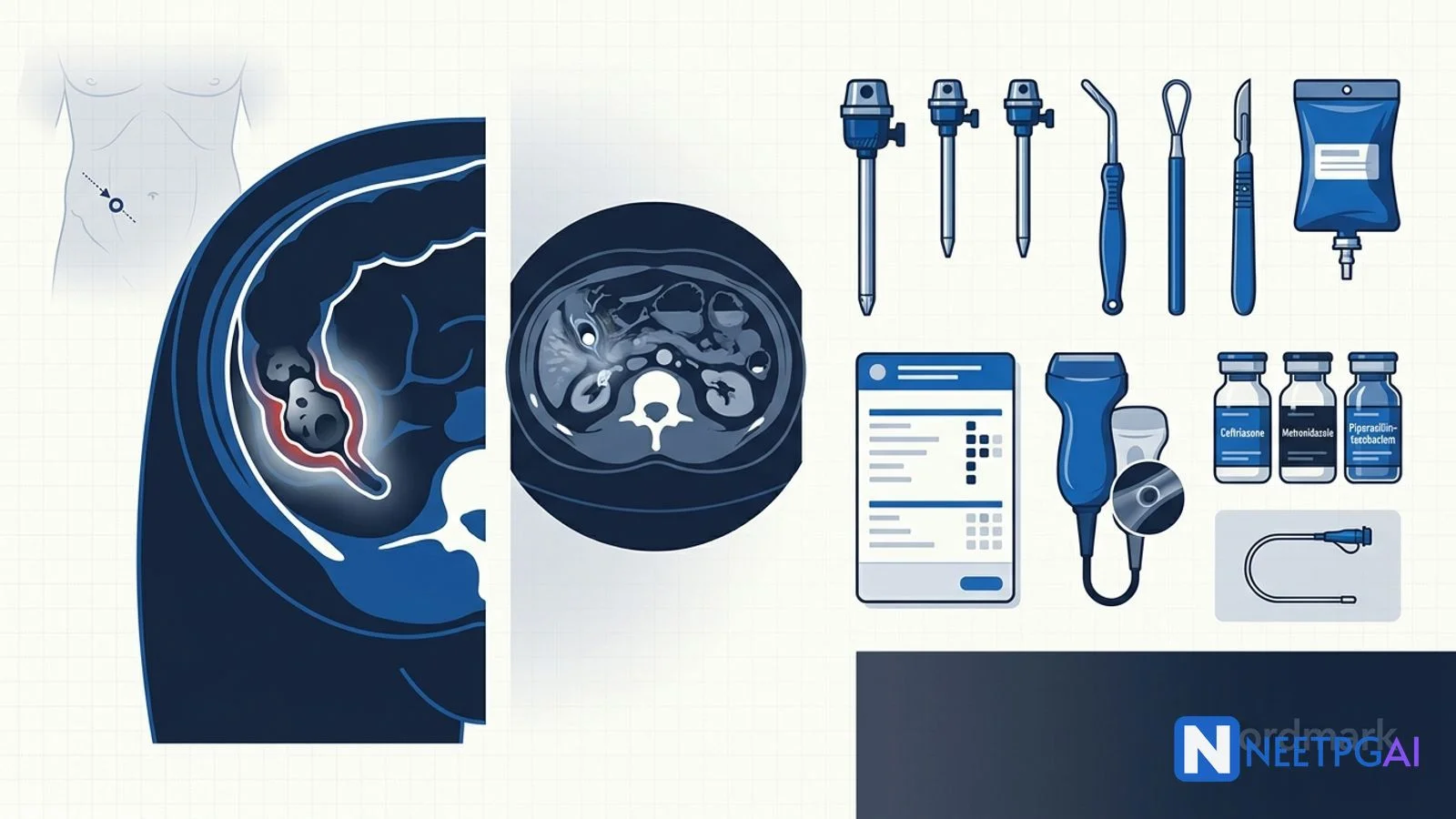
Acute appendicitis is the most common surgical emergency on Indian general-surgery rotations and a perennial NEET PG favourite — expect 2 to 3 questions per paper. Lock these:
Classical migration — periumbilical visceral pain (T10) migrating to McBurney point (somatic) over 12 to 24 hours.
Imaging — ultrasound first in India, CT for equivocal or perforated cases.
Alvarado 7+ — operate or image to confirm.
Surgery — laparoscopic appendicectomy is gold standard for uncomplicated and most complicated cases.
Antibiotic-only — option for uncomplicated, no appendicolith, low-risk patients; 20 to 30 percent recur.
Acute appendicitis carries a lifetime incidence of 7 to 8 percent and remains the commonest cause of acute abdomen requiring emergency surgery in India. NEET PG examiners reward students who can navigate the differential diagnosis trap (every female of reproductive age in the RIF is also a potential ovarian torsion or ectopic), grade the Alvarado score on the fly, and pick the right imaging modality for the right patient.
This NEETPGAI deep dive walks through pathophysiology, signs, scoring systems, imaging, differentials by age and gender, surgical and non-surgical management, and India-specific resource considerations. Pair this with the ovarian cysts and tumors guide and the pelvic inflammatory disease clinical case for the complete RIF-pain differential map.
Pathophysiology
The appendix is a blind-ended diverticulum arising from the caecum, typically 8 to 10 cm long, lined by lymphoid tissue (Peyer-like aggregates). Its location varies — retrocaecal (65 percent, the commonest, explains atypical presentations), pelvic (30 percent — bladder and rectal irritation), preileal, postileal, paracaecal.
The pathological sequence:
Luminal obstruction — faecolith (most common in adults), lymphoid hyperplasia (commonest in children, post-viral), foreign body, parasite (Enterobius, Ascaris — relevant in India), tumour (carcinoid in young adults, adenocarcinoma in elderly).
Mucus accumulation distends the lumen.
Bacterial overgrowth — predominantly E. coli, Bacteroides fragilis, Enterococcus, Pseudomonas.
Arterial compromise — mural ischaemia, gangrene (6 to 12 hours).
Perforation — typically at 48 to 72 hours if untreated; commoner at the antimesenteric border.
Initial pain is visceral referred to T10 dermatome (periumbilical) because the appendix is a midgut structure. Once inflammation reaches the parietal peritoneum, the pain becomes somatic and localises to the RIF (McBurney point — junction of outer one-third and inner two-thirds of a line from the umbilicus to the right anterior superior iliac spine).
Clinical features
Symptoms
Pain — classical periumbilical-to-RIF migration over 12 to 24 hours (50 percent of cases). Retrocaecal appendix may produce flank or back pain; pelvic appendix produces suprapubic or rectal pain.
Anorexia — present in 90 percent; if the patient is hungry, doubt the diagnosis.
Nausea and vomiting — present in 60 to 70 percent; appear after pain, not before (vomiting before pain suggests gastroenteritis).
Low-grade fever — 37.5 to 38.5 C in early appendicitis. Higher fever suggests perforation or abscess.
Constipation or diarrhoea (pelvic appendix).
Signs
RIF tenderness at McBurney point — most sensitive sign.
Rebound tenderness — peritoneal irritation.
Rovsing sign — palpation of LIF elicits pain in RIF.
Psoas sign — pain on right thigh extension (retrocaecal appendix irritating psoas).
Obturator sign — pain on internal rotation of flexed right hip (pelvic appendix irritating obturator internus).
Dunphy sign — sharp RIF pain on coughing.
Markle (heel-drop) sign — pain on dropping from tip-toes to heels.
Blumberg sign — rebound tenderness specifically.
Bassler sign — sharp pain on pressing appendix against iliacus.
Per-rectal examination — tenderness in the right rectovesical pouch (pelvic appendix).
Alvarado score (MANTRELS)
Feature
Points
Migration of pain to RIF
1
Anorexia
1
Nausea / vomiting
1
Tenderness in RIF
2
Rebound tenderness
1
Elevated temperature (above 37.3 C)
1
Leucocytosis (above 10,000)
2
Shift of WBC to left (neutrophilia above 75 percent)
1
Total
10
Interpretation
1 to 4: appendicitis unlikely; consider discharge.
5 to 6: equivocal; observe or image.
7 to 10: appendicitis very likely; operate or image to confirm.
The AIR (Appendicitis Inflammatory Response) score is an alternative used in European protocols — adds CRP and may be more accurate in women and elderly.
Investigations
Laboratory
CBC — leucocytosis (10,000 to 18,000) with neutrophilia. Counts above 20,000 suggest perforation.
CRP — rises after 6 to 12 hours; useful for follow-up.
Urinalysis — to rule out UTI; mild sterile pyuria common (pelvic appendix irritates ureter).
Beta-HCG — mandatory in every woman of reproductive age (rule out ectopic).
Serum electrolytes, creatinine — pre-operative.
Imaging
Ultrasound (first-line in India)
Non-compressible blind-ended tubular structure greater than 6 mm.
Wall thickness greater than 3 mm.
Periappendiceal fluid or hyperechoic mesenteric fat.
Appendicolith.
Sensitivity 75 to 90 percent, specificity 85 to 95 percent. Operator-dependent.
Preferred in pregnancy (no radiation) and children.
CT scan with IV contrast (confirmatory)
Appendix diameter greater than 6 mm, wall thickening, periappendiceal fat stranding, appendicolith, fluid collection, abscess.
Sensitivity 95 percent, specificity 95 percent.
Reserved for equivocal cases, suspected perforation or abscess, elderly patients.
MRI
Used in pregnancy when ultrasound is equivocal — second-trimester onwards, no contrast.
Differential diagnosis by age and gender
Infants and toddlers — gastroenteritis (more vomiting and diarrhoea), intussusception, Meckel diverticulitis, mesenteric adenitis.
Children and adolescents — mesenteric adenitis (preceding URI, multiple enlarged nodes on USG, conservative treatment), Yersinia ileitis, Meckel diverticulitis.
Women of reproductive age — ectopic pregnancy (always do beta-HCG), ovarian torsion (sudden severe pain, USG Doppler), ruptured corpus luteum, pelvic inflammatory disease (cervical motion tenderness, bilateral adnexal tenderness, discharge), endometriosis, mittelschmerz.
Pregnancy — appendix displaced superolaterally as gestation progresses (RUQ tenderness in third trimester); MRI second-line if USG equivocal.
Management
Pre-operative preparation
IV access, crystalloid resuscitation.
IV antibiotics within 1 hour of diagnosis (ceftriaxone 1 g plus metronidazole 500 mg, or piperacillin-tazobactam if complicated).
NPO, analgesia (paracetamol; opioids do not mask diagnosis — old myth busted by multiple RCTs).
DVT prophylaxis if delayed surgery.
Surgery — laparoscopic versus open
Laparoscopic appendicectomy is the gold standard in adults and children unless logistics or surgeon expertise dictate otherwise.
Advantages of laparoscopy — better cosmesis, less wound infection, shorter hospital stay, faster return to work, allows diagnostic look at pelvis (especially in women).
Open (Lanz / McBurney / Gridiron incision) — still common in Indian district hospitals due to laparoscopic-tower availability; equally effective for uncomplicated appendicitis.
Stump management — endoloop or stapler closure. Inversion of stump is historical, no longer mandatory.
Antibiotic-only treatment
Considered for uncomplicated appendicitis (no perforation, no abscess, no appendicolith), based on CODA (2020) and APPAC (2018) trials.
30-day treatment success: 73 percent (CODA).
5-year recurrence: 30 to 40 percent.
Failure rate exceeds 50 percent when appendicolith is present — surgery preferred.
Indian guidelines still favour appendicectomy for most cases due to lower long-term cost and definitive resolution.
Complicated appendicitis
Perforation with localised peritonitis — laparoscopic appendicectomy plus peritoneal lavage; antibiotics 5 to 7 days.
Generalised peritonitis — urgent laparotomy, appendicectomy, peritoneal lavage, IV antibiotics 7 to 14 days, possible drains.
Appendicular mass (phlegmon, no abscess) — Ochsner-Sherren conservative regimen: IV antibiotics, bowel rest, observation; interval appendicectomy at 6 to 8 weeks (controversial — many centres now omit in adults without appendicolith).
Appendicular abscess — image-guided percutaneous drainage plus IV antibiotics. Interval appendicectomy debated.
Complications
Surgical site infection — 3 to 5 percent in uncomplicated, up to 15 percent after perforated.
Stump appendicitis — rare; residual stump greater than 5 mm.
Faecal fistula — caecal injury.
Adhesive small-bowel obstruction — late.
Stump leak.
Tubo-ovarian infertility in women after perforated appendicitis.
Special situations
Pregnancy — appendicitis is the commonest non-obstetric surgical emergency in pregnancy. Foetal loss rate is 1 to 2 percent in uncomplicated, up to 20 to 35 percent with perforation. Operate promptly, prefer laparoscopy in trimesters one and two; open in trimester three or as expertise dictates.
Children — perforation rate higher (30 to 50 percent) due to delayed presentation and atypical features; commonest cause of acute abdomen in children over 5.
Elderly — atypical presentation, delayed diagnosis, perforation rate up to 50 percent. Always image (CT) and consider caecal carcinoma post-operatively (colonoscopy at 6 to 8 weeks).
Immunocompromised — fewer signs, more perforation; image early.
NEET PG MCQ traps
Hungry patient with RIF pain — usually NOT appendicitis. Anorexia is 90 percent sensitive.
Vomiting before pain — gastroenteritis, not appendicitis.
Retrocaecal appendix — psoas sign positive; less peritoneal signs anteriorly.
Appendix in pregnancy — displaced upward; RUQ tenderness in third trimester.
Mesenteric adenitis — preceding URI, multiple enlarged ileocolic nodes on USG, normal appendix, conservative treatment.
Meckel diverticulitis — rule of 2s (2 percent of population, 2 feet from ileocaecal valve, 2 inches long, presents under 2 years, 2 types of ectopic mucosa).
Beta-HCG mandatory — every female of reproductive age with RIF pain.
Carcinoid of appendix — commonest appendiceal tumour; tip location; appendicectomy curative if under 2 cm.
Stump appendicitis — residual stump greater than 5 mm; presents as recurrent RIF pain post-appendicectomy.
Appendicolith plus antibiotic-only failure — exceeds 50 percent; operate.
Caecal carcinoma in elderly post-appendicitis — colonoscopy at 6 to 8 weeks.
Recent updates and Indian context
CODA trial (2020) — antibiotic-only treatment is non-inferior at 30 days; 30 percent require appendicectomy within 5 years.
APPAC trial (2018, Finland) — similar long-term results; appendicolith strongest predictor of antibiotic failure.
EAES and SAGES 2020 — laparoscopic appendicectomy is gold standard for uncomplicated and complicated cases.
Indian context — laparoscopic-tower access varies widely; rural and district hospitals still rely on open appendicectomy with excellent results. PMJAY covers both procedures.
Antibiotic stewardship — Indian Council of Medical Research 2024 update emphasises switching from broad-spectrum to narrow-spectrum once cultures (if drawn) return; total antibiotic course 5 to 7 days for complicated, 24 to 48 hours for uncomplicated.
NEET PG / FMGE / NEXT alignment — high-yield topics are McBurney point anatomy, Alvarado score components, imaging choice, antibiotic-only candidacy, complications of perforation, and the female reproductive-age differential.
Frequently asked questions
What is the classical clinical presentation of acute appendicitis?
The classical sequence is anorexia, then periumbilical (visceral T10) pain that migrates to the right iliac fossa over 12 to 24 hours, then nausea or vomiting, then low-grade fever. McBurney point tenderness, Rovsing sign, psoas sign, and Dunphy sign (pain on coughing) confirm peritoneal irritation. The Alvarado score formalises this — 7 or more suggests appendicitis.
What is the imaging investigation of choice for appendicitis?
Ultrasound is first-line in India because it is cheap, rapid, and radiation-free — especially useful in women of reproductive age and children. Findings include a non-compressible blind-ended tubular structure over 6 mm in diameter, periappendiceal fluid, or an appendicolith. CT scan with IV contrast has sensitivity of 95 percent and is reserved for equivocal cases, suspected perforation or abscess, and elderly patients.
Can appendicitis be treated without surgery?
Yes — antibiotic-only treatment for uncomplicated appendicitis (no perforation, no abscess, no appendicolith) has 70 to 80 percent success at one year per CODA and APPAC trials. Twenty to thirty percent recur within 5 years. Surgery remains the gold standard, especially when an appendicolith is present (failure rate of antibiotic-only treatment exceeds 50 percent). Indian guidelines still favour laparoscopic appendicectomy for most patients.
What is the management of an appendicular abscess?
An appendicular mass that has progressed to an abscess (greater than 4 to 6 cm or septic patient) is best managed by image-guided percutaneous drainage plus IV antibiotics (ceftriaxone plus metronidazole or piperacillin-tazobactam). Interval appendicectomy at 6 to 8 weeks is controversial — many centres now omit it in adults without appendicolith. Phlegmon (mass without abscess) is managed conservatively with antibiotics and bowel rest (Ochsner-Sherren regimen).
What is the Alvarado score and how is it used?
The Alvarado score uses 8 features — migratory RIF pain (1), anorexia (1), nausea/vomiting (1), RIF tenderness (2), rebound (1), fever above 37.3 C (1), leucocytosis above 10,000 (2), left-shift (1) — totalling 10. Score 1 to 4 makes appendicitis unlikely (consider discharge). Score 5 to 6 is equivocal (observe or image). Score 7 to 10 strongly suggests appendicitis (operate or image to confirm).
This content is for educational purposes for NEET PG exam preparation. It is not a substitute for professional medical advice, diagnosis, or treatment. Clinical information has been reviewed by qualified medical professionals.
Written by: NEETPGAI Editorial Team
Reviewed by: Pending SME Review
Last reviewed: May 2026